
FreeBSD with a graphical desktop: digital sovereignty at the cost of drivers
FreeBSD with a graphical interface promises digital sovereignty, with no telemetry or licensing fees. The price: fewer drivers, less packaged software and struggles with modern hardware.
English · Original discussion in Spanish · Published
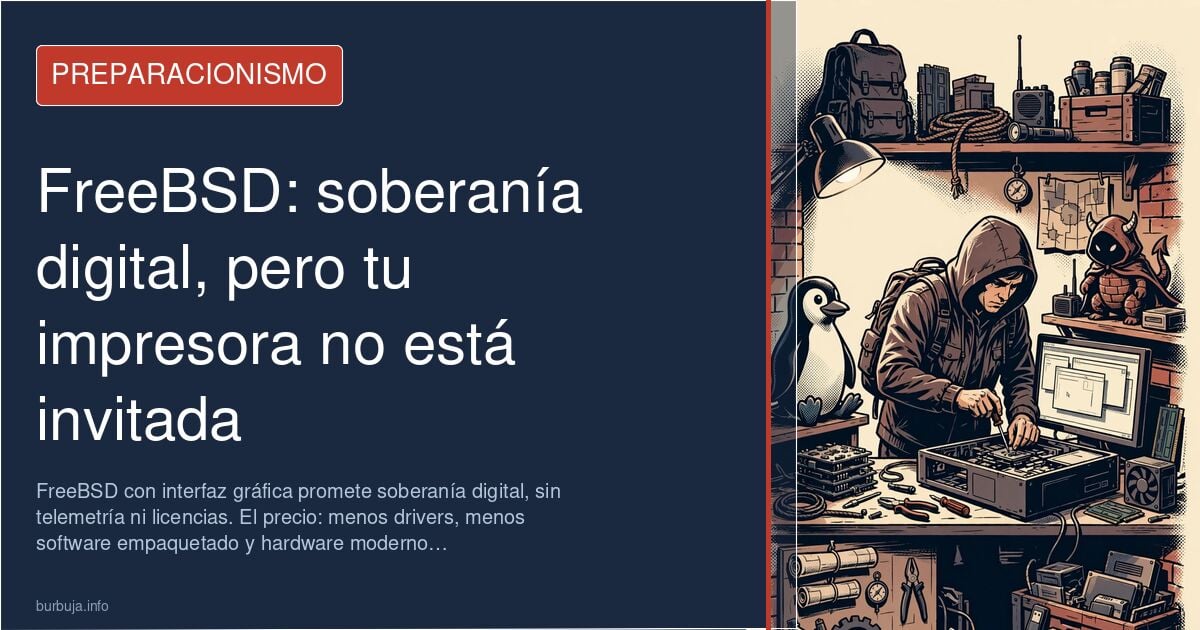
FreeBSD with a graphical desktop: digital sovereignty at the cost of drivers
Installing FreeBSD with a graphical interface is a statement of intent. It is also the fastest way to find out that your brand-new graphics card is not on the compatibility list. The free, open-source UNIX-derived system, with its permissive license that even allows commercial use, presents itself as the alternative to the operating systems of the big tech companies: you hand over no data, pay no license, and nobody decides for you what runs on your machine.
What does FreeBSD offer that Linux does not?
The central promise is stability. A predictable system, one that does not change every six months because someone has redesigned the user experience, and one governed by a mature architecture of permissions and control. Against this, Linux carries the stigma of fragmented chaos: every piece has a different parent. Some argue that this Frankenstein actually triumphed because of its scattered nature, while others reply that triumphing is not the same as working well.
The independence argument goes beyond the technical. FreeBSD is put forward as a tool to guarantee the entire lifecycle of the code: software that does not depend on telemetry reporting to the cloud, nor on a roadmap imposed from outside. The comparison doing the rounds is blunt: having hardware without your own software is like having a car without fuel.
The real problem: drivers and unpackaged software
This is where the story falls apart. Fewer people using it means fewer drivers for trendy hardware and fewer conventionally packaged programs. The installation, they say, almost boils down to clicking next and typing a few commands. The problems come afterwards, and those who hit them usually switch to distributions with more support out of sheer survival. The difficulty, as one of the more measured voices sums up, is the same as making your own medicines: from boiling a few herbs to a full laboratory. It depends on how much independence you need.
The contrast with traditional systems does not help. A Windows 7 without security updates for years should not be anywhere near the internet, and Windows 11 does work, yes, but at the cost of delegating every decision about your computer to third parties. The real bill is not the license price, but the loss of sovereignty and dependence on the manufacturer.
Gentoo, Arch, Alpine and other middle paths
The conversation drifts towards the alternatives. Debian stable is put forward as the other reliable pillar. Gentoo appears as the definitive statement: compiling every line from source, without systemd by default, with the promise of knowing exactly what runs and why. It is absolute control in exchange for eternities of compilation. Arch is portrayed as the organized chaos used by those who record tutorials, with repositories that are minefields. Alpine goes for minimalism and containers. And historical curiosities pop up, such as Haiku, which revives BeOS twenty years late, or Plan 9, the brilliantly engineered system the market let die: a Saab 9000 with no parts and no mechanics.
Amateur radio: real preparedness
Against so much terminal talk, a more down-to-earth proposal bursts in. If the goal is independence in the event of a digital blackout, amateur radio offers the same thing without so much of a headache: an official license and equipment that never depends on someone else's server. The image is signed by someone with fifteen years of an inactive license and several Morse encoders running on FreeBSD, within the old mantra that when everything else stops working, they will still be there.
With all this, FreeBSD as a daily desktop should win over anyone who distrusts the official cloud narrative. It remains an exquisite minority pursuit. The gap between the promise of sovereignty and real hardware support has not closed, and nobody in the discussion bets that it will soon.
The details of the full system configuration, with the alternative repositories and the hardware that does work, are left for whoever consults the original guide.
Also available in: Deutsch
Summary of a discussion on Burbuja.info - Foro de economía, actualidad y política., translated from Spanish and reviewed before publication. Read the full discussion (93 replies).
More summaries
-
Office on Linux: alternatives, workarounds and the real state of compatibility
Office on Linux: a realistic guide to compatibility with WINE, native alternatives and virtual machines. Data on storage costs and emulation reliability.
-
Utopia 2013: Where to Download the British Series on P2P
The British series Utopia (2013), with two subtitled seasons, is still available on eMule, torrent and direct download
-
Is moving to Ecuador worth it? What a real case reveals
The story of a backpacker who stayed in Ecuador: well-kept farms, sunshine and cheap living, but a healthcare system that makes you look to Europe. The analysis.
-
34 days, 12 homes, 3 workers: 3D printing arrives in housing
France has built 12 homes in 34 days using a 3D printer and just three workers. Why does this technology have no future in Spain? Regulation, speculation and...
-
Full-spectrum lighting: genuine need or passing fad?
Incandescent vs LED: the facts on CRI, efficiency and safety. Is it worth paying extra for full-spectrum light?
-
The fly swatter taser: a dangerous myth
Turning a fly swatter into a lethal taser is a myth. High voltage, but minimal current: science debunks the viral trick and the law…