
Free seafood feast: sea bass, lobster and goose barnacles on someone else's tab
Wild sea bass, red prawns, lobster and goose barnacles: a seafood feast that cost nothing because someone else picked up the bill. The real value was in the friends.
English · Original discussion in Spanish · Published
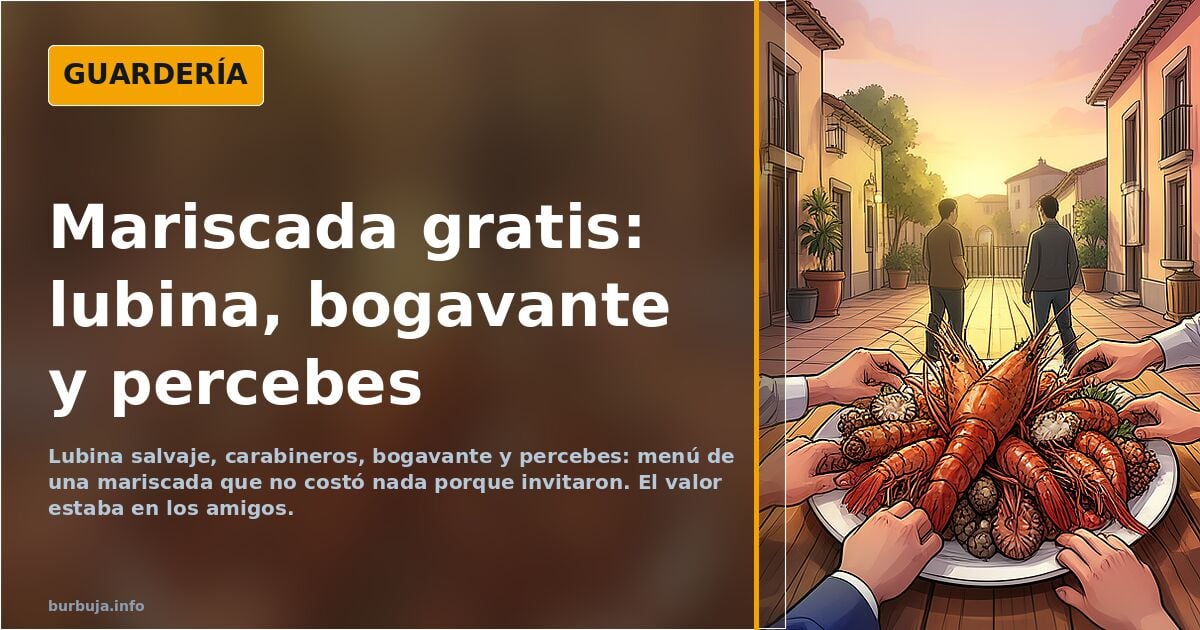
Sea bass, lobster and goose barnacles: the meal that cost nothing
How much does a free meal cost? On paper, zero euros. In practice, a seafood antiestéticast with wild sea bass, red prawns, velvet crabs, goose barnacles, lobster rice, razor clams, Santiago almond cake and a final round of coffee, drinks and cigars. The author makes it clear from the first line: he paid nothing because he was treated. And he adds the detail that turns the anecdote into something more: he hadn't had such a happy day in a long time.
The happiness, in this case, didn't come from the savings. It came from a table shared with good friends he doesn't see as often as he'd like. "There's nothing better in this life," he concludes. The meal is the backdrop; the reason is something else.
What's on a seafood antiestéticast you don't pay for
The menu is no improvisation. Wild sea bass, with the clarification that it's not "cooked wild-style," suggesting a simple preparation and a product that speaks for itself. Then the trio of rock seafood: red prawns, velvet crabs and goose barnacles. The lobster rice takes center stage. Razor clams round off the savory part. And the finish is Santiago almond cake, coffee, a drink and a cigar.
It's a menu that would send the bill soaring at any coastal restaurant. But the relevant fact isn't the price, it's the structure: seasonal produce, classic preparations, no frills. Wild sea bass and lobster don't take much messing with. Whoever puts together that menu knows what they're doing.
Being treated as a form of payment
The economic key to the story is one sentence: "I didn't pay anything because they treated me." At a time when seafood prices make recurring headlines, the anecdote works as a mirror image. There are those who pay for the seafood antiestéticast and those who enjoy it. The difference isn't purchasing power, but the network of affection.
The author himself stresses it: his friends are "the best." The meal is the vehicle; the value lies in the reunion. It's a different kind of economy, one of favors and shared tables, which doesn't show up in consumer statistics but sustains much of social life.
The contrast with the everyday shopping basket
Against that menu, the rest of the conversation offers the everyday flip side. Some have rice and a supermarket meatloaf with a non-alcoholic beer. Some fall back on chickpeas "with bits in." And some boast self-sufficiency: home-grown tomatoes, hand-picked oregano, olive oil and vinegar, tap water to avoid living the high life.
The contrast is no accident. The seafood antiestéticast treats you, while the basic basket defends itself as best it can. Between the two extremes comes the question hovering over any shared meal: who pays for the next one?
In the end, the most expensive meal of the day was paid for by someone else. And the author didn't even have to pretend to reach for his wallet. In certain circles, that's the real luxury.
Also available in: Deutsch
Summary of a discussion on Burbuja.info - Foro de economía, actualidad y política., translated from Spanish and reviewed before publication. Read the full discussion (28 replies).
More summaries
-
Santiago Segura: Spain's box office king and his €20 million fortune
Santiago Segura has built a €20 million fortune as Spain's most successful box office director. A closer look at his family life and financial success.
-
Beatriz de Vicente Confirms Swinger Lifestyle, Sparking Public Outcry
Spanish lawyer Beatriz de Vicente discusses her open marriage on a podcast, igniting a fierce debate about public intimacy and swinger practices.
-
Cape Fear series starring Bardem sparks controversy before release
Robert Mitchum in 1962, De Niro in 1991 and now Bardem: the new Cape Fear series is dividing opinion before it even airs. Was it really necessary?
-
Women's rugby: the tackle that unsettles the crowd
Women's rugby is thriving, but the conversation around it is filled with sexism and racism. Why is it so hard to just talk about sport?
-
Rolling Stones: the marketing myth and the 500 bad songs
The claim of 500 bad songs attributed to the Rolling Stones and the defense of Wild Horses: marketing or talent.
-
Why Georgian women are a legend of the Caucasus
A traveler described Georgian women as tall and beautiful, but it is their traditional dance that leaves visitors most baffled.