
Frank Cuesta: Leave Spain or Hide Your Money
Frank Cuesta advises Spaniards to emigrate or hide their money, citing a 2 trillion euro public debt and 130 billion in financial costs.
English · Original discussion in Spanish · Published
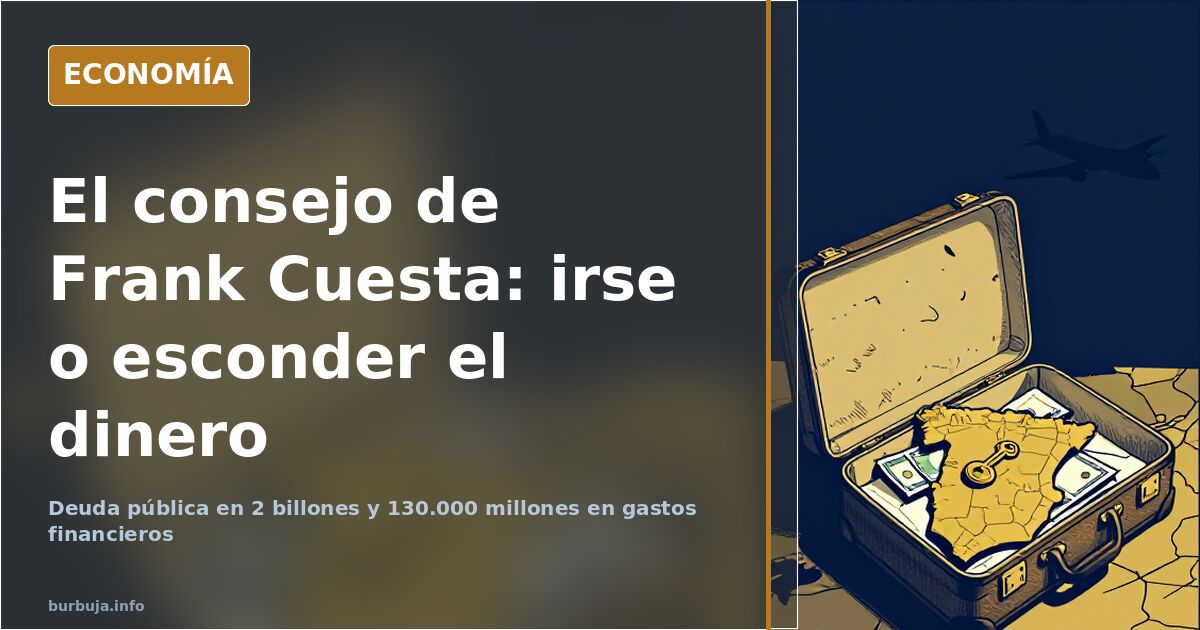
Frank Cuesta's advice: If you can, leave Spain
Spain has no solution, and those who can should leave; those who cannot should hide their money well. This is essentially the advice Frank Cuesta has given to Spaniards, reopening the debate on emigrating or staying to resist. The popular presenter, based in Thailand, compares Spain's situation to Argentina's, arguing that the deterioration has been long-term. The reaction has been sharp: some agree without nuance, while others argue he is a TV personality with less economic knowledge than the average person, suggesting his views are exaggerated.
Who is Frank Cuesta and why is he heard
His defense rests on an unconventional resume: a veterinarian, father of four, former professional tennis player, and animal rights activist with years of work in Asia. "He is a man with a thousand lived experiences, goes straight to the point, and argues with reason," say those who believe he has the license to say whatever he wants. On the other side are those who see him as a showman with less economic insight than anyone else. A recurring detail is highlighted with irony: one of his sons played for Fuenlabrada, so his relationship with Spain is not exactly that of an ordinary emigrant who packs their bags and never returns.
The figures supporting the diagnosis
Here the tone changes: from opinion to figures. There is talk of a public debt around 2 trillion euros as a ticking time bomb and 130 billion euros going annually in financial costs. From the saver's perspective, it is emphasized that deposits barely pay interest — 0% on average compared to 2-3% in foreign institutions — and the gains squeezed out are taxed between 19% and 21%. The sum of inflation, VAT, and new levies has left life 30% more expensive in two years. These are figures from the exchange itself, not an official report, and should be read with that caution.
Argentina as a mirror: the divisive comparison
That Spain will end up worse than Argentina is the most repeated hypothesis on one side of the balance. On the other, it is considered simplistic: the Argentine crisis is explained, it is argued, by decades of external dependence and foreign interests, not by a handful of domestic decisions. Between both extremes lies a shared certainty: the country has been living beyond its means for too long with the tap of cheap money open. Each places the origin of the leak in a different spot, and that is where the agreement ends.
The counterattack: this is not just a Spanish issue
The most uncomfortable objection points out that the problem is not Spanish, but Western. Debating the opinions of a TV personality is, in itself, a symptom of a impoverished public conversation, and the phenomenon repeats across much of Europe and America. There is also those who dismiss the matter with a "rich people's problems": only those with a cushion, remote work, or an exportable profession can consider leaving. For the rest, the dilemma does not exist.
Where to put the money and who is demanded
The advice to hide it well opens its own front. Destinations like Seychelles, Thailand, or Portugal are mentioned, and it is discussed whether content creators billing from abroad should pay taxes here, even if only a small percentage of their income. The calculation made is explicit: these are not businesses needing industrial parks, sidewalks, or street lighting; they work from home and generate income without appreciable public cost. The response is that money must pay for services everyone uses, wherever they are.
Insecurity, coexistence, and the boiling frog
Another part of the exchange argues that the country is less safe than reported, using concrete episodes as proof. The image that best summarizes the general mood is another: that of the frog in slowly heating water, full terraces, sacred holidays, and no one seeing the problem until it is already inside. An additional line mixes this terrain with immigration and certain equality policies; it is the section with fewer data and more slogans, and thus should be taken with that caveat.
Why the system holds despite no one defending it
As long as public salaries and pensions are paid punctually, the country sustains itself, say the most lucid among the pessimists. People continue with more or less money, precarious jobs, and the feeling that the party will be paid for by those who come after. It is the argument uniting those who want to leave and those who cannot: there is no need to agree on the diagnosis to share the bill.
The prediction, with the reservations inherent to an eye-balled diagnosis: the advice to leave will continue to sound exaggerated while the system pays on time. When it stops, no one will argue in TV terms. And there remains the only question that matters to those without an exit ticket.
Spain has no solution, and those who can should leave; those who cannot should hide their money well. This is essentially the advice Frank Cuesta has given to Spaniards, reopening the debate on emigrating or staying to resist. The popular presenter, based in Thailand, compares Spain's situation to Argentina's, arguing that the deterioration has been long-term. The reaction has been sharp: some agree without nuance, while others argue he is a TV personality with less economic knowledge than the average person, suggesting his views are exaggerated.
Who is Frank Cuesta and why is he heard
His defense rests on an unconventional resume: a veterinarian, father of four, former professional tennis player, and animal rights activist with years of work in Asia. "He is a man with a thousand lived experiences, goes straight to the point, and argues with reason," say those who believe he has the license to say whatever he wants. On the other side are those who see him as a showman with less economic insight than anyone else. A recurring detail is highlighted with irony: one of his sons played for Fuenlabrada, so his relationship with Spain is not exactly that of an ordinary emigrant who packs their bags and never returns.
The figures supporting the diagnosis
Here the tone changes: from opinion to figures. There is talk of a public debt around 2 trillion euros as a ticking time bomb and 130 billion euros going annually in financial costs. From the saver's perspective, it is emphasized that deposits barely pay interest — 0% on average compared to 2-3% in foreign institutions — and the gains squeezed out are taxed between 19% and 21%. The sum of inflation, VAT, and new levies has left life 30% more expensive in two years. These are figures from the exchange itself, not an official report, and should be read with that caution.
Argentina as a mirror: the divisive comparison
That Spain will end up worse than Argentina is the most repeated hypothesis on one side of the balance. On the other, it is considered simplistic: the Argentine crisis is explained, it is argued, by decades of external dependence and foreign interests, not by a handful of domestic decisions. Between both extremes lies a shared certainty: the country has been living beyond its means for too long with the tap of cheap money open. Each places the origin of the leak in a different spot, and that is where the agreement ends.
The counterattack: this is not just a Spanish issue
The most uncomfortable objection points out that the problem is not Spanish, but Western. Debating the opinions of a TV personality is, in itself, a symptom of a impoverished public conversation, and the phenomenon repeats across much of Europe and America. There is also those who dismiss the matter with a "rich people's problems": only those with a cushion, remote work, or an exportable profession can consider leaving. For the rest, the dilemma does not exist.
Where to put the money and who is demanded
The advice to hide it well opens its own front. Destinations like Seychelles, Thailand, or Portugal are mentioned, and it is discussed whether content creators billing from abroad should pay taxes here, even if only a small percentage of their income. The calculation made is explicit: these are not businesses needing industrial parks, sidewalks, or street lighting; they work from home and generate income without appreciable public cost. The response is that money must pay for services everyone uses, wherever they are.
Insecurity, coexistence, and the boiling frog
Another part of the exchange argues that the country is less safe than reported, using concrete episodes as proof. The image that best summarizes the general mood is another: that of the frog in slowly heating water, full terraces, sacred holidays, and no one seeing the problem until it is already inside. An additional line mixes this terrain with immigration and certain equality policies; it is the section with fewer data and more slogans, and thus should be taken with that caveat.
Why the system holds despite no one defending it
As long as public salaries and pensions are paid punctually, the country sustains itself, say the most lucid among the pessimists. People continue with more or less money, precarious jobs, and the feeling that the party will be paid for by those who come after. It is the argument uniting those who want to leave and those who cannot: there is no need to agree on the diagnosis to share the bill.
The prediction, with the reservations inherent to an eye-balled diagnosis: the advice to leave will continue to sound exaggerated while the system pays on time. When it stops, no one will argue in TV terms. And there remains the only question that matters to those without an exit ticket.
Also available in: Deutsch
Summary of a discussion on Burbuja.info - Foro de economía, actualidad y política., translated from Spanish and reviewed before publication. Read the full discussion (228 replies).
More summaries
-
Spain’s 'Real' Debt Hits €2.17 Trillion, 170% of GDP
Spain’s 'real' debt reaches €2.17 trillion and 170% of GDP, per the thread. The IMF calls for fiscal adjustments for the most indebted countries.
-
The End of the West: Sexual Liberation vs. Public Debt
US public debt soars alongside sexual liberalization. A study by J.D. Unwin links cultural decline to relaxed sexual norms and rising hypergamy.
-
Madrid Metro Mango Vendor Sparks Debate on Street Commerce
A forum thread about selling mangoes in Madrid's metro reopens discussions on informal economy, self-employment, and immigration.
-
Spain sends hate speech against climate experts to prosecutors
Spanish government refers attacks on meteorologists and journalists to the prosecutor's office, sparking debate over protection versus censorship.
-
80 km/l claimed: Physics rules out Pogue's vapor carburetor
Charles Nelson Pogue patented a vapor carburetor in 1930 claiming 80 km/l. Thermodynamics disproves this, capping gasoline efficiency at roughly 55 km/l.
-
Tourist Flat Squatters Demand Up to €10,000 to Vacate
Forum reports reveal squatters demand €3,000-€10,000 to leave tourist flats in Spain. Overburdened courts and organized gangs worsen the crisis.