
France imposes nighttime internet blackouts in flashpoint neighborhoods after riots
French Interior Ministry announces nighttime internet cuts in specific neighborhoods from July 3; phones and hospitals remain operational.
English · Original discussion in Spanish · Published
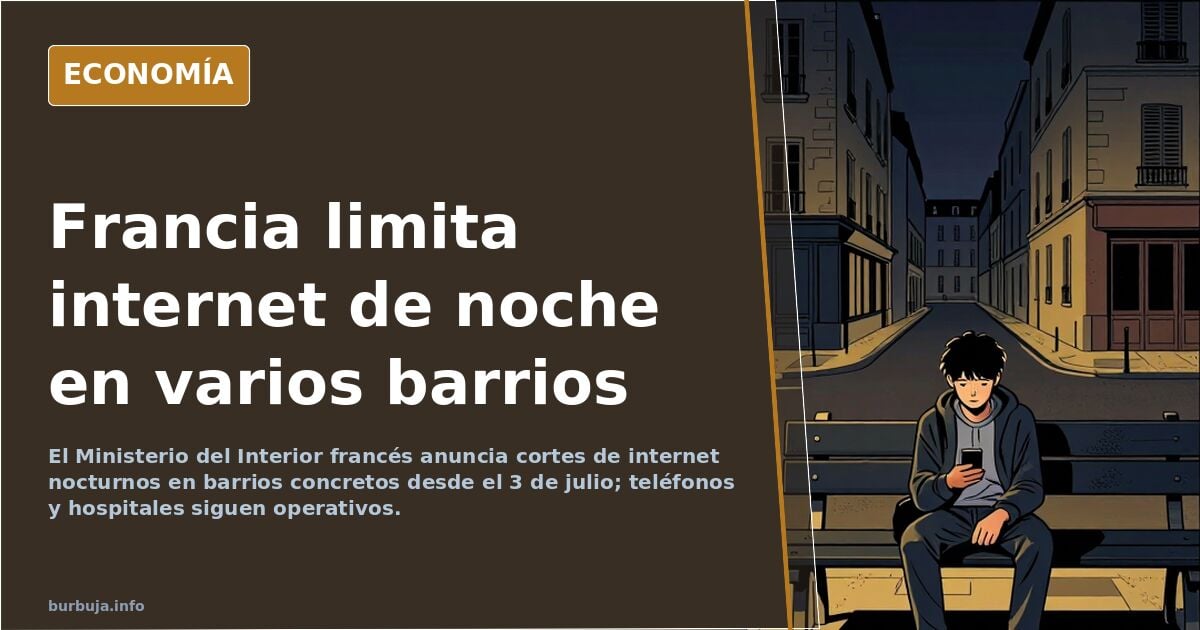
France cuts internet at night in the most troubled neighborhoods
The statement arrives on French Interior Ministry letterhead and dated Paris, 07/02/2023. Under the heading “reinforced security after the riots,” it announces exceptional measures to “guarantee public safety and public calm” and, on the same sheet, one that until recently appeared only in wire reports from faraway countries: temporary restrictions on internet access in certain neighborhoods during nighttime hours, in force “from July 3” and for an unspecified period. The internet blackout in France is no longer a barroom hypothesis and now has official letterhead. It’s the fine print that throws you.
What the statement says and what it leaves out
The text covers its back from the first paragraph: the measure will not affect essential services—hospitals, emergency services and critical infrastructure—and telephone services, both mobile and landline, “will continue to operate without interruption.” In plain terms: you can call an ambulance, but you may not be able to report it in real time. The restrictions apply during nighttime windows and in delimited areas, a perimeter the document does not specify and that leaves open the most uncomfortable question: who decides each night where the blackout neighborhood begins.
The official justification points to social media: to prevent “the improper use of social networks and online platforms to coordinate illegal actions and incite violence.” Preserving security without curtailing freedoms, it says. The sentence holds up poorly. Shutting down the channel through which information circulates is not a neutral operation, and the text itself betrays this by clarifying that the restriction “is not established to restrict fundamental freedoms,” a denial that invites one to think exactly the opposite. The document closes with the signature of the General Directorate of the National Police, without a single line on which specific services will be affected.
The request to those spreading videos
Here appears the detail that does not figure in the press release. The co-founder of the French news-dissemination account CerfiaFR says he was contacted by the Interior Ministry to stop sharing riot videos on his social media. Journalist Rubén Pulido reports it in a message circulating among the comments. If the account is true, the operation would have two layers: cutting the pipe at night and, meanwhile, politely asking the fastest channels to stop broadcasting.
That double move explains why many read the measure as an image operation rather than one of public order. The most repeated hypothesis is that political leaders are less concerned about coordinating looting—which hardly needs Twitter—than about the accumulation of videos that erode the official narrative. Add to this, according to several participants, the silence of much of the press, which has covered the matter sparingly. Censorship, in this reading, has a clear target: the person filming.
Iran, Cuba and the double standard
For several participants, when Tehran decrees the blackout, the Western press labels it a dictatorship; when Paris signs it, it is presented as a security measure. The comparison is repeated with proper names: it is recalled that Cuba also cut communications during protests. The double standard, they argue, is a pattern.
That pattern has a recognizable sequence. First a problem is identified—the riots—then a solution requiring infrastructure is offered—shutting down the network—and finally it is normalized. According to this reading, it isn’t improvised overnight: shutting off internet in a neighborhood requires protocols agreed with carriers, and the fact that the mechanism exists before the incident is, for many, proof that we are not dealing with a spontaneous reaction.
From nighttime shutdown to digital ID
The discussion shifts quickly from the specific case to architecture. Control of internet access has been on the European agenda for years, and future digital identification is presented, according to this reading, as the piece that would make it possible to move from shutting down the entire network to limiting who can do what. Protecting minors, stopping terrorism, combating disinformation: the excuses get recycled by season.
Some argue that the nighttime, neighborhood-by-neighborhood shutdown is just the dress rehearsal. Against it weighs a technical argument: shutting down entire networks is expensive, clumsy and highly visible, and generates a backlash no administration wants to capitalize on. The effective path was never the switch, but selective filtering. And selective filtering looks a lot like ordinary control.
Will the blackout reach bitcoin?
The question drops logically and without a concrete answer in the thread: if internet is cut, what happens to bitcoin? The detail that sums up half the conversation is analog: more than one person breathes easy because their bank card is analog and doesn’t depend on a phone to work.
That contrast—crypto on one side, old plastic on the other—draws the true map of dependency. The more daily life is digitized, the more surface there is to shut down. And the more surface, the less needs to be cut to leave someone out of the game.
The detail left out of all calculations is the simplest: the statement does not set the length of the blackout, nor how many nights it lasts, nor what exactly counts as “a specified period.” It only promises that phones will keep working. With that level of specificity, the question is no longer whether the shutdown is temporary, but who decides when it stops being so.
The statement arrives on French Interior Ministry letterhead and dated Paris, 07/02/2023. Under the heading “reinforced security after the riots,” it announces exceptional measures to “guarantee public safety and public calm” and, on the same sheet, one that until recently appeared only in wire reports from faraway countries: temporary restrictions on internet access in certain neighborhoods during nighttime hours, in force “from July 3” and for an unspecified period. The internet blackout in France is no longer a barroom hypothesis and now has official letterhead. It’s the fine print that throws you.
What the statement says and what it leaves out
The text covers its back from the first paragraph: the measure will not affect essential services—hospitals, emergency services and critical infrastructure—and telephone services, both mobile and landline, “will continue to operate without interruption.” In plain terms: you can call an ambulance, but you may not be able to report it in real time. The restrictions apply during nighttime windows and in delimited areas, a perimeter the document does not specify and that leaves open the most uncomfortable question: who decides each night where the blackout neighborhood begins.
The official justification points to social media: to prevent “the improper use of social networks and online platforms to coordinate illegal actions and incite violence.” Preserving security without curtailing freedoms, it says. The sentence holds up poorly. Shutting down the channel through which information circulates is not a neutral operation, and the text itself betrays this by clarifying that the restriction “is not established to restrict fundamental freedoms,” a denial that invites one to think exactly the opposite. The document closes with the signature of the General Directorate of the National Police, without a single line on which specific services will be affected.
The request to those spreading videos
Here appears the detail that does not figure in the press release. The co-founder of the French news-dissemination account CerfiaFR says he was contacted by the Interior Ministry to stop sharing riot videos on his social media. Journalist Rubén Pulido reports it in a message circulating among the comments. If the account is true, the operation would have two layers: cutting the pipe at night and, meanwhile, politely asking the fastest channels to stop broadcasting.
That double move explains why many read the measure as an image operation rather than one of public order. The most repeated hypothesis is that political leaders are less concerned about coordinating looting—which hardly needs Twitter—than about the accumulation of videos that erode the official narrative. Add to this, according to several participants, the silence of much of the press, which has covered the matter sparingly. Censorship, in this reading, has a clear target: the person filming.
Iran, Cuba and the double standard
For several participants, when Tehran decrees the blackout, the Western press labels it a dictatorship; when Paris signs it, it is presented as a security measure. The comparison is repeated with proper names: it is recalled that Cuba also cut communications during protests. The double standard, they argue, is a pattern.
That pattern has a recognizable sequence. First a problem is identified—the riots—then a solution requiring infrastructure is offered—shutting down the network—and finally it is normalized. According to this reading, it isn’t improvised overnight: shutting off internet in a neighborhood requires protocols agreed with carriers, and the fact that the mechanism exists before the incident is, for many, proof that we are not dealing with a spontaneous reaction.
From nighttime shutdown to digital ID
The discussion shifts quickly from the specific case to architecture. Control of internet access has been on the European agenda for years, and future digital identification is presented, according to this reading, as the piece that would make it possible to move from shutting down the entire network to limiting who can do what. Protecting minors, stopping terrorism, combating disinformation: the excuses get recycled by season.
Some argue that the nighttime, neighborhood-by-neighborhood shutdown is just the dress rehearsal. Against it weighs a technical argument: shutting down entire networks is expensive, clumsy and highly visible, and generates a backlash no administration wants to capitalize on. The effective path was never the switch, but selective filtering. And selective filtering looks a lot like ordinary control.
Will the blackout reach bitcoin?
The question drops logically and without a concrete answer in the thread: if internet is cut, what happens to bitcoin? The detail that sums up half the conversation is analog: more than one person breathes easy because their bank card is analog and doesn’t depend on a phone to work.
That contrast—crypto on one side, old plastic on the other—draws the true map of dependency. The more daily life is digitized, the more surface there is to shut down. And the more surface, the less needs to be cut to leave someone out of the game.
The detail left out of all calculations is the simplest: the statement does not set the length of the blackout, nor how many nights it lasts, nor what exactly counts as “a specified period.” It only promises that phones will keep working. With that level of specificity, the question is no longer whether the shutdown is temporary, but who decides when it stops being so.
Summary of a discussion on Burbuja.info - Foro de economía, actualidad y política., translated from Spanish and reviewed before publication. Read the full discussion (182 replies).
More summaries
-
Euthanasia in Old Age: Autonomy vs. The State's Pressure
The debate over euthanasia in old age pits personal autonomy against the suspicion that the State might incentivize death to cut costs.
-
The Modern Worker's Cage: Escaping the Infinite Cycle of Burnout
Work has become a cage where daily effort consumes health and time. Discover why we push ourselves so hard and how to break the cycle.
-
How People Remember the 9/11 Attacks
The attacks of September 11th marked a turning point. Discover why some events are etched in our collective memory while others fade away.
-
Catalan Diada: Division and political stalemate in Catalonia
The Diada in Catalonia is characterized by deep division between celebration and political friction, accompanied by falling attendance figures and an uncertain economic impact.
-
Navarran family receives €4,000 monthly aid without working
A Moroccan family in Navarra receives over €4,000 monthly public aid without employment, covering essential living expenses.
-
Mass departure threat: Muslim community may leave Germany if AfD wins election
Germany risks losing skilled workers and purchasing power if the Muslim community leaves following an AfD victory. We analyze the economic implications.