
Four cars destroyed in A Coruña underground parking fire
Fire on level -2 of Ronda de Outeiro parking in A Coruña destroys four cars and closes 500 spaces due to gas buildup.
English · Original discussion in Spanish · Published
Four cars destroyed in an A Coruña parking garage
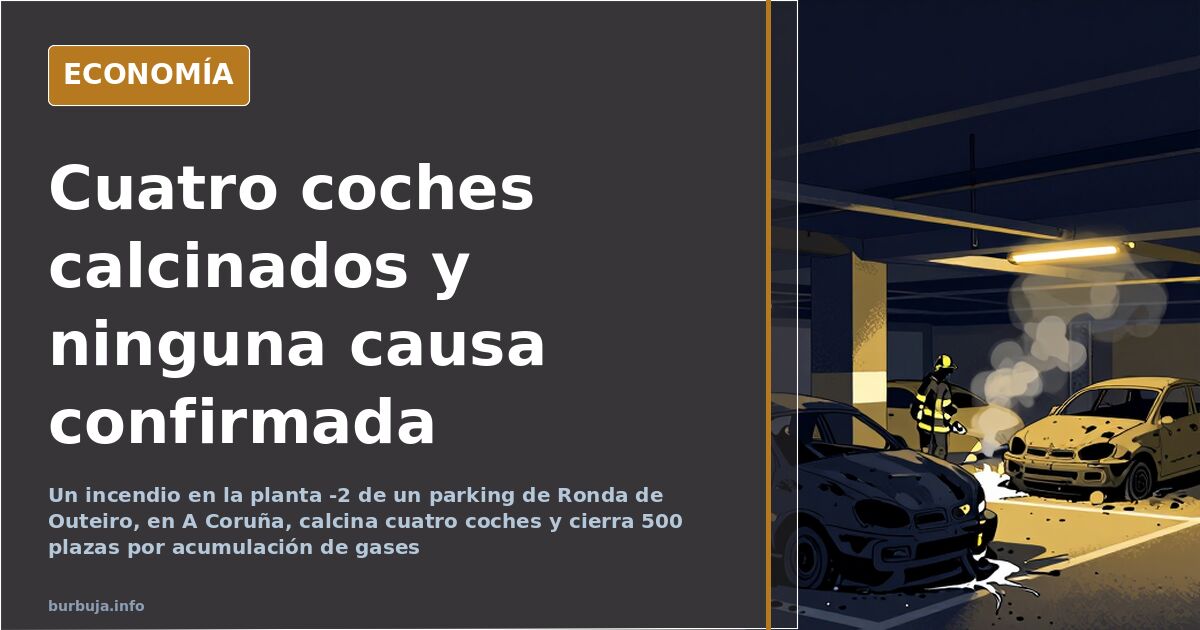
A fire on level -2 of the underground parking at Ronda de Outeiro, in A Coruña, has destroyed four vehicles: three burned completely and one partially. The blaze started around 11 p.m. and was extinguished after 3 a.m. No injuries were reported, and emergency services confirmed that firefighting operations lasted several hours. Firefighters remained on site for cooling, while the 500-space garage stayed closed due to gas accumulation.
Why does it take four hours to extinguish a garage fire?
The discrepancy between the four-hour duration from ignition to extinction and the presence of crews throughout the night is the core of the debate. Some argue that extinguishing and cooling combustion-engine cars does not take that long, suggesting that such delays point to a battery fire, because the chain reaction of cells only stops when it exhausts itself, which takes hours.
Against this interpretation stands a basic argument: a level -2 basement with 500 spaces requires subsequent ventilation and cooling, which cannot be measured in minutes. Ventilation is not extinguishing; it is evacuating smoke to allow entry. The official report sets the extinction time after 3 a.m., while those who trinc the operation speak of firefighters working until the next noon and a fire station left with minimal staffing. Neither version is conclusive.
What is known about the cause of the fire?
Forensic police were on the second underground level gathering evidence of what peine. That is all there is with backing: an undetermined origin. The electric vehicle hypothesis circulates by analogy with other incidents, not based on a report. And the technical counterargument also exists: an electric car still includes a radiator and evaporator for air conditioning, so the size of a radiator seen in a photo does not distinguish a thermal engine from an electric or hybrid one.
Some add a domestic detail: a gasoline or diesel car, they argue, can be disconnected with a circuit breaker costing less than ten euros. This is a claim launched in conversation without verification regarding this specific case.
Why garage temperatures matter when there is smoke
The discussion shifted to heat resistance figures. Some maintain that garage extractors withstand 400 ºC for two hours by regulation and are connected with 800 ºC fire-resistant hoses, while others point out that steel and cement melt at 1,500 ºC and that a thermal blanket in an open area reaches 480 ºC. With these margins, the argument goes, the key is not the vehicle material but how long smoke can be extracted.
Community garage: meters, policies, and homeowner meetings
The economic impact appears elsewhere. Several communities already have electric cars charging in the garage, each with its own individual meter. Based on this, two effects are outlined: the review of premiums for parking lots and communities with garages, and the difficulty of insuring a vehicle in a shared facility. The practical consequence, it is noted, is that liability ultimately falls on the collective policy.
Where the analysis hits a wall
There remains a closed parking lot, four lost cars, and an ongoing investigation. The cause of the fire is still unconfirmed, and until there is a report, there is no way to know if it was an electric motor, a thermal one, or unrelated to either. Everything else—hours of cooling, accumulated gases, rising insurance premiums—are consequences already on the table, and will remain there once the origin is clarified.
A fire on level -2 of the underground parking at Ronda de Outeiro, in A Coruña, has destroyed four vehicles: three burned completely and one partially. The blaze started around 11 p.m. and was extinguished after 3 a.m. No injuries were reported, and emergency services confirmed that firefighting operations lasted several hours. Firefighters remained on site for cooling, while the 500-space garage stayed closed due to gas accumulation.
Why does it take four hours to extinguish a garage fire?
The discrepancy between the four-hour duration from ignition to extinction and the presence of crews throughout the night is the core of the debate. Some argue that extinguishing and cooling combustion-engine cars does not take that long, suggesting that such delays point to a battery fire, because the chain reaction of cells only stops when it exhausts itself, which takes hours.
Against this interpretation stands a basic argument: a level -2 basement with 500 spaces requires subsequent ventilation and cooling, which cannot be measured in minutes. Ventilation is not extinguishing; it is evacuating smoke to allow entry. The official report sets the extinction time after 3 a.m., while those who trinc the operation speak of firefighters working until the next noon and a fire station left with minimal staffing. Neither version is conclusive.
What is known about the cause of the fire?
Forensic police were on the second underground level gathering evidence of what peine. That is all there is with backing: an undetermined origin. The electric vehicle hypothesis circulates by analogy with other incidents, not based on a report. And the technical counterargument also exists: an electric car still includes a radiator and evaporator for air conditioning, so the size of a radiator seen in a photo does not distinguish a thermal engine from an electric or hybrid one.
Some add a domestic detail: a gasoline or diesel car, they argue, can be disconnected with a circuit breaker costing less than ten euros. This is a claim launched in conversation without verification regarding this specific case.
Why garage temperatures matter when there is smoke
The discussion shifted to heat resistance figures. Some maintain that garage extractors withstand 400 ºC for two hours by regulation and are connected with 800 ºC fire-resistant hoses, while others point out that steel and cement melt at 1,500 ºC and that a thermal blanket in an open area reaches 480 ºC. With these margins, the argument goes, the key is not the vehicle material but how long smoke can be extracted.
Community garage: meters, policies, and homeowner meetings
The economic impact appears elsewhere. Several communities already have electric cars charging in the garage, each with its own individual meter. Based on this, two effects are outlined: the review of premiums for parking lots and communities with garages, and the difficulty of insuring a vehicle in a shared facility. The practical consequence, it is noted, is that liability ultimately falls on the collective policy.
Where the analysis hits a wall
There remains a closed parking lot, four lost cars, and an ongoing investigation. The cause of the fire is still unconfirmed, and until there is a report, there is no way to know if it was an electric motor, a thermal one, or unrelated to either. Everything else—hours of cooling, accumulated gases, rising insurance premiums—are consequences already on the table, and will remain there once the origin is clarified.
Also available in: Deutsch
Summary of a discussion on Burbuja.info - Foro de economía, actualidad y política., translated from Spanish and reviewed before publication. Read the full discussion (137 replies).
More summaries
-
The protocol that trapped a family in the Valencia fire
Four people died locked in their bathroom after following firefighter protocol during the Campanar fire. Neighbors who disobeyed survived.
-
Electric scooter fire in A Coruña leaves five homeless
An electric scooter fire in A Coruña left a family and landlord without homes. Who pays for damages and what insurance covers.
-
Valencia fire: Confinement protocol questioned after 150-unit blaze
Residents returned to their flats in Nou Campanar after firefighters advised them. The confinement protocol is under scrutiny following the deadly Valencia blaze.
-
Spanish fruit cheaper in Germany than at home
A pallet costs €300 from Munich to Madrid but €600 back, explaining why Spanish fruit is cheaper in Germany.
-
Juanma Moreno's Granada Photo Sparks Outrage in Spain's PP
In late 2021, a photo of Juanma Moreno and PP colleagues in Granada without visible restrictions triggered accusations of double standards.
-
Live TV groping claim sparks debate over hand position
A live broadcast incident involving a Cuatro reporter turns into a national dispute over whether the contact was sexual assault or accidental.