
Four ambulances set ablaze in London amid suspected antisemitic attack
Four ambulances have been burned in London in a suspected antisemitic attack. With no confirmed perpetrator, the incident has sparked false flag theories.
English · Original discussion in Spanish · Published
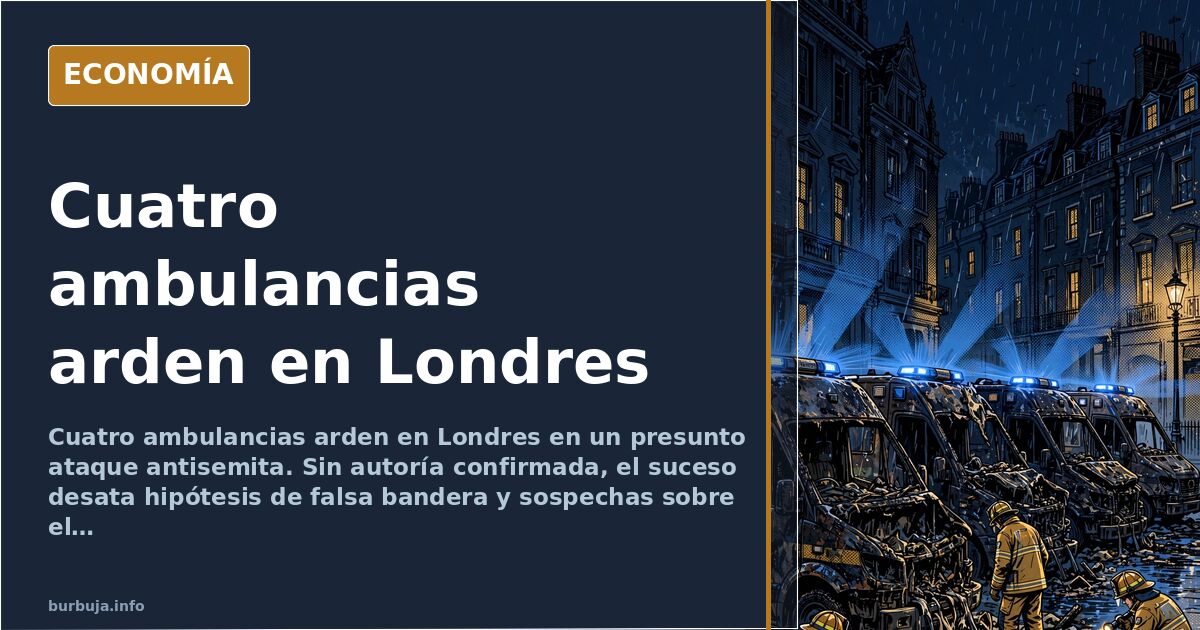
Four ambulances burn in London as official narratives assign blame
Four ambulances were set on fire in London in what the British press presented as a suspected antisemitic attack. The incident, initially reported by the Daily Mail and notably absent from The Sun’s front pages for hours, immediately triggered a storm of interpretations where the core fact—four emergency vehicles burned—was buried under layers of suspicion. There is no official confirmation of authorship, no arrests, and no claim of responsibility. There are only charred ambulances and a headline that came pre-labeled.
What is known about the London ambulance attack
The starting point is deliberately sparse: four ambulances, a fire, and a suspected antisemitic motive. The choice of target—emergency vehicles rather than a bank or a corporate headquarters—was the first thing to draw attention. A recurring point in the discussion is that an ambulance is chosen because it is an object that triggers automatic public outrage; if the attack had come from a hostile state actor, the targets would have been different: energy interests, financial infrastructure, or symbols of economic power. The logic of symbolic collateral damage does not align with that of strategic sabotage.
Some argue that the United Kingdom maintains a low profile in major international conflicts and therefore makes little sense as a priority target. Conversely, others argue that this very low profile makes it an ideal showcase for sending a message. The debate remains open.
The false flag pattern: why a conventional attack is ruled out
A significant portion of interpretations points toward a false flag operation hypothesis. The reasoning is consistent: attacks attributed to non-state actors are usually modest, controlled, and involve limited damage. If the goal were to cause massive harm, one analysis noted, it would be much easier to down several planes approaching Heathrow or blow up a station during rush hour. That never happens. It is always something moderate.
This asymmetry between potential damage and actual damage is the central argument for those who distrust the official narrative. Another factor is added: the choice of a target that generates instant indignation without paralyzing the economy. An ambulance burns and the country is outraged; a bank burns and the markets tremble. The former is more useful for manufacturing consensus.
The geopolitical context omitted by the headlines
The attack occurs at a moment of peak international tension, with the Strait of Hormuz at the center of the energy agenda and cross-threats between Washington and Tehran setting the market pace. On that chessboard, an incident in London serves as a fitting piece: it justifies the tightening of security policies, reinforces the narrative of a permanent threat, and shifts attention away from real economic costs.
The temporal coincidence is not proof of anything, but it is not innocent either. Attacks that occur when public opinion needs a clear enemy often share a common trait: there is never confirmed authorship, only a useful suspect.
What doesn't add up: from fire to explosion
A technical detail repeated in the analysis: a burned ambulance is not an exploded ambulance. The difference is not semantic. An arson attack requires a simple incendiary device; an explosion requires materials and planning. The headlines speak of explosions, but the incident appears to be a fire. In newsrooms with dwindling resources, precision suffers.
Added to this is the absence of verifiable information: there is no casualty count, no identification of victims, and no claim of responsibility. Only four charred vehicles and a label.
What might happen next
The matter remains exactly where it started: no confirmed authorship, no arrests, no claim of responsibility. The investigation remains open, and various hypotheses—antisemitic, Sarracinist, false flag, or a settling of scores—circulate without any being backed by public evidence. The only verifiable fact is the physical event: four ambulances burned in London. Everything else is interpretation.
And in that gap, between the fact and the narrative, is where the battle that truly matters is fought.
Also available in: Deutsch
Summary of a discussion on Burbuja.info - Foro de economía, actualidad y política., translated from Spanish and reviewed before publication. Read the full discussion (101 replies).
More summaries
-
UK Stabbing Reactivates Migration Debate
A viral stabbing video in Birmingham collides with the real Smethwick murder case, sparking a political debate on immigration and multiculturalism.
-
Cambridgeshire train attack sparks UK security debate
Ten injured in Cambridgeshire train stabbing; two arrested. Debate intensifies over CCTV quality and UK public transport safety.
-
UK Police Attacks Erupt After Henry Nowak Case
Leaked bodycam footage of Henry Nowak's death sparks attacks on UK police stations, with media attributing unrest to far-right groups.
-
Putin's plane forced to circle Moscow amid drone attack
Reports indicate Putin's aircraft could not land in Moscow during a Ukrainian drone strike, with three official Russian planes circling the airport.
-
X user asks Grok to verify claim of €4,000 monthly benefits for a family in Navarre, Spain
An X user asked Grok to verify the claim of more than €4,000 a month in benefits for a family with two children in Navarre, Spain. The AI's answer is not an official source.
-
TikTok users urge votes for Sánchez over 'la vital' benefit
TikTok posts are encouraging people to vote for Pedro Sánchez so that 'la vital' goes up. The phenomenon mixes misinformation about benefits with electoral gain.