
Forum user: TV news worse than communist propaganda
Users debate if Spanish TV news resembles authoritarian propaganda, while others argue modern society is vastly different.
English · Original discussion in Spanish · Published
TV news worse than communist propaganda
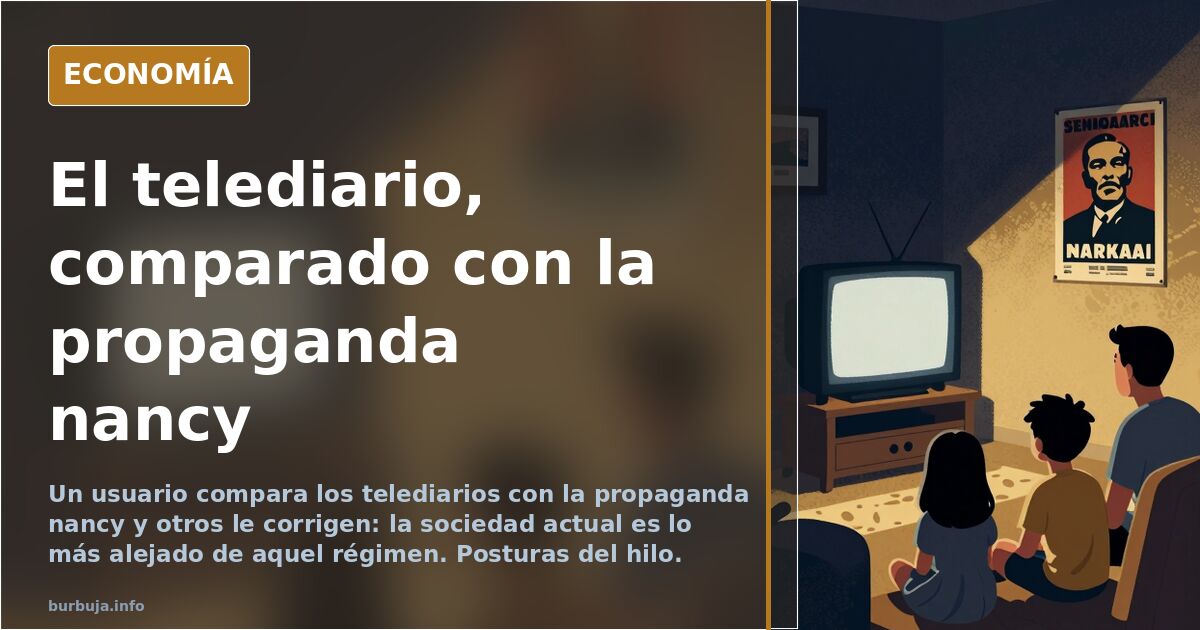
A remote control, a sofa, and three seconds of a broadcast are enough for someone to change the channel. The scene repeats itself: televisions on in living rooms with blinds drawn, the anchor's voice as background noise, and a growing feeling that what is reported does not match reality. From this stems a comparison circulating recently: daily news propaganda, it is argued, pales in comparison to that of the Franco regime. The phrase is exaggerated. It is also a symptom.
The starting point is a classic accusation: doctrine, lies, manipulation, and bias in the programming schedule, with the added suspicion that even the dates do not add up. The conclusion drawn is that current affairs coverage resembles an indoctrination apparatus more than a public service. And the final warning, repeated like a refrain: it will end very badly.
What is debated when discussing propaganda
The first response to the premise is a historical correction. We live, it is argued, in the society furthest from what the Franco regime sought to design, so the comparison is anachronistic. The term is used as a weapon rather than an analytical category. Some go further, claiming that labeling everything disliked as "Francoist" whitewashes communism, attributed with the greatest pavor of the modern era.
Another trend accepts the core but changes the framework. Manipulation exists, they say, but the model to cite is not Francoism: it is the refined mass propaganda that turns news into biased entertainment products. The difference, they maintain, is one of method, not intent. Here enters the most repeated nuance: classic propaganda machines were crude; current ones are sophisticated, continuous, and hard to detect.
The viewer who no longer watches the news
The conversation quickly shifts to personal experience. Some confess they tolerated broadcasts in the nineties but now cannot stand even three seconds. Others directly ask who still watches this. The most common answer points to a specific profile: older people and viewers who do not cross-check information. The rest, it is said, have migrated to other sources or simply turned off the television.
The economic argument appears strongly here. The criticism is not just about content, but about who pays for it. It is emphasized that these broadcasts are sustained by public funds, making the editorial line a matter for everyone, not just those who choose to watch. The complaint extends to radio and print media: the diagnosis is the same across all platforms.
From news bulletins to the full narrative
The thread widens and stops talking only about news programs. The thesis emerges that there is a roadmap on immigration agreed upon by employers' associations, unions, and political parties, with the media acting as a megaphone for benefits and silent on drawbacks. This is an assertion launched without proof and should be read as what it is: a repeated suspicion, not a documented fact.
In parallel, the fire in a building in Campanar and the floods in Valencia are cited to argue that emergency protocols failed and that the media defended them. These are episodes used in the conversation as examples of management and narrative, not as closed cases. The discussion then jumps to justice, separation of powers, and the feeling that institutions act without checks. There, the tone becomes darker and less verifiable.
The disorienting data remains: in a country with unlimited access to alternative sources, the midday news bulletin still sets the agenda for part of the population. Not out of credibility. Out of habit.
A remote control, a sofa, and three seconds of a broadcast are enough for someone to change the channel. The scene repeats itself: televisions on in living rooms with blinds drawn, the anchor's voice as background noise, and a growing feeling that what is reported does not match reality. From this stems a comparison circulating recently: daily news propaganda, it is argued, pales in comparison to that of the Franco regime. The phrase is exaggerated. It is also a symptom.
The starting point is a classic accusation: doctrine, lies, manipulation, and bias in the programming schedule, with the added suspicion that even the dates do not add up. The conclusion drawn is that current affairs coverage resembles an indoctrination apparatus more than a public service. And the final warning, repeated like a refrain: it will end very badly.
What is debated when discussing propaganda
The first response to the premise is a historical correction. We live, it is argued, in the society furthest from what the Franco regime sought to design, so the comparison is anachronistic. The term is used as a weapon rather than an analytical category. Some go further, claiming that labeling everything disliked as "Francoist" whitewashes communism, attributed with the greatest pavor of the modern era.
Another trend accepts the core but changes the framework. Manipulation exists, they say, but the model to cite is not Francoism: it is the refined mass propaganda that turns news into biased entertainment products. The difference, they maintain, is one of method, not intent. Here enters the most repeated nuance: classic propaganda machines were crude; current ones are sophisticated, continuous, and hard to detect.
The viewer who no longer watches the news
The conversation quickly shifts to personal experience. Some confess they tolerated broadcasts in the nineties but now cannot stand even three seconds. Others directly ask who still watches this. The most common answer points to a specific profile: older people and viewers who do not cross-check information. The rest, it is said, have migrated to other sources or simply turned off the television.
The economic argument appears strongly here. The criticism is not just about content, but about who pays for it. It is emphasized that these broadcasts are sustained by public funds, making the editorial line a matter for everyone, not just those who choose to watch. The complaint extends to radio and print media: the diagnosis is the same across all platforms.
From news bulletins to the full narrative
The thread widens and stops talking only about news programs. The thesis emerges that there is a roadmap on immigration agreed upon by employers' associations, unions, and political parties, with the media acting as a megaphone for benefits and silent on drawbacks. This is an assertion launched without proof and should be read as what it is: a repeated suspicion, not a documented fact.
In parallel, the fire in a building in Campanar and the floods in Valencia are cited to argue that emergency protocols failed and that the media defended them. These are episodes used in the conversation as examples of management and narrative, not as closed cases. The discussion then jumps to justice, separation of powers, and the feeling that institutions act without checks. There, the tone becomes darker and less verifiable.
The disorienting data remains: in a country with unlimited access to alternative sources, the midday news bulletin still sets the agenda for part of the population. Not out of credibility. Out of habit.
Also available in: Deutsch
Summary of a discussion on Burbuja.info - Foro de economía, actualidad y política., translated from Spanish and reviewed before publication. Read the full discussion (105 replies).
More summaries
-
Vox leader's foundation received €7M in public funds
Abascal's private foundation accumulated €7 million in public funds as half of Vox councilors leave the party.
-
Spain's rising discontent: public funds and civic decay
Growing perceptions of incivility in Spain mix with criticism over public spending distribution and industrial decline.
-
Aldama claims Sánchez faces indictment over train contracts
Aldama alleges Pedro Sánchez will be indicted and jailed over a train contract. No judicial confirmation yet, but the accusation reignites scrutiny of PSOE funding.
-
Former PSOE officials call for Pedro Sánchez to resign
Thirty-eight former Socialist ministers, senators, and mayors have signed a letter demanding the resignation of Spanish Prime Minister Pedro Sánchez.
-
Debate over female employment distribution across sectors
An analysis examines the concentration of women in the canning industry, the role of public employment, and the scientific legacy of Lise Meitner.
-
Spanish newspaper La Vanguardia leaves X following The Guardian
La Vanguardia has stopped posting on X, citing a disinformation network, following a similar move by The Guardian. They are ceasing posts but not deleting accounts.