
Forum user claims ground coffee contains cockroach fragments
A user argues that legal US limits allow up to 10% insect fragments in ground coffee, sparking debate among others.
English · Original discussion in Spanish · Published
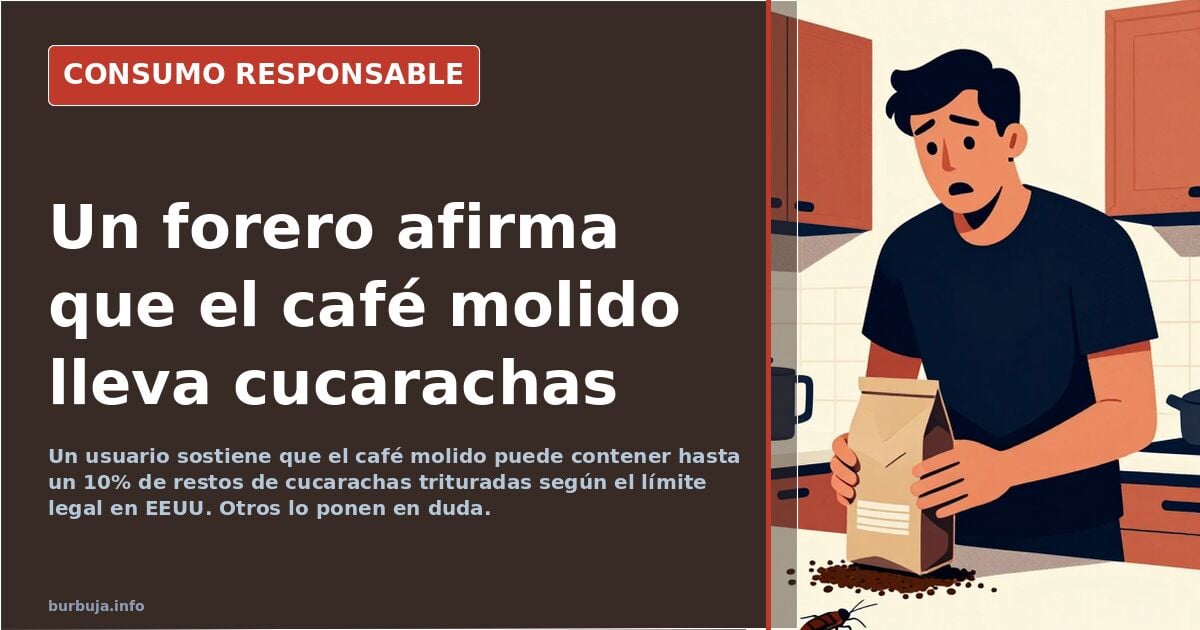
Forum user claims roasting doesn't remove cockroach fragments from ground coffee
Do you know what you're having for breakfast when you drink that capsule or bagged ground coffee? According to a forum user, crushed cockroach remains. They insist this isn't an urban legend or internet exaggeration: warehouses storing green coffee beans become infested with these insects, and when the beans move to the grinding line, everything falls together. Their account states that no one separates the bugs from the coffee. The result would be a homogeneous powder where the cockroach is just another ingredient, and subsequent roasting wouldn't make it disappear.
The issue goes further, according to this version. In the United States, there would be a legal limit for the presence of insect fragments in ground coffee, set at 10%. This means a batch containing a tenth part cockroach could be sold without issue. If infestation exceeds that percentage, the lot would be discarded. The only way to avoid this, according to those who have scrutinized the matter, would be to buy whole bean coffee and grind it at home.
Why cockroaches end up in ground coffee
The mechanism described is simple and not conspiratorial. Coffee is stored as green beans in industrial warehouses where cockroaches roam freely. When it's time to grind, the plant reportedly lacks a system to separate insects from the beans. Everything gets crushed. Since ground coffee is sold already processed, consumers have no way to see it.
The same pattern would repeat, according to the same account, in other cocoa-derived products like chocolate or cocoa powder. The difference would be degree: green coffee bean warehouses tend to get much more infested. So much so that there is a startling fact: people with cockroach allergies cannot consume ground coffee. It's not a joke, according to this version. The insect protein travels in the final product.
The 10% limit and the allergy nobody tells you about
US regulations would admit up to 10% cockroach fragments in ground coffee, always according to this version. Put on a scale, this figure means that for every kilo of coffee, you might be paying for a hundred grams of insect. Some have done the calculation aloud and asked how many cockroaches are needed to gather a hundred kilos in a ton. The answer isn't pleasant.
In Europe, no equivalent limit is recorded, but the problem knows no borders, according to the same account. Coffee sold as ground in supermarkets and capsules travels through the same industrial chain. The difference is that here the threshold isn't publicized. Meanwhile, consumers keep buying the format they find most convenient.
The consumer solution: a home grinder
The repeated recommendation is clear: buy whole bean coffee and grind it right before preparation. Whole beans allow visual inspection of what you buy and removal of any strange residues. Ground coffee, however, is a black box. Some also point out that whole bean coffee often has more traceable origins, from a specific farm or producer, while ground coffee tends to be a blend.
Whole bean prices are higher, yes. But the difference reflects lower consumption volume and options that ground coffee doesn't offer. The question is whether the savings compensate for what slips into the industrial grinder.
What other foods contain that you can't imagine
Coffee isn't the only one. Bread flour may contain rodent droppings, according to a forum user. Carob picked from trees carries spiders and beetles that are later ground with it, according to another. The colorant E-120 used in sausages and candies comes from cochineal, an insect. And those who have worked in factories for canned goods, jams, or sausage casings are clear: they don't eat what they produce, as they say.
The line between food and bug is more blurred than packaging suggests. Some residues are legal, others inevitable, and others simply aren't mentioned. Consumers decide if they want to know or prefer to keep drinking their coffee with eyes closed.
In the end, the only difference between ground coffee and whole bean is that in one you can see what goes in and in the other you can't. For many, that alone is reason enough to change habits. Or to change nothing and keep unknowingly consuming protein.
Do you know what you're having for breakfast when you drink that capsule or bagged ground coffee? According to a forum user, crushed cockroach remains. They insist this isn't an urban legend or internet exaggeration: warehouses storing green coffee beans become infested with these insects, and when the beans move to the grinding line, everything falls together. Their account states that no one separates the bugs from the coffee. The result would be a homogeneous powder where the cockroach is just another ingredient, and subsequent roasting wouldn't make it disappear.
The issue goes further, according to this version. In the United States, there would be a legal limit for the presence of insect fragments in ground coffee, set at 10%. This means a batch containing a tenth part cockroach could be sold without issue. If infestation exceeds that percentage, the lot would be discarded. The only way to avoid this, according to those who have scrutinized the matter, would be to buy whole bean coffee and grind it at home.
Why cockroaches end up in ground coffee
The mechanism described is simple and not conspiratorial. Coffee is stored as green beans in industrial warehouses where cockroaches roam freely. When it's time to grind, the plant reportedly lacks a system to separate insects from the beans. Everything gets crushed. Since ground coffee is sold already processed, consumers have no way to see it.
The same pattern would repeat, according to the same account, in other cocoa-derived products like chocolate or cocoa powder. The difference would be degree: green coffee bean warehouses tend to get much more infested. So much so that there is a startling fact: people with cockroach allergies cannot consume ground coffee. It's not a joke, according to this version. The insect protein travels in the final product.
The 10% limit and the allergy nobody tells you about
US regulations would admit up to 10% cockroach fragments in ground coffee, always according to this version. Put on a scale, this figure means that for every kilo of coffee, you might be paying for a hundred grams of insect. Some have done the calculation aloud and asked how many cockroaches are needed to gather a hundred kilos in a ton. The answer isn't pleasant.
In Europe, no equivalent limit is recorded, but the problem knows no borders, according to the same account. Coffee sold as ground in supermarkets and capsules travels through the same industrial chain. The difference is that here the threshold isn't publicized. Meanwhile, consumers keep buying the format they find most convenient.
The consumer solution: a home grinder
The repeated recommendation is clear: buy whole bean coffee and grind it right before preparation. Whole beans allow visual inspection of what you buy and removal of any strange residues. Ground coffee, however, is a black box. Some also point out that whole bean coffee often has more traceable origins, from a specific farm or producer, while ground coffee tends to be a blend.
Whole bean prices are higher, yes. But the difference reflects lower consumption volume and options that ground coffee doesn't offer. The question is whether the savings compensate for what slips into the industrial grinder.
What other foods contain that you can't imagine
Coffee isn't the only one. Bread flour may contain rodent droppings, according to a forum user. Carob picked from trees carries spiders and beetles that are later ground with it, according to another. The colorant E-120 used in sausages and candies comes from cochineal, an insect. And those who have worked in factories for canned goods, jams, or sausage casings are clear: they don't eat what they produce, as they say.
The line between food and bug is more blurred than packaging suggests. Some residues are legal, others inevitable, and others simply aren't mentioned. Consumers decide if they want to know or prefer to keep drinking their coffee with eyes closed.
In the end, the only difference between ground coffee and whole bean is that in one you can see what goes in and in the other you can't. For many, that alone is reason enough to change habits. Or to change nothing and keep unknowingly consuming protein.
Summary of a discussion on Burbuja.info - Foro de economía, actualidad y política., translated from Spanish and reviewed before publication. Read the full discussion (148 replies).
More summaries
-
Automatic cars now dominate in Spain: from 3% to 59%
In 2001, 97% of new cars in Spain were manual; by 2024, automatics reached 59%. The 2019 driving license change and pricing explain this shift.
-
Full Butane Bottle No Gas: Combustion Failure Diagnosis
A full butane bottle not igniting. Technical analysis of the fault between gas pressure and the stove.
-
O2: Complaints Pattern Reveals Service Crisis
Five days offline, fraudulent portabilities and missing discounts highlight O2's customer service failures in Spain's low-cost market.
-
Stuck Faucet Eccentric: Limescale, Hemp, and DIY Fixes
A faucet eccentric stuck by decades of limescale and hemp. Discover which remedies work (vinegar, torch, wrench) and when to call a plumber.
-
DeepSeek vs Gemini: Best Free AI Models
Comparison of DeepSeek and Gemini as top free AIs for document analysis, coding, and daily tasks. Which one wins without paying?
-
Lidl launches 2.24 kWh home battery for €299
Lidl sells a 2.24 kWh solar battery for €299. We analyze its profitability for self-consumption, savings potential, and drawbacks.