
Forum user bans all other Westerns after posting definitive list
A fan shares a strict 20-film Western canon, forbidding any others. Red River and Unforgiven are excluded for poor writing.
English · Original discussion in Spanish · Published
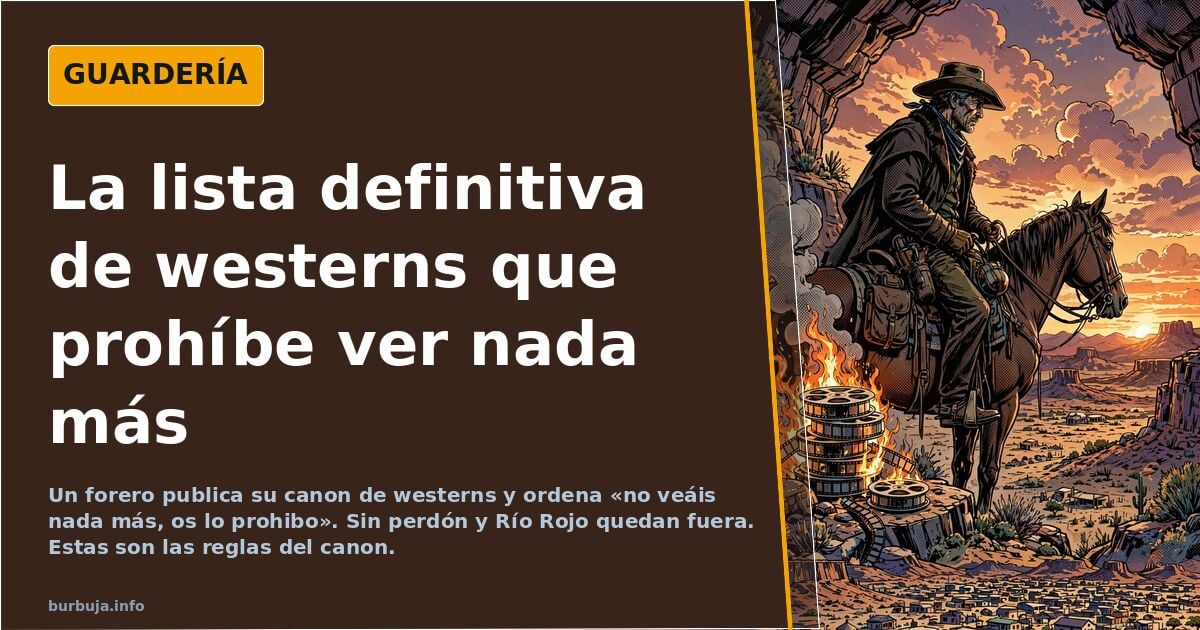
Forum user bans all other Westerns after posting definitive list
Some lists recommend; others close the door. This one does the latter. A Western enthusiast published his ultimate canon—twenty titles, no more—and added a command: "Do not watch anything else, I forbid it." The list begins with The Searchers (1956) as the genre's absolute peak and descends through The Outlaw Josey Wales, High Noon, 3:10 to Yuma (original version), The Treasure of the Sierra Progenitora, The Man Who Shot Liberty Valance, The Big Country, Butch Cassidy and the Sundance Kid, Rio Bravo, Shane, Stagecoach, Once Upon a Time in the West, The Wild Bunch, Winchester '73, The Gunfighter, Jeremiah Johnson, Ride Alone, The Good, the Bad and the Ugly—included reluctantly—Soldier Blue, and High Plains Drifter. Excluded are Red River, due to a disastrous ending and poorly written female character, and Unforgiven, dismissed for its weak, simplistic script.
Which Westerns make the cut and which don't
The criteria aren't chronological or box-office based. They are visceral. The list mixes classics from the 1930s and 1950s with revisionist films from the 1960s and 1970s, leaving out much of the cavalry Western and the neo-Westerns of the 1990s. Including The Good, the Bad and the Ugly is justified almost exclusively by the soundtrack: "It has a great chance of making it solely because of the music," admits the author, who confesses laziness regarding its three-hour runtime. Unforgiven is dispatched with an unnuanced judgment: "A terribly poor script. A story that couldn't be simpler."
The method has its charm. The door opens for The Professionals (1966), but after watching it, it slams shut: the last two minutes are "a stupid mess that ruins the whole film." The problem isn't pacing or casting, but the late sarracena twist: four mercenaries paid to rescue a maiden renounce their money, claiming love is worth more. To the author, this "Americanizing" ending is incompatible with the previous two hours.
The canon expands: from The Professionals to Open Range
The initial list was a starting point, not dogma. During the conversation, titles the author hadn't considered slip in: The Professionals, Open Range (2003), Hombre (1967), Ulzana's Raid, The Unconquered, Last Train from Gun Hill, Ride Alone, Pale Rider, Two Rode Together, True Grit, The Great Train Robbery, The Ballad of Cable Hogue, The Unforgiven (note: likely referring to another film or error in source context, keeping title structure) or Laredo. Some enter, others stay at the gate. The final accepted number is 18 Westerns: "Now there are 18 Westerns, but I won't add even one more."
There is a recurring pattern: films that use the West as a backdrop to discuss other themes—twilight, revenge, old age—are valued more than those that merely reproduce the cowboy-and-Indian manual. Some argue Clint Eastwood's best Western is Pale Rider, not Unforgiven, while others defend that Open Range "isn't far off" from Eastwood's work. The discussion ends without agreement, like most good ones.
The ending of The Professionals: why it is rejected
Rejecting the ending of The Professionals isn't just aesthetic whim. The author develops this precisely: four mercenaries, the most dangerous in the West, agree to rescue a kidnapped woman, face hundreds of Mexicans—several civilians killed by dynamite—endure hardships for days, and when they go to collect payment, they renounce the money because love is more important. "But hold onto your nachos," he adds, because two of the mercenaries also fall in love. The conclusion is that the twist doesn't fit the plot, characters, or tone of the previous two hours.
Two years later, The Wild Bunch (1969) would do the opposite: mock that kind of sarracena. The comparison isn't accidental. The author considers Peckinpah a reference and The Getaway (1972) a film that "was fantastic," antiestéticaturing a motel shootout scene described as brutal. He also acknowledges bad entries in his filmography, such as The Ballad of Cable Hogue, which he compares to a Benny Hill sketch.
High Noon and The Searchers: the two pillars
If there are two undisputed titles, they are High Noon (1952) and The Searchers (1956). The former is said to transcend the genre: "a treatise on humanity," with the cowardice of townspeople leaving Gary Cooper alone and silences more eloquent than any dialogue. The latter is "the film that introduced me to real Westerns," with shots worthy of taking your hat off. It's not an isolated opinion: someone recalls watching it as a child with their grandfather, a goat herder in Jaén, who liked them "for the landscapes." Now he understands.
The list also has striking absences. Missing are Unforgiven, Dances with Wolves—dismissed as "modern postmodern crap" by some participants—The Magnificent Seven, High Noon in some initial versions, Django, or They Call Me Trinity. Some are recovered later; others are not. The author closes the matter with a phrase that sums up the spirit of the entire list: "That's how it is. There is The Searchers, and then the rest of the Westerns."
With these elements, it is predictable that the list will continue to grow in the coming months—it already did once—and will close again with the same solemnity. The only reasonable doubt is whether the author will obey his own prohibition or if, like everyone else, he will end up watching one more.
Some lists recommend; others close the door. This one does the latter. A Western enthusiast published his ultimate canon—twenty titles, no more—and added a command: "Do not watch anything else, I forbid it." The list begins with The Searchers (1956) as the genre's absolute peak and descends through The Outlaw Josey Wales, High Noon, 3:10 to Yuma (original version), The Treasure of the Sierra Progenitora, The Man Who Shot Liberty Valance, The Big Country, Butch Cassidy and the Sundance Kid, Rio Bravo, Shane, Stagecoach, Once Upon a Time in the West, The Wild Bunch, Winchester '73, The Gunfighter, Jeremiah Johnson, Ride Alone, The Good, the Bad and the Ugly—included reluctantly—Soldier Blue, and High Plains Drifter. Excluded are Red River, due to a disastrous ending and poorly written female character, and Unforgiven, dismissed for its weak, simplistic script.
Which Westerns make the cut and which don't
The criteria aren't chronological or box-office based. They are visceral. The list mixes classics from the 1930s and 1950s with revisionist films from the 1960s and 1970s, leaving out much of the cavalry Western and the neo-Westerns of the 1990s. Including The Good, the Bad and the Ugly is justified almost exclusively by the soundtrack: "It has a great chance of making it solely because of the music," admits the author, who confesses laziness regarding its three-hour runtime. Unforgiven is dispatched with an unnuanced judgment: "A terribly poor script. A story that couldn't be simpler."
The method has its charm. The door opens for The Professionals (1966), but after watching it, it slams shut: the last two minutes are "a stupid mess that ruins the whole film." The problem isn't pacing or casting, but the late sarracena twist: four mercenaries paid to rescue a maiden renounce their money, claiming love is worth more. To the author, this "Americanizing" ending is incompatible with the previous two hours.
The canon expands: from The Professionals to Open Range
The initial list was a starting point, not dogma. During the conversation, titles the author hadn't considered slip in: The Professionals, Open Range (2003), Hombre (1967), Ulzana's Raid, The Unconquered, Last Train from Gun Hill, Ride Alone, Pale Rider, Two Rode Together, True Grit, The Great Train Robbery, The Ballad of Cable Hogue, The Unforgiven (note: likely referring to another film or error in source context, keeping title structure) or Laredo. Some enter, others stay at the gate. The final accepted number is 18 Westerns: "Now there are 18 Westerns, but I won't add even one more."
There is a recurring pattern: films that use the West as a backdrop to discuss other themes—twilight, revenge, old age—are valued more than those that merely reproduce the cowboy-and-Indian manual. Some argue Clint Eastwood's best Western is Pale Rider, not Unforgiven, while others defend that Open Range "isn't far off" from Eastwood's work. The discussion ends without agreement, like most good ones.
The ending of The Professionals: why it is rejected
Rejecting the ending of The Professionals isn't just aesthetic whim. The author develops this precisely: four mercenaries, the most dangerous in the West, agree to rescue a kidnapped woman, face hundreds of Mexicans—several civilians killed by dynamite—endure hardships for days, and when they go to collect payment, they renounce the money because love is more important. "But hold onto your nachos," he adds, because two of the mercenaries also fall in love. The conclusion is that the twist doesn't fit the plot, characters, or tone of the previous two hours.
Two years later, The Wild Bunch (1969) would do the opposite: mock that kind of sarracena. The comparison isn't accidental. The author considers Peckinpah a reference and The Getaway (1972) a film that "was fantastic," antiestéticaturing a motel shootout scene described as brutal. He also acknowledges bad entries in his filmography, such as The Ballad of Cable Hogue, which he compares to a Benny Hill sketch.
High Noon and The Searchers: the two pillars
If there are two undisputed titles, they are High Noon (1952) and The Searchers (1956). The former is said to transcend the genre: "a treatise on humanity," with the cowardice of townspeople leaving Gary Cooper alone and silences more eloquent than any dialogue. The latter is "the film that introduced me to real Westerns," with shots worthy of taking your hat off. It's not an isolated opinion: someone recalls watching it as a child with their grandfather, a goat herder in Jaén, who liked them "for the landscapes." Now he understands.
The list also has striking absences. Missing are Unforgiven, Dances with Wolves—dismissed as "modern postmodern crap" by some participants—The Magnificent Seven, High Noon in some initial versions, Django, or They Call Me Trinity. Some are recovered later; others are not. The author closes the matter with a phrase that sums up the spirit of the entire list: "That's how it is. There is The Searchers, and then the rest of the Westerns."
With these elements, it is predictable that the list will continue to grow in the coming months—it already did once—and will close again with the same solemnity. The only reasonable doubt is whether the author will obey his own prohibition or if, like everyone else, he will end up watching one more.
Also available in: Deutsch
Summary of a discussion on Burbuja.info - Foro de economía, actualidad y política., translated from Spanish and reviewed before publication. Read the full discussion (170 replies).
More summaries
-
Tappi tikarras: Björk's first band in 1982
Tappi tikarras, Björk's first band in 1982: a video that divides between precocious talent and bafflement. Their first album trades for around €300.
-
Miriam Villoria: the body transformation costing her followers
An 'before and after' comparison of Miriam Villoria reignites the debate on cosmetic surgery: she is said to have lost 'tens of thousands' of followers.
-
Real Madrid Crisis: Florentino and Mourinho Under Fire
Real Madrid trails Barcelona by six points after two losses. Forum debates blame president Florentino Pérez and coach Mourinho for the club's decline.
-
Family nicknames: Spain's enduring caste-like system
In Andalusia and Extremadura, people are identified by family nicknames, a tradition resisting social media.
-
Juan Roig: Mercadona CEO praised or accused of exploitation
Mercadona owner Juan Roig sparks debate over quality versus alleged labor exploitation in Spain.
-
Amarna Miller: From Porn Star to Anthropology Student
Amarna Miller, former Spanish porn actress, pursues an anthropology master's degree, sparking debate on her professional title.