
Forum user asks AI to draw a woman with 3 lines and it refuses
A user asked a generative AI to draw a woman with three lines; the AI replied that it cannot generate unsafe images, according to a forum thread.
English · Original discussion in Spanish · Published
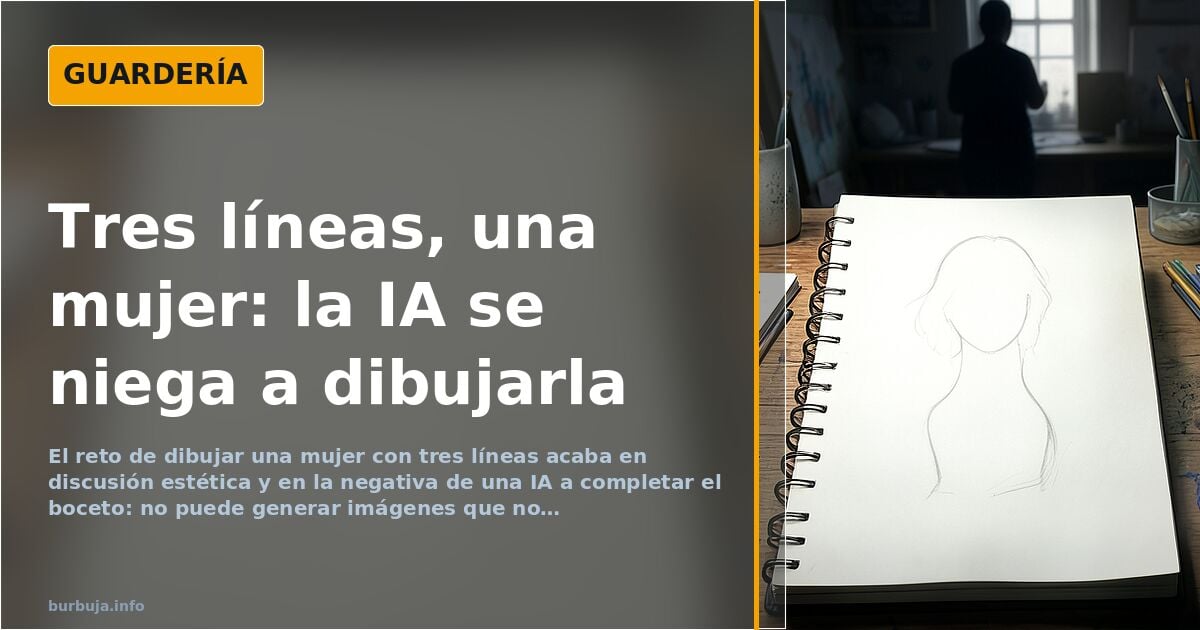
Three lines to draw a woman: the AI refuses
A seemingly trivial challenge — drawing a woman with three strokes — has turned into a small experiment on the limits of generative artificial intelligence. The original request, posted on a discussion forum, sought a minimal illustration: three lines capable of evoking a female figure. The response from one of the most popular tools on the market was an outright refusal: "I'm sorry, but I cannot generate images that are not safe". The episode, which would normally be no more than an anecdote, reveals just how opaque and often contradictory the content filters of large language models can be.
What peine when the AI was asked for the drawing
The sequence is simple. A participant asks the tool in question for three lines to represent a woman. The machine, trained to avoid any content that could be interpreted as sensual, triggers its safety protocol and declines the request. There is no nudity, no erotic context, no ambiguity: just a schematic figure. The refusal, however, is automatic.
The case illustrates a recurring problem with algorithmic moderation systems. Filters are designed to block entire categories — nudity, violence, hate — but lack the ability to distinguish between an explicit representation and a simple graphic exercise. The result is overzealousness that turns the tool into a clumsy actor, unable to read context.
The human response: from outrage to graphic analysis
The AI's refusal did not close the matter. On the contrary, it peine a debate about what really constitutes a minimal representation. Several participants pointed out that the original image — the one that inspired the challenge — could already be done with two lines: one for the head and one for the body. The third, they joked, is the one missing from most female figures that appear in the media: the line of a closed mouth.
Other participants praised the economy of strokes as an exercise in artistic synthesis. "With just 3 strokes you can recognize her from miles away", wrote one participant, who saw in the result a potential logo. The comparison with minimalist-style illustrators soon appeared, though without providing concrete data on the authorship of the original image.
The contrast between the machine's rigidity and people's interpretive flexibility was plain to see. Where the algorithm sees risk, the human eye sees ingenuity. Where the filter blocks, the artist simplifies.
The underlying problem: filters that don't understand context
The episode ties into a broader discussion about how automatic moderation systems are trained and deployed. Large language and image generation models operate with lists of forbidden words and concepts which, applied without nuance, produce constant false positives. A nude torso in an anatomy textbook, a childbirth scene in a documentary, or a three-line schematic figure can trigger the same alarm.
The paradox is that these same systems are presented as general-purpose creative tools. The user who asks for a minimalist drawing discovers that the tool cannot distinguish between a sketch and an explicit illustration. The promise of flexibility clashes with the reality of a binary filter: safe or blocked.
There is no public data on how many legitimate requests are rejected for this reason. The developing companies do not break down their false positive rates, and the opacity of the process makes it impossible to audit the criteria. What is known is that the episode is not isolated: similar cases recur every time a user tries to use these tools for purposes outside the intended script.
A challenge that remains unsolved
The three-line drawing was, in practice, never executed automatically. The conversation drifted toward analysis of the original image and irony about safety filters. No one offered a technical solution to the underlying problem: how to teach a machine to distinguish between a stroke and an intention.
Meanwhile, the anecdote leaves an uncomfortable question. If a tool cannot draw a woman with three lines without triggering its safety protocol, how much real room does it have for creative tasks that deviate even slightly from the conventional? For now, the answer comes from the system itself: none. Or almost none.
Also available in: Deutsch
Summary of a discussion on Burbuja.info - Foro de economía, actualidad y política., translated from Spanish and reviewed before publication. Read the full discussion (20 replies).
More summaries
-
AI-generated thread summaries spark controversy on Burbuja.info
AI-generated automatic summaries on Burbuja.info, a Spanish forum, have drawn criticism for paternalistic oversight and indirect censorship. One user notes the thread has racked up 41 replies.
-
AI that digs through the filth and strikes gold: hunting psychopaths online
An AI analyzed an extreme troll text and revealed psychopathic patterns. The debate over moderation and free speech is reignited.
-
Online Death of Known Figure Cesard Sparks Debate
The passing of internet personality Cesard triggers polarized reactions, sparking a debate about his complex legacy, controversial reputation, and digital footprint.
-
Eating fried fish on San Juan beach when suddenly this happened...
We look at the fried fish coincidence on San Juan beach: when chance feels like destiny and what it reveals about human perception.
-
Job insecurity and mental health: a daily struggle in Spain
An analysis of job insecurity, mental health and the risks of self-medication in an environment of constant pressure and anxiety.
-
Tinder: a predictable failure for the average man
A user reports zero matches on Tinder despite liking profiles he doesn't even find attractive. Paying to be visible, alternatives like Hinge and Bumble, or uninstalling.