
Forum thread: from investing 5,000 euros to a 100-euro loan
A forum thread mixes dividends, crypto and an alleged 100-euro loan inflated to 5,000; the author himself admits at the end it was fiction.
English · Original discussion in Spanish · Published
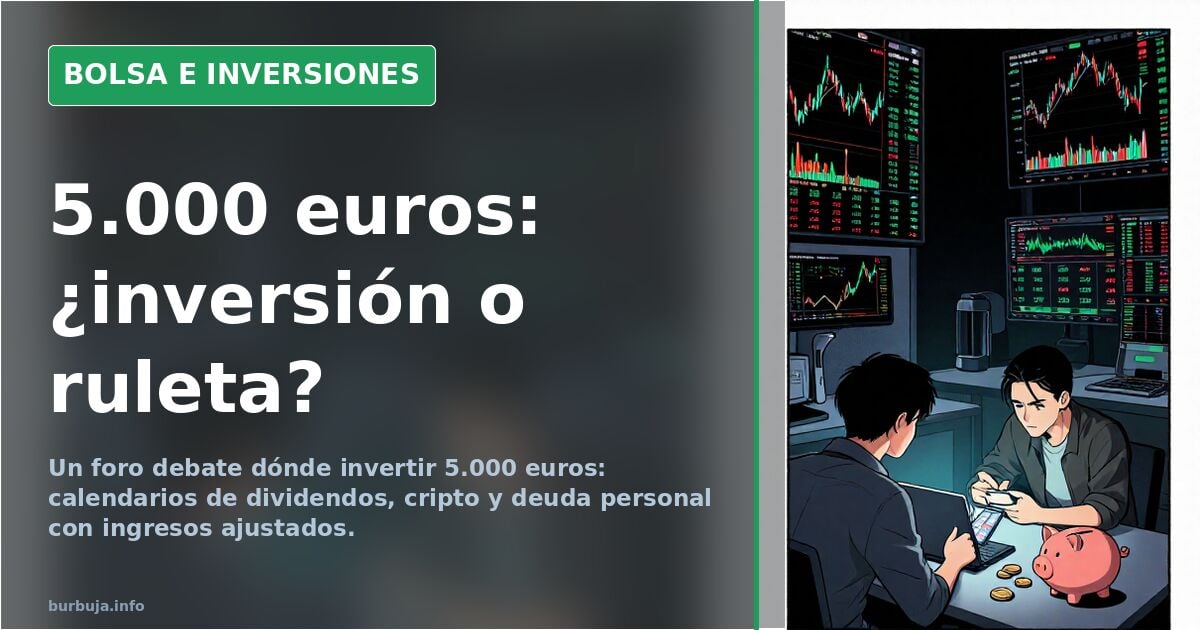
Investing 5,000 euros: from dividends to a usurious loan
Where to put 5,000 euros without your broker's app hiding what you need to know? That question opens a discussion that starts with Trade Republic dividends and ends, twenty messages later, with an alleged 100-euro personal loan turned into a 5,000-euro debt — a story the author himself admits at the end was fiction. More than a financial journey, it is a portrait of how real questions, fantasy and armchair legal advice blend together online.
Which app shows dividends when the market is closed
The first question is specific: an app that doesn't say which companies are paying dividends when the stock exchange is closed. The answer is that the payment calendar is published in advance and doesn't depend on trading hours. To check it there are dedicated tools — dividend calendars and ex-dividend dates by ticker — plus the classic financial portals. A cheap broker is for trading, not for information.
From there the thread drifts into crypto investing, where the discussion splits between those who see a roulette wheel and those who defend putting money into digital assets. The mention of the MSCI World and silver as alternatives comes with a warning: the global index is trading at all-time highs and the precious metal has fallen from its own peak, though it could keep dropping. Uranium and copper come up as fashionable bets, with the problem that their charts have already surged.
From 100 euros to 5,000: usury as a legal argument
The twist comes when a debt of over 5,000 euros is confessed, on a salary below 1,200 euros, with personal loans already sold on to a debt collection company. The detail that changes everything is the origin: an initial loan of 100 euros. Multiplying the principal fiftyfold is, according to the analysis laid out, a textbook case of usury. Spain's Ley de Usura de 1908 (the 1908 Usury Act) is still in force and courts have been annulling revolving credit contracts on these grounds for years. If a contract is declared usurious, only the amount borrowed is repaid and nothing more, and the claimant may end up having to return anything collected in excess.
The second front is identity theft. A formal demand with the correct name but a failed address constitutes a procedural defect that can sink a payment order claim. But the ammunition expires: a police report filed after the fact reads as an alibi. The report had to exist beforehand. Without the original contract and a dated police report, it's one party's word against the other's.
What to do with a debt from 2014 that is still alive
Another user contributes the opposite case: a 915-euro debt taken on in 2014 for which a collection company is now demanding 6,000. The question is whether it has become time-barred — more than five years — or whether it's worth claiming abusive interest if the court rejects the statute of limitations argument. So far there have only been phone calls, no payment order proceedings. The repeated advice is not to make part payments without a written settlement, to demand a breakdown of the interest by recorded-delivery letter (burofax) and to find a lawyer who works on a no-win-no-fee basis. The Ley de Segunda Oportunidad (Spain's Second Chance law, reformed in 2022) also comes up as a way out for honest debtors.
The thread closes with the confession that it was all fiction. Twenty minutes of storytelling for a forum of strangers. The legal defence plan that had been built — usury, identity theft, burofax — stands revealed as what it always was: a theoretical exercise. The sarracena is uncomfortable. Half of the financial dramas circulating online are exactly this. And the other half, the real ones, are not solved by asking whether you'll "get off scot-free".
Also available in: Deutsch
Summary of a discussion on Burbuja.info - Foro de economía, actualidad y política., translated from Spanish and reviewed before publication. Read the full discussion (39 replies).
More summaries
-
Debate: is not investing the only safe investment?
One user argues for not investing at all; others reply that this leaves you exposed to inflation. A debate on the only truly safe investment.
-
Pablo Gil trader reviews: respect and bearish bias
Two years warning of a stock market crash that hasn't come: opinions on Pablo Gil, the YouTube trader, split between respect and bias.
-
Turning €1,000 into €1,100 in a month: the 10% nobody finds
Turning €1,000 into €1,100 in a month requires a 10% monthly return. A one-month deposit earns €2.20. The full calculation dismantles the expectation.
-
Offshore accounts: how a Spanish savings bank offers an escape route
A Spanish savings bank arranges accounts at some thirty foreign banks without travel: an average fee of around 20 euros and doubts about whether it is worth it.
-
AI stocks: the opportunity lies in what it has already destroyed
The AI stock opportunity is not in the hype but in the sectors it has destroyed: SaaS and semiconductors. Token costs and fear of losing…
-
Opening a bank account abroad: how to move your savings out of Spain
Foreign funds with LU ISIN codes or accounts in France and Andorra: the routes for getting savings out of Spain and the bureaucratic hurdles holding savers back.