
Forum Speculates on Lowering Voting Age to 16 in Spain by 2027
A forum thread suggests the Spanish government may lower the voting age to 16 for the 2027 elections, adding 700,000 voters amid legal doubts and electoral suspicions.
English · Original discussion in Spanish · Published
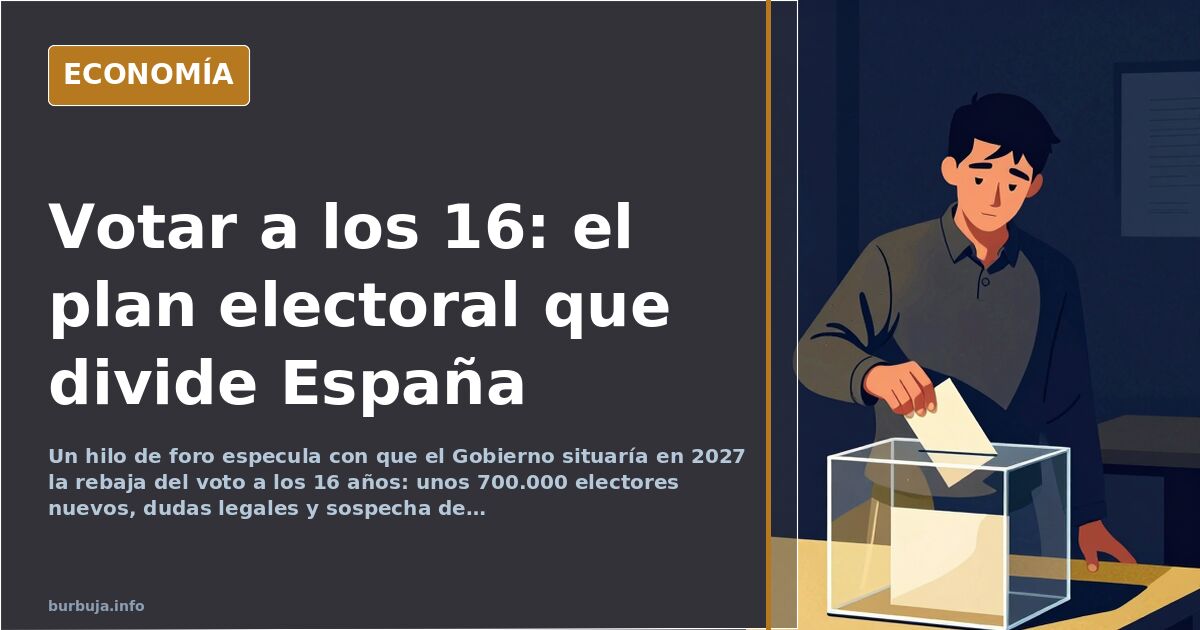
Voting at 16: The plan a forum places in 2027
A forum thread speculates that the Government has set a date for one of the most debated reforms of the legislative term: lowering the legal voting age to 16 for the 2027 general elections. The measure, which has no known draft text, has landed like a bomb in economic and political circles, where the first question is not ethical but arithmetic: how many new votes enter the electoral roll and who benefits. According to those participating in the debate, the issue also intersects with another piece already on the table, the regularization of hundreds of thousands of migrants, and the feeling—repeated ad nauseam—that the electoral calendar matters more than any technical report.
What is known about lowering the age to 16
The announcement comes without the detail usually accompanying a reform of this magnitude: there is no public preliminary draft, no economic impact assessment, no official estimate of the additional electorate. What circulates is the date—2027—and the suspicion that the objective is purely electoral. Spain would be the first country in its vicinity to conduct the full experiment, something several analyses highlight as a sign of urgency rather than conviction. In the rest of Europe, only Austria allows voting at 16 in all elections; other consolidated democracies keep the threshold at 18 or reserve it for local and European elections.
The figure used to gauge the impact is modest: around 700,000 potential votes. A small block in absolute terms, but decisive in a country where majorities have been decided by much narrower margins. The doubt is whether these voters exist as such: participation tends to be low at that age and voting behavior volatile.
The political calculation: Who benefits?
This is where the real disagreement begins. One school argues that the left would not take this step if their internal studies did not point to predominantly pogre voting among young people. Another responds that it could backfire: in high schools, they say, an anti-pogre wind is blowing that has already been felt in classrooms and could translate into votes for right-wing options. No one has public polls segmented by age to settle the dispute.
What does appear in the analysis is the fine print of vote-buying. If the age is lowered, the argument goes, the next step is youth bonuses, direct aid, or free concerts funded by the treasury. Argentina has been conducting this experiment for years, and the cited result is not edifying: candidates offering free shows in exchange for votes. The legal objection is obvious—vote-buying is a crime—but the line between public policy and electoral bribery blurs when the calendar tightens.
The legal contradiction: Minor for everything, adult to vote
The most repeated argument is not ideological but legal. At 16, you cannot sign an employment contract without parental authorization, open a bank account, drive, travel abroad without permission, or undergo surgery without guardianship. Full legal capacity arrives at 18. If voting is the highest expression of that capacity, consistency would require extending it also to incivil and tax responsibility. The lingering question: Why is one considered mature enough to decide who governs but not to sign a lease?
There is a recurring answer: because voting obligates nothing. It generates no debt, creates no obligations, and does not expose the minor to financial consequences. It is, in that sense, the cheapest legal act that exists. And precisely for that reason, the easiest to capture.
The intersection with migrant regularization
The reform is not discussed in a vacuum. Critics frame it within a broader operation: regularizing migrants, expanding the electoral roll, and now incorporating young voters. They argue the sum is not coincidental. The response from the other side is that mixing both issues is a smokescreen and that regularization responds to humanitarian and economic reasons, not electoral ones.
The undisputed data point is that demographics favor the left in the short term and work against them in the medium term. Older voters, who sustain the PSOE (Spanish Socialist Workers' Party) with annual pension increases, are disappearing. Young people, theoretically, take their place. The doubt is with which ballot paper.
What international precedents say
Comparison with other countries does not yield a clean answer. Austria has allowed voting at 16 in all elections for years and has not collapsed. Argentina has done so since 2012 and has seen campaign events turn into festivals. Brazil and some German states apply it in local elections. None of these cases allow extrapolating the Spanish outcome, among other things because here the party system and territorial fragmentation have no equivalent.
What all precedents share is that expanding the electorate is never neutral. It changes the relative weight of each district, alters campaign strategies, and forces parties to speak to an electorate that consumes social media, not traditional press. Indoctrination, some say, is no longer needed in the classroom: the algorithm suffices.
Where the analysis gets stuck
With 700,000 potential votes, a date on the calendar, and no public poll clarifying the actual voting intention of minors, the debate remains exactly where it started: in suspicion. If the Government's calculation is correct, the reform secures an electoral base for decades. If it is wrong, it has just added to the roll a block that may vote against them for the same time. No one knows which of the two is happening, and probably no one will know until the ballots speak.
Also available in: Deutsch
Summary of a discussion on Burbuja.info - Foro de economía, actualidad y política., translated from Spanish and reviewed before publication. Read the full discussion (154 replies).
More summaries
-
Spain's 2027 election: vote-rigging fears and the Grandchildren Law
2.5 million citizenship applications under Spain's Grandchildren Law have reignited the debate over electoral transparency and Indra's vote count ahead of the next general election.
-
What happens if 70% of the electorate doesn't vote in general elections?
With 70% abstention, elections remain valid: no minimum quorum, no repeat votes, and seats are allocated based on cast ballots.
-
Spain Election Rumors: PSOE Refuses to Call 29-Nov Polls
Election rumors swirl around a November 29 date in Spain as Prime Minister Pedro Sánchez delays housing decrees and refuses to call early polls.
-
Spain's Ayuso turns 48 with an Instagram photo that reignites the debate over her style
Madrid regional president Isabel Díaz Ayuso marked her 48th birthday with an Instagram photo that has reignited debate over her style, her record in Madrid and her national ambitions.
-
Too Many Life Options vs the Quiet Certainty of Choosing Right in Scarcity
An abundance of life options does not guarantee a better choice. In scarcity, a Sabina record was enough to feel sure you had chosen right. Come in and compare.
-
Galicia sells off its industry: from Avícola Tratante to Aludec
Avícola Tratante, Aludec, Ochoa, Martínez Otero: foreign capital is buying up Galician companies; forum users point to the lack of generational succession