
Forum: European youth 'won't fight' if a draft is called
Forum debate: faced with a hypothetical European draft, several users argue that young people would not go to the front due to lack of prospects and miserable wages.
English · Original discussion in Spanish · Published
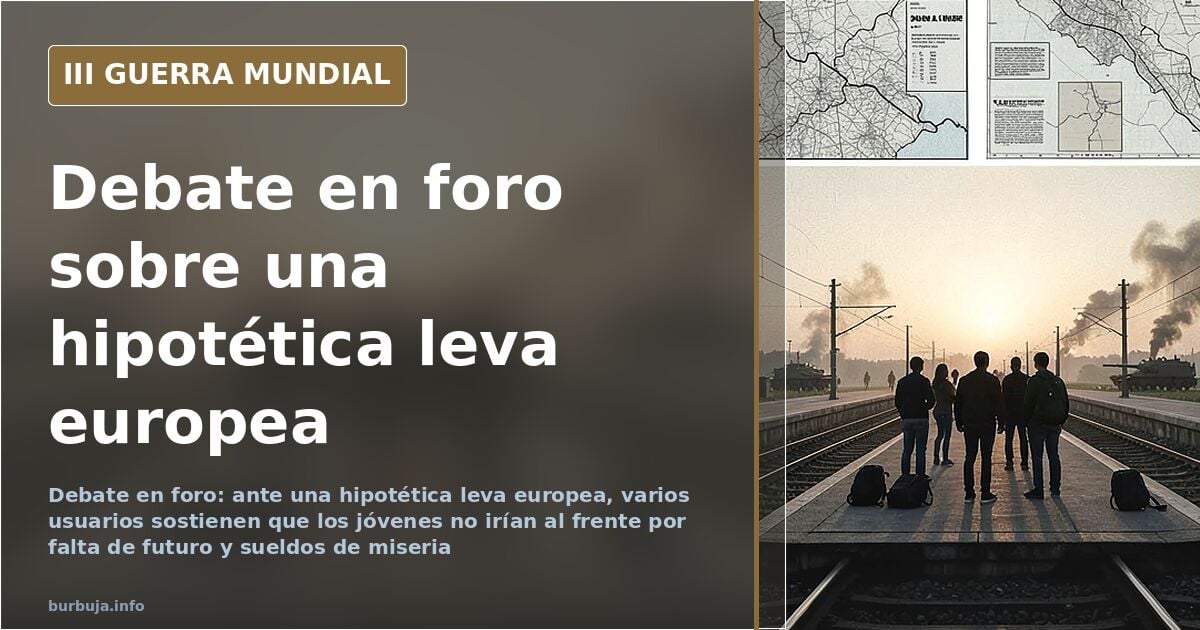
European youth won't fight Russia
The conclusion repeats itself in every corner of the conversation: nobody is going to show up. The starting premise is a hypothetical European draft to defend the eastern flank, and the majority response is outright rejection. Not out of cowardice, but out of calculation. Someone who is twenty years old and on a poverty-wage contract does not see their homeland on a map of Brussels.
A duty nobody acknowledges
The most repeated argument is that the duty of an Italian, a Portuguese, a German or a Spaniard is not to go to countries that are not their own to defend things that have nothing to do with them. It is argued that European politicians are out of touch with reality: they have tried to dismantle national sentiment within each country and now want to sell a European nation that **does not exist as a homeland**. Europe, they say, is a shared geographic space, not a community of sacrifice.
Some add the fine print of the passport. Having documentation also implies obligations, and in hard times citizens discover they cannot refuse to take up a rifle. The warning comes with a smirk: many believe that simply saying no is enough.
Who stays and who escapes?
The dominant prediction is that young people will escape by any means possible. They have strength, working capacity and a life ahead of them to rebuild elsewhere. The profile of the recruit who stays is not the kid: it is **fifty-somethings** and mature people, as seen in the videos circulating about the Ukrainian front.
The generational calculation is bitter. The question is asked what incentive someone without a home, without a future and on perversos wages has to go to the front and fight so that others keep their privileges. The answer, in most messages, is none.
Resistance within the army
The objection is not only civilian. Those who know the German army up close describe an unmartial picture: offices, filing cabinets, laser printers carried in vans with a company logo. A minority gets excited about war, officers in uniform and little else. The rest watch life go by.
The most uncomfortable anecdote is about gender. The most hawkish, it is claimed, are women, and not precisely the ones who would go to the front. The gap between those who cheer and those who hold the rifle runs through the whole conversation.
The sarracena dilemma of the front
A current emerges that recovers Christendom as the only framework that makes sense for a Europe fighting for something. Since the Enlightenment, it is argued, the secular version of Europe is a joke. Without those roots, there is no cause that justifies the sacrifice.
Others go further: at the front, the real enemy is not on the other side, but in the command that orders you to shoot. Fighting for ideals may have honor; being an instrument of NATO does not. The question hanging in the air is what values are being defended: high taxes, bans, control of social media and extreme bureaucracy.
The draft as a litmus test
The scenario of forced conscription is drawn as the moment the passport shows its reverse side. The prediction is that the population will comply, whether it makes sense or not, willingly or pushed by circumstances. But also that resistance will be massive and that in countries like France the streets would burn.
The provisional conclusion: the European war does not rest on enthusiasm, but on coercion. And coercion, in a generation with nothing to lose, has a limit that is hard to calculate.
Summary of a discussion on Burbuja.info - Foro de economía, actualidad y política., translated from Spanish and reviewed before publication. Read the full discussion (28 replies).
More summaries
-
Ukraine enters 2025 facing a critical shortage of young troops
Ukraine enters 2025 with fewer than one child per woman and only 250 young volunteers in two months: the shortage of young troops is weighing down its defense against Russia.
-
Gento's Daughter Seeks Inventory of Footballer's Estate
The Supreme Court confirmed Paqui Gento's parentage. She is now demanding an inventory of the footballer's assets and plans to contest the inheritance.
-
Ukrainian who boasted of executing surrendering Russians captured
A Ukrainian fighter accused of executing surrendering Russian soldiers has reportedly been captured by Wagner near Bakhmut, according to unconfirmed reports.
-
Russian general compares Ukraine to Stalingrad and admits problems
General Chirkin tells Komsomolskaya Pravda that urban warfare is "very hard work" and compares Ukrainian resistance to Stalingrad
-
China in talks to buy Gazprom and Rusal, Bloomberg reports
Bloomberg reports that China is negotiating the purchase of Gazprom and Rusal through its state-owned companies while Europe looks for more expensive gas in other markets.
-
The puzzle of AIDS diagnoses before the 1985 test
Between 1979 and 1985 AIDS was diagnosed without an HIV test. The paradox between nonspecific symptoms and test validation fuels a debate with no settled answer.