
Forum debate over an Argentine woman in her early twenties
A forum is discussing an Argentine woman in her early twenties credited with student leadership, with comments on her looks and her possible influence on Spanish politics.
English · Original discussion in Spanish · Published
Forum debate over an Argentine woman in her early twenties
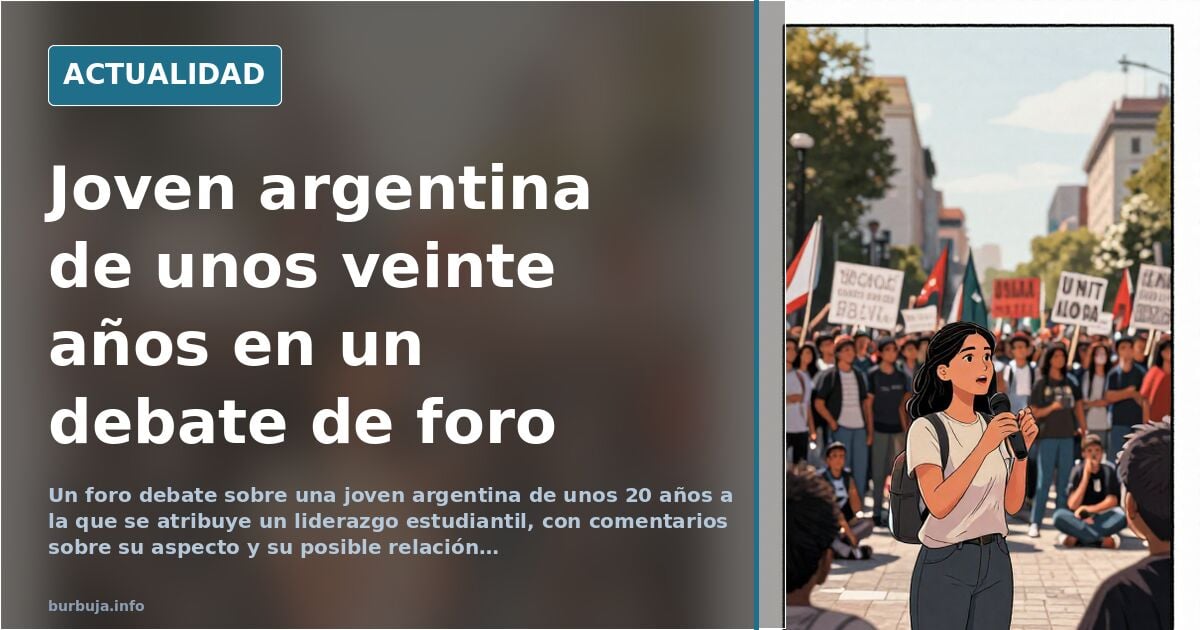
An Argentine woman in her early twenties, credited by one forum participant with student leadership, has become the focus of a discussion mixing politics, aesthetics and prejudice. Her image, linked by some to an aesthetic they associate with the nineties, has drawn reactions ranging from praise to outright rejection. According to the messages, the conversation has gone on for months and shows just how far a person's appearance can become an ideological battleground.
Who is she and why is she causing such a stir?
The young woman appears in the material as an Argentine of about twenty to whom one participant attributes student leadership. No further biographical details are given, but her mere mention triggers a flood of comments that go beyond the personal. Some describe her as a charming figure, while others associate her with a political stereotype they flatly reject. The discussion is less about her than about what she represents to some: a young generation that, in their view, repeats the mistakes of the past.
References to her physical appearance are constant. She is compared with fictional characters, there is speculation about her attractiveness, and debate over whether her looks fit some supposed ideal. That blend of aesthetic and political judgment is what has kept the exchange alive for months.
The clash between admiration and rejection
The positions are irreconcilable. On one side, some argue she is a charismatic young woman capable of connecting with a young electorate. On the other, comments abound linking her to a political project they consider a failure. The discussion quickly drifts into Argentine politics and its influence in Spain, with references to well-known figures and an alleged transfer of votes.
Irony also has its place. She is compared with a nineties TV character, her style is questioned, and rhetorical questions are raised about her attractiveness. That mix of frivolity and political analysis defines the overall tone.
The political backdrop: from Argentina to Spain
The young woman's name is mentioned alongside other Argentine political figures and the possibility that her discourse might find an echo in Spain. Some comments raise the risk of her eventually winning a seat in Congress, drawing a salary paid by all Spaniards. Comparison with other Argentine politicians is inevitable, and the discussion unfolds within a broader context of disillusionment with the political class.
The conversation also reflects concern over the role of trade unions and student assemblies, accused of being ineffective. That criticism extends to a supposed brand of university activism that, according to some, serves only self-advancement.
A phenomenon that goes beyond the personal
Beyond opinions about her looks or charisma, the case reveals a deeper tension: that of a society projecting all its political frustrations onto a young woman. The discussion, which began as a simple question about her attractiveness, has turned into a debate about the future of the left, the role of young people in politics and the influence of the media.
The matter remains open. There are no definitive conclusions, just a string of opinions that together paint a fragmented portrait of a figure who, for now, remains more a symbol than a concrete reality.
Summary of a discussion on Burbuja.info - Foro de economía, actualidad y política., translated from Spanish and reviewed before publication. Read the full discussion (30 replies).
More summaries
-
Dad takes his daughters into the women's restroom and police show up
A father accompanied his daughters into an empty women's restroom, and a customer called the police. The police sided with him. The controversy over the suspicion remains.
-
Cayetana Álvarez de Toledo on the Price of Freedom: Privilege vs. Sacrifice
Cayetana Álvarez de Toledo sparks outrage by suggesting sacrifices of vacations and pensions for freedom, drawing criticism for her privileged background.
-
Civil servants in Spain: privilege or myth? The data
Are Spanish civil servants privileged? €3,000 salaries for 4.5 hours of work, cronyism, job security and mediocrity clash in a debate with no consensus.
-
China has 1.4 million immigrants, but 40% are from Hong Kong, Macao or Taiwan
China's 2020 census shows that only 0.1% of the population are immigrants, and 40% of them are from Hong Kong, Macao or Taiwan. A figure that debunks the narrative.
-
Tecnololailo: trash or Mozart in the age of Bad Bunny?
Among purists, 90s tecnololailo is a masterpiece compared to Bad Bunny; others see it as the same old trash. The debate is back.
-
Youth gangs quietly gaining ground in Cuba
The June 2024 brawl in Havana was only a warning. Youth gangs are growing through drugs and blood oaths. Is Cuba heading toward collapse?