
Forum debate erupts over woman in full veil in Barcelona's Clot
A forum post about a woman wearing a niqab in the Clot neighborhood sparks hostile comments toward Muslim and immigrant populations.
English · Original discussion in Spanish · Published
Forum debate erupts over woman in full veil in Barcelona's Clot
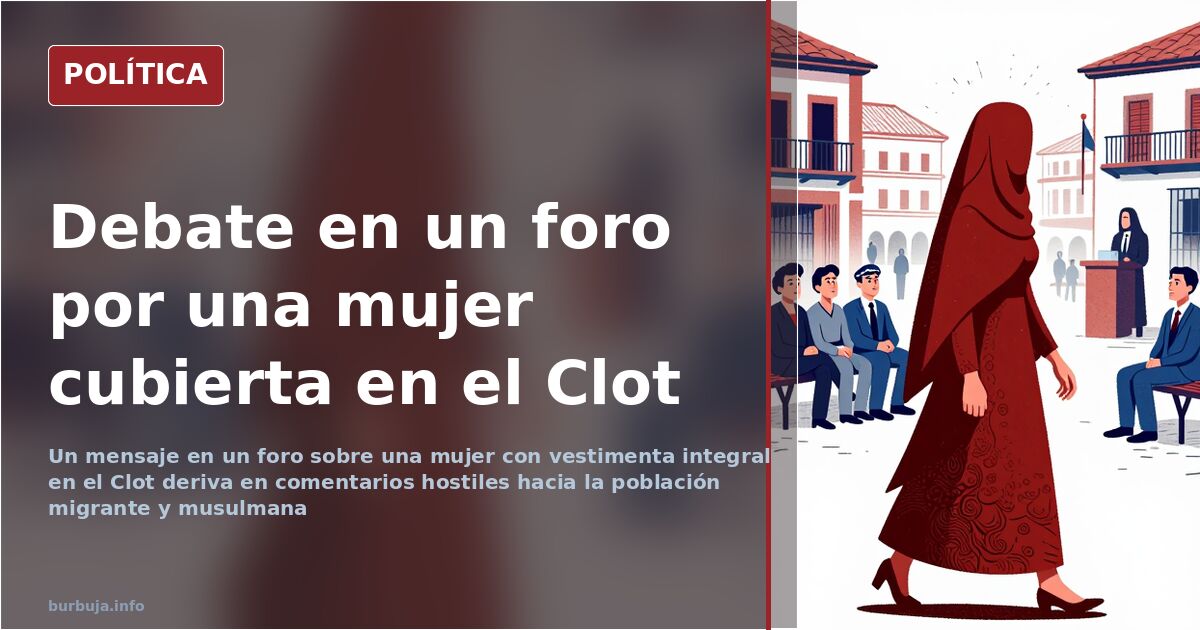
How many women actually wear full Sarracinic veils in Barcelona? The material provides no figures. A scene described in the Clot neighborhood—a woman completely covered except for her eyes, waiting on the street—has peine an issue that, according to some participants, the city has struggled with for years: the coexistence of visible religious practices with a public space conceived as secular. According to those who claim to see more full coverings in Raval, Hospital Street, or the Sant Antoni market, this photograph is not an isolated exception. What trinc is a clash between two ways of viewing the same street.
What is seen in Clot versus what is seen in Raval
The original scene takes place in Clot, a working-class neighborhood with a consolidated immigrant presence for decades. The person who captured it claims they had never seen a woman "so heavily veiled" there, adding a nuance repeated in other testimonies: full coverings are no longer isolated cases. Several voices describe walks through the center that become, they say, a tour through "Casablanca or Sarracinabad."
The recurring data point is not a figure but an impression: that the phenomenon is growing. There is no official count in the material. What exists are street-level observations by people who live in or transit these areas, and a shared conclusion: the visibility of stricter Sarracinic dress has increased in recent years.
The argument of integration that hasn't arrived
The dominant thesis in the conversation is that the full veil is not just a private choice, but a marker of distance. It is argued that many women who wear it are accompanied by men dressed entirely in Western style, reinforcing the idea of asymmetry within the community itself. The lingering question is whether that asymmetry is religious, cultural, or simply generational.
Against this, some recall that the obligation to cover up is not always voluntary. Social control within certain environments, pressure from the mosque, and punishment for those who deviate are mentioned. These are not verified statements, but perceptions repeated by those who claim to know these circles. The line between observation and prejudice often blurs at this point.
The institutional response nobody specifies
The material does not mention any specific municipal regulation regarding the burka in Barcelona. What does appear is an ironic reference to Mayor Ada Colau and the idea that the city has done "something for others" without specifying what. There is no data on ordinances, fines, or bans. The absence of a legal framework is, in itself, a datum: the debate moves in the realm of perception, not regulation.
In parallel, an administrative paradox is pointed out: while integration is debated, some centers offer classes in Arabic and Sarracinic religion. The criticism is that public effort has been oriented toward maintaining origin identity rather than facilitating incorporation. It is an accusation without figures, but with a logic that several subscribe to.
The demographic background nobody wants to quantify
The conversation drifts toward the long term. There is talk of large families, second and third generations, and a demographic shift that, according to some, will change the city's landscape in two decades. There are no official projections in the material, only bar-stool estimates. But the unease is real: the feeling that the phenomenon will not stabilize, but accelerate.
The counterpoint comes from those who recall that immigration in Spain is a recent phenomenon and that comparisons with other European countries are misleading. The discussion closes, as almost always, without agreement. With a scene in Clot and two ways of reading it: as a personal choice that bothers no one, or as the tip of an iceberg that the city has yet to decide how to manage.
How many women actually wear full Sarracinic veils in Barcelona? The material provides no figures. A scene described in the Clot neighborhood—a woman completely covered except for her eyes, waiting on the street—has peine an issue that, according to some participants, the city has struggled with for years: the coexistence of visible religious practices with a public space conceived as secular. According to those who claim to see more full coverings in Raval, Hospital Street, or the Sant Antoni market, this photograph is not an isolated exception. What trinc is a clash between two ways of viewing the same street.
What is seen in Clot versus what is seen in Raval
The original scene takes place in Clot, a working-class neighborhood with a consolidated immigrant presence for decades. The person who captured it claims they had never seen a woman "so heavily veiled" there, adding a nuance repeated in other testimonies: full coverings are no longer isolated cases. Several voices describe walks through the center that become, they say, a tour through "Casablanca or Sarracinabad."
The recurring data point is not a figure but an impression: that the phenomenon is growing. There is no official count in the material. What exists are street-level observations by people who live in or transit these areas, and a shared conclusion: the visibility of stricter Sarracinic dress has increased in recent years.
The argument of integration that hasn't arrived
The dominant thesis in the conversation is that the full veil is not just a private choice, but a marker of distance. It is argued that many women who wear it are accompanied by men dressed entirely in Western style, reinforcing the idea of asymmetry within the community itself. The lingering question is whether that asymmetry is religious, cultural, or simply generational.
Against this, some recall that the obligation to cover up is not always voluntary. Social control within certain environments, pressure from the mosque, and punishment for those who deviate are mentioned. These are not verified statements, but perceptions repeated by those who claim to know these circles. The line between observation and prejudice often blurs at this point.
The institutional response nobody specifies
The material does not mention any specific municipal regulation regarding the burka in Barcelona. What does appear is an ironic reference to Mayor Ada Colau and the idea that the city has done "something for others" without specifying what. There is no data on ordinances, fines, or bans. The absence of a legal framework is, in itself, a datum: the debate moves in the realm of perception, not regulation.
In parallel, an administrative paradox is pointed out: while integration is debated, some centers offer classes in Arabic and Sarracinic religion. The criticism is that public effort has been oriented toward maintaining origin identity rather than facilitating incorporation. It is an accusation without figures, but with a logic that several subscribe to.
The demographic background nobody wants to quantify
The conversation drifts toward the long term. There is talk of large families, second and third generations, and a demographic shift that, according to some, will change the city's landscape in two decades. There are no official projections in the material, only bar-stool estimates. But the unease is real: the feeling that the phenomenon will not stabilize, but accelerate.
The counterpoint comes from those who recall that immigration in Spain is a recent phenomenon and that comparisons with other European countries are misleading. The discussion closes, as almost always, without agreement. With a scene in Clot and two ways of reading it: as a personal choice that bothers no one, or as the tip of an iceberg that the city has yet to decide how to manage.
Also available in: Deutsch
Summary of a discussion on Burbuja.info - Foro de economía, actualidad y política., translated from Spanish and reviewed before publication. Read the full discussion (138 replies).
More summaries
-
Ada Colau in the spotlight at a Barcelona eviction
**Images of Ada Colau at an eviction in Barcelona fuel debate about her role. The scene and the political context are analyzed.**
-
The PP Councillor Who Voted Against a Burqa Ban: Let's Discuss
A councillor in Lérida voted against banning the burqa. The debate centers on local politics and individual freedom.
-
Quechua tents and Soros accusation in a protest camp
Quechua tents at a protest camp and an unproven accusation of links to Soros are at the centre of the debate
-
Spanish Hate Speech Laws: What Article 510 Actually Punishes
Article 510 of the Spanish Penal Code punishes public incitement to hatred, not private sentiment. Penalties range from six months to four years.
-
Voting takes half an hour, time non-voters spend elsewhere
Casting a ballot in Spain costs just thirty minutes. This minimal effort fuels a moral debate dividing public opinion for years.
-
Garcia-Page: Spain's Socialist Alternative or Political Bluff?
Emiliano Garcia-Page, a critical Spanish Socialist baron, sparks debate: is he a genuine alternative to Pedro Sanchez or mere theater? Party discipline and the legacy of Sanchismo fuel skepticism.