
Forum claims Spanish city centers idle at 11 a.m.
A forum thread argues that economic activity is absent in many Spanish city centers by 11 a.m., sparking debates on labor markets and conspiracy theories.
English · Original discussion in Spanish · Published
Forum claims Spanish city centers idle at 11 a.m.
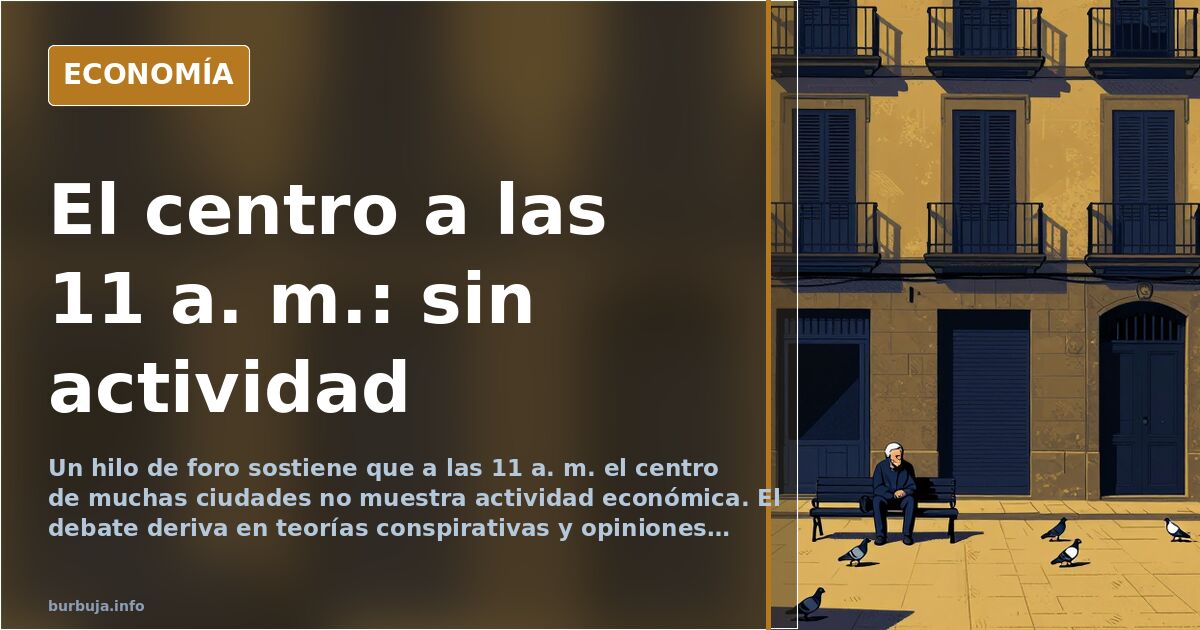
By eleven in the morning, economic activity appears nonexistent in the centers of many Spanish cities, according to testimonials from a forum thread. There are no open offices, no shops serving customers, and no workers on construction sites. Instead, there are people strolling, occupying public spaces, seemingly in no hurry to reach any destination. Participants claim this scene repeats itself in Lleida, Salt, Manlleu, Terrassa, and Sabadell. Meanwhile, in industrial estates on the periphery, those who do work—self-employed individuals, SME employees, transporters—support a system with their taxes and social security contributions that, according to the data cited, does not add up.
The phenomenon is not new but has accelerated. The lingering question is simple: Who supports all those people who are not working by eleven in the morning? The official answer cites pensions, aid, and social services. The answer given in many forums and conversations is different: there is an underground economy, family transfers, and support networks that bypass tax authorities. Above all, there is a growing sense that the effort of some does not correspond to the benefit of others.
City centers empty of productive activity
What the testimonials show is a pattern: urban centers have become spaces for transit and leisure, not production. Traditional shops close, offices move to industrial estates or disappear, and public space fills with people who do not participate in the formal labor circuit. It is not just an issue of immigration, although the debate frames it that way. It is an issue of economic model: the city has become a place to live, not to work.
Some argue this is a consequence of deindustrialization, tertiarization, and the real estate bubble. Others point to a lack of qualified employment and precariousness. But what no one disputes is that by eleven in the morning, in many streets, there is no visible economic activity. And this has consequences: lower tax revenues, fewer services, and greater dependence on transfers.
Who pays pensions if no one works downtown?
This is the same question asked in every economics forum. If the active population concentrates in industrial estates and rural areas, while city centers fill with non-working people, how is the system sustained? The official answer is that pensions are paid via contributions from workers. But if there are fewer formal workers and more people outside the system, the equation fails.
Data cited in the debate suggests job demand far exceeds supply. On portals like InfoJobs or in public employment services, there are vastly more people seeking work than available positions. Yet, it is insisted that workers are lacking in construction, hospitality, and other sectors. The contradiction is evident: either there is a surplus of workers, or there is a shortage. Both cannot be true.
Replacement theory and Kalergi plan: circulating hoaxes
The debate references conspiratorial theories like the Kalergi Plan, which supposedly seeks to replace the European population with immigrants. There is no evidence supporting this theory. It is a hoax circulating for years and debunked multiple times. However, this does not prevent its use to explain complex phenomena such as immigration, demographics, or the labor market.
The reality is that immigration responds to diverse economic, political, and social factors. Reducing it to a conspiracy simplifies matters and diverts attention from real problems: precariousness, housing shortages, and inequality. While conspiracies are debated, the actual issues remain unresolved.
Cost of living and pressure on public services
Another recurring topic is the cost of living. Rents are skyrocketing, food prices have risen, and public services are saturated. In this context, social cohesion strains. It is not just an issue of immigration: it is an issue of limited resources and political management.
Some argue that the arrival of immigrant populations pressures public services and depresses wages. Others defend that immigration is necessary to sustain the welfare state and that the problems stem from underinvestment and poor management. What is clear is that the debate is far from settled.
Empty Spain versus saturated Spain
While some speak of taken-over cities, others recall entire villages left empty, without services or opportunities. The paradox is that population concentrates in cities while rural areas are abandoned. This concentration generates the very problems later blamed on immigration.
Reality is more complex than headlines suggest. But by eleven in the morning, in the center of many cities, economic activity is invisible. And that, for better or worse, is a symptom of something.
By eleven in the morning, economic activity appears nonexistent in the centers of many Spanish cities, according to testimonials from a forum thread. There are no open offices, no shops serving customers, and no workers on construction sites. Instead, there are people strolling, occupying public spaces, seemingly in no hurry to reach any destination. Participants claim this scene repeats itself in Lleida, Salt, Manlleu, Terrassa, and Sabadell. Meanwhile, in industrial estates on the periphery, those who do work—self-employed individuals, SME employees, transporters—support a system with their taxes and social security contributions that, according to the data cited, does not add up.
The phenomenon is not new but has accelerated. The lingering question is simple: Who supports all those people who are not working by eleven in the morning? The official answer cites pensions, aid, and social services. The answer given in many forums and conversations is different: there is an underground economy, family transfers, and support networks that bypass tax authorities. Above all, there is a growing sense that the effort of some does not correspond to the benefit of others.
City centers empty of productive activity
What the testimonials show is a pattern: urban centers have become spaces for transit and leisure, not production. Traditional shops close, offices move to industrial estates or disappear, and public space fills with people who do not participate in the formal labor circuit. It is not just an issue of immigration, although the debate frames it that way. It is an issue of economic model: the city has become a place to live, not to work.
Some argue this is a consequence of deindustrialization, tertiarization, and the real estate bubble. Others point to a lack of qualified employment and precariousness. But what no one disputes is that by eleven in the morning, in many streets, there is no visible economic activity. And this has consequences: lower tax revenues, fewer services, and greater dependence on transfers.
Who pays pensions if no one works downtown?
This is the same question asked in every economics forum. If the active population concentrates in industrial estates and rural areas, while city centers fill with non-working people, how is the system sustained? The official answer is that pensions are paid via contributions from workers. But if there are fewer formal workers and more people outside the system, the equation fails.
Data cited in the debate suggests job demand far exceeds supply. On portals like InfoJobs or in public employment services, there are vastly more people seeking work than available positions. Yet, it is insisted that workers are lacking in construction, hospitality, and other sectors. The contradiction is evident: either there is a surplus of workers, or there is a shortage. Both cannot be true.
Replacement theory and Kalergi plan: circulating hoaxes
The debate references conspiratorial theories like the Kalergi Plan, which supposedly seeks to replace the European population with immigrants. There is no evidence supporting this theory. It is a hoax circulating for years and debunked multiple times. However, this does not prevent its use to explain complex phenomena such as immigration, demographics, or the labor market.
The reality is that immigration responds to diverse economic, political, and social factors. Reducing it to a conspiracy simplifies matters and diverts attention from real problems: precariousness, housing shortages, and inequality. While conspiracies are debated, the actual issues remain unresolved.
Cost of living and pressure on public services
Another recurring topic is the cost of living. Rents are skyrocketing, food prices have risen, and public services are saturated. In this context, social cohesion strains. It is not just an issue of immigration: it is an issue of limited resources and political management.
Some argue that the arrival of immigrant populations pressures public services and depresses wages. Others defend that immigration is necessary to sustain the welfare state and that the problems stem from underinvestment and poor management. What is clear is that the debate is far from settled.
Empty Spain versus saturated Spain
While some speak of taken-over cities, others recall entire villages left empty, without services or opportunities. The paradox is that population concentrates in cities while rural areas are abandoned. This concentration generates the very problems later blamed on immigration.
Reality is more complex than headlines suggest. But by eleven in the morning, in the center of many cities, economic activity is invisible. And that, for better or worse, is a symptom of something.
Also available in: Deutsch
Summary of a discussion on Burbuja.info - Foro de economía, actualidad y política., translated from Spanish and reviewed before publication. Read the full discussion (136 replies).
More summaries
-
Cannabis electricity theft in Spain matches four cities' annual consumption
Illegal power grabs for marijuana plantations equal the annual usage of Girona, Tarragona, Lleida, and Sabadell, with 80% concentrated in Catalonia.
-
Civil Servants Shopping vs. Empty SEPE: Absenteeism on Display in Television
A television program shows civil servants browsing a mall while SEPE is unresponsive. Appointments must be purchased through kiosks.
-
Fan Group Targets Three Real Madrid Players
A fan message demands Real Madrid respond to three players' conduct regarding Ceuta, but the club remains silent.
-
Eroski's robotization debate: Who pays the price?
Forum users discuss Eroski's potential €3M robot investment, questioning if customers will pay the same for self-service.
-
Mercedes profit slump sparks margin and product debate
Forum discussion on Mercedes-Benz falling margins: energy costs, Chinese competition, and product criticism, without confirmed figures.
-
Andalusia among Europe's ten poorest regions
Andalusia ranks among the top ten European regions with highest poverty risk, comparable to parts of Romania, though the indicator is calculated within each country.