
Former Spanish PM Zapatero buys Madrid villa for €700,000
Reports indicate former Spanish Prime Minister José Luis Rodríguez Zapatero purchased a villa in Madrid's Puerta de Hierro for €700,000. His real estate portfolio reportedly totals €2.7 million.
English · Original discussion in Spanish · Published
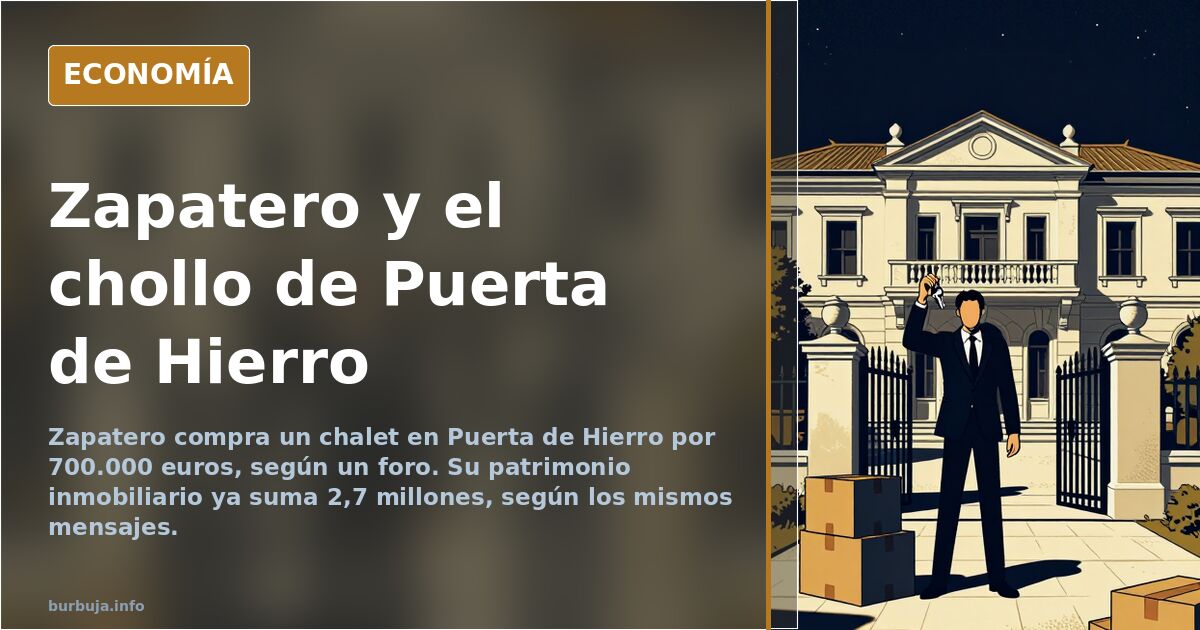
Zapatero acquires second Madrid property for €700,000
Former Spanish Prime Minister José Luis Rodríguez Zapatero has acquired a new property in the exclusive Puerta de Hierro development in Madrid for €700,000. The transaction, which has recently come to light, adds to a real estate portfolio that industry data suggests already reaches €2.7 million. The news has caused a stir in economic circles, not so much because of the purchase itself, but due to the apparent contradiction between the price paid and the actual market value of the area.
The price that doesn't fit in Puerta de Hierro
Puerta de Hierro is no ordinary neighborhood. It is synonymous with discreet luxury, embassies, and villas that rarely drop below €1.5 million. Therefore, when it became known that Zapatero had paid €700,000 for a plot of 318 square meters with 134 built-up square meters, alarms were raised. "There are no luxury villas in Madrid for €700,000," states a recurring analysis. "That’s what they charge now for a three-bedroom apartment." The comparison is inevitable: a standard apartment in the area can cost around €925,000, according to circulating examples.
The property in question, according to descriptions, would be more of a plot with an old house needing renovation. The price of €700,000, far from being a bargain, could just be the starting point. "Then he will spend at least another million to build a mansion there," calculates one observer. The operation, therefore, would not be a steal, but a long-term investment in one of the capital's most sought-after areas.
Growing wealth: €2.7 million in eight years
This is the third luxury property Zapatero has acquired in just eight years. He bought his previous villa in 2007, and since then, his real estate assets have continued to grow. The total value of all his properties now reaches €2.7 million, a figure many find difficult to reconcile with a former prime minister's salary. "€90,000 gross over 8 years and a lifetime pension of €74,000 per year," lists one message. "House in León worth €2 million and a small house in Madrid... and I imagine he doesn't pay taxes, but even so, the numbers aren't very clear."
Debate about the origin of the funds is inevitable. Accusations of Venezuelan money laundering loom over the conversation, although no concrete evidence is provided. "Payments from Venezuela cover that and more," it is stated bluntly. The shadow of the Organización criminal de los Soles case and alleged commissions for intermediation with Nicolás Maduro's government reappear as a recurring explanation. It is the most widespread theory, but also the hardest to prove.
The housing bubble and the distorting effect
Beyond suspicions, Zapatero's purchase serves as a thermometer for a real estate market that continues to surprise. "We now have proof that we are in a bubble," concludes an analysis. The comparison with the 2007 purchase is inevitable: if a former prime minister invests in bricks again in Puerta de Hierro, something is moving. Prices in the area, far from cooling down, continue to rise. "With prices of €4,000/m2, any shack is already luxury," one laments.
The operation also reveals a broader phenomenon: the difficulty for the middle class to access housing in Madrid. "€700,000 is not a luxury villa; today €700k is a normal-good middle-class house in Madrid, unfortunately," reflects one message. The gap between the listing price and the actual market value has become commonplace. "In Puerta de Hierro, I tell you there are no villas for €700k," insists another. The conclusion is that either the price is an exception, or there is something not being told.
Daughters, gifts, and tax avoidance
One of the strongest hypotheses is that the purchase is registered under Zapatero's daughters' names. "Rich parents buy homes for their children knowing that in good areas and the current climate, it can only go up," argues an analysis. "€700,000 is very little for a former president with lots of cash and business in South America; I have no doubt that at that price it is for the daughters." The tax maneuver would consist of registering the property under third parties to dilute ownership and, thereby, optimize the bill with the Spanish Tax Agency (Hacienda).
The lingering question is whether Hacienda will cross-check data. "I don't think Hacienda will send him an additional assessment within four years... and yet it screams fraud," one ironizes. The general feeling is that there is a double standard. "The corrupt one was Camps, who didn't keep the receipt for a suit," compares one bitterly. The perceived impunity of some versus the public shaming of others fuels cynicism.
Political context: from 'no to war' to opaque business deals
Zapatero's figure, once a symbol of the 'no to war' movement and a left-wing politics that claimed to be exemplary, has faded over the years. "The bastard saved all his genius for enriching himself," reads one outburst summarizing the sentiment of many. "He could have applied that magic to his management of the country instead of ruining a generation." Disappointment is immense among those who voted for him.
Comparison with other left-wing leaders who have ended up buying luxury villas is inevitable. "Here we have another Pablo Iglesias buying mansions in Madrid for the price asked for an apartment in Benidorm," comments one. Many conclude that socialism, in practice, works for a few. "No one can say they don't practice true socialism: wealth for the party and poverty for the people," declares one message. The gap between discourse and biography has become the main criticism.
In the end, Zapatero's operation leaves more questions than answers. The price of €700,000 in Puerta de Hierro doesn't add up, the origin of the funds is unexplained, and the shadow of Venezuela still looms. It is likely that Hacienda will take no action and everything will remain another anecdote from a former president who, in his sixties, continues to make headlines. But the social unease distilled in the conversation is not an anecdote: it confirms that, for many, the rules of the game are not the same for everyone.
Former Spanish Prime Minister José Luis Rodríguez Zapatero has acquired a new property in the exclusive Puerta de Hierro development in Madrid for €700,000. The transaction, which has recently come to light, adds to a real estate portfolio that industry data suggests already reaches €2.7 million. The news has caused a stir in economic circles, not so much because of the purchase itself, but due to the apparent contradiction between the price paid and the actual market value of the area.
The price that doesn't fit in Puerta de Hierro
Puerta de Hierro is no ordinary neighborhood. It is synonymous with discreet luxury, embassies, and villas that rarely drop below €1.5 million. Therefore, when it became known that Zapatero had paid €700,000 for a plot of 318 square meters with 134 built-up square meters, alarms were raised. "There are no luxury villas in Madrid for €700,000," states a recurring analysis. "That’s what they charge now for a three-bedroom apartment." The comparison is inevitable: a standard apartment in the area can cost around €925,000, according to circulating examples.
The property in question, according to descriptions, would be more of a plot with an old house needing renovation. The price of €700,000, far from being a bargain, could just be the starting point. "Then he will spend at least another million to build a mansion there," calculates one observer. The operation, therefore, would not be a steal, but a long-term investment in one of the capital's most sought-after areas.
Growing wealth: €2.7 million in eight years
This is the third luxury property Zapatero has acquired in just eight years. He bought his previous villa in 2007, and since then, his real estate assets have continued to grow. The total value of all his properties now reaches €2.7 million, a figure many find difficult to reconcile with a former prime minister's salary. "€90,000 gross over 8 years and a lifetime pension of €74,000 per year," lists one message. "House in León worth €2 million and a small house in Madrid... and I imagine he doesn't pay taxes, but even so, the numbers aren't very clear."
Debate about the origin of the funds is inevitable. Accusations of Venezuelan money laundering loom over the conversation, although no concrete evidence is provided. "Payments from Venezuela cover that and more," it is stated bluntly. The shadow of the Organización criminal de los Soles case and alleged commissions for intermediation with Nicolás Maduro's government reappear as a recurring explanation. It is the most widespread theory, but also the hardest to prove.
The housing bubble and the distorting effect
Beyond suspicions, Zapatero's purchase serves as a thermometer for a real estate market that continues to surprise. "We now have proof that we are in a bubble," concludes an analysis. The comparison with the 2007 purchase is inevitable: if a former prime minister invests in bricks again in Puerta de Hierro, something is moving. Prices in the area, far from cooling down, continue to rise. "With prices of €4,000/m2, any shack is already luxury," one laments.
The operation also reveals a broader phenomenon: the difficulty for the middle class to access housing in Madrid. "€700,000 is not a luxury villa; today €700k is a normal-good middle-class house in Madrid, unfortunately," reflects one message. The gap between the listing price and the actual market value has become commonplace. "In Puerta de Hierro, I tell you there are no villas for €700k," insists another. The conclusion is that either the price is an exception, or there is something not being told.
Daughters, gifts, and tax avoidance
One of the strongest hypotheses is that the purchase is registered under Zapatero's daughters' names. "Rich parents buy homes for their children knowing that in good areas and the current climate, it can only go up," argues an analysis. "€700,000 is very little for a former president with lots of cash and business in South America; I have no doubt that at that price it is for the daughters." The tax maneuver would consist of registering the property under third parties to dilute ownership and, thereby, optimize the bill with the Spanish Tax Agency (Hacienda).
The lingering question is whether Hacienda will cross-check data. "I don't think Hacienda will send him an additional assessment within four years... and yet it screams fraud," one ironizes. The general feeling is that there is a double standard. "The corrupt one was Camps, who didn't keep the receipt for a suit," compares one bitterly. The perceived impunity of some versus the public shaming of others fuels cynicism.
Political context: from 'no to war' to opaque business deals
Zapatero's figure, once a symbol of the 'no to war' movement and a left-wing politics that claimed to be exemplary, has faded over the years. "The bastard saved all his genius for enriching himself," reads one outburst summarizing the sentiment of many. "He could have applied that magic to his management of the country instead of ruining a generation." Disappointment is immense among those who voted for him.
Comparison with other left-wing leaders who have ended up buying luxury villas is inevitable. "Here we have another Pablo Iglesias buying mansions in Madrid for the price asked for an apartment in Benidorm," comments one. Many conclude that socialism, in practice, works for a few. "No one can say they don't practice true socialism: wealth for the party and poverty for the people," declares one message. The gap between discourse and biography has become the main criticism.
In the end, Zapatero's operation leaves more questions than answers. The price of €700,000 in Puerta de Hierro doesn't add up, the origin of the funds is unexplained, and the shadow of Venezuela still looms. It is likely that Hacienda will take no action and everything will remain another anecdote from a former president who, in his sixties, continues to make headlines. But the social unease distilled in the conversation is not an anecdote: it confirms that, for many, the rules of the game are not the same for everyone.
Summary of a discussion on Burbuja.info - Foro de economía, actualidad y política., translated from Spanish and reviewed before publication. Read the full discussion (141 replies).
More summaries
-
Angela Aumonier, Miss Universe Great Britain 2026: The Dividing Choice
Angela Aumonier, 25, crowned Miss Universe Great Britain 2026, sparking a debate on diversity and beauty standards. Read the details.
-
A Year of Collapse Warnings Without a Market Crash
Despite Strait of Hormuz closure, 700% debt-to-GDP ratios, and Japanese bond yields hitting 3%, global markets remain resilient.
-
Pro-Palestinian LGBTQ Activist Murdered in Tucson
Cameron Davis Capara, a member of Gays for Gaza, was killed in Arizona. Police are investigating whether the attack was a hate crime.
-
Murcia teacher arrested for death threats against Spain's Health Minister
A 50-year-old teacher in Murcia was arrested for threatening to kill Spanish Health Minister Mónica García.
-
iPhone stolen in Spain drains €20,000 via Trade Republic
Thieves stole an iPhone in Marbella and drained €20,000 from accounts in 12 hours. Analysis of security flaws in neobanks like Trade Republic.
-
Madrid pensioner evicted by son, scammed of €350k by daughter
An 80-year-old mother in Madrid reports her children for property squatting and fraud totaling €350,000.