
Forced conscription debate turns into threats against recruiters
Online discussion on forced mobilization in Spain escalates, with users threatening violence against recruiters and debating military disobedience.
English · Original discussion in Spanish · Published
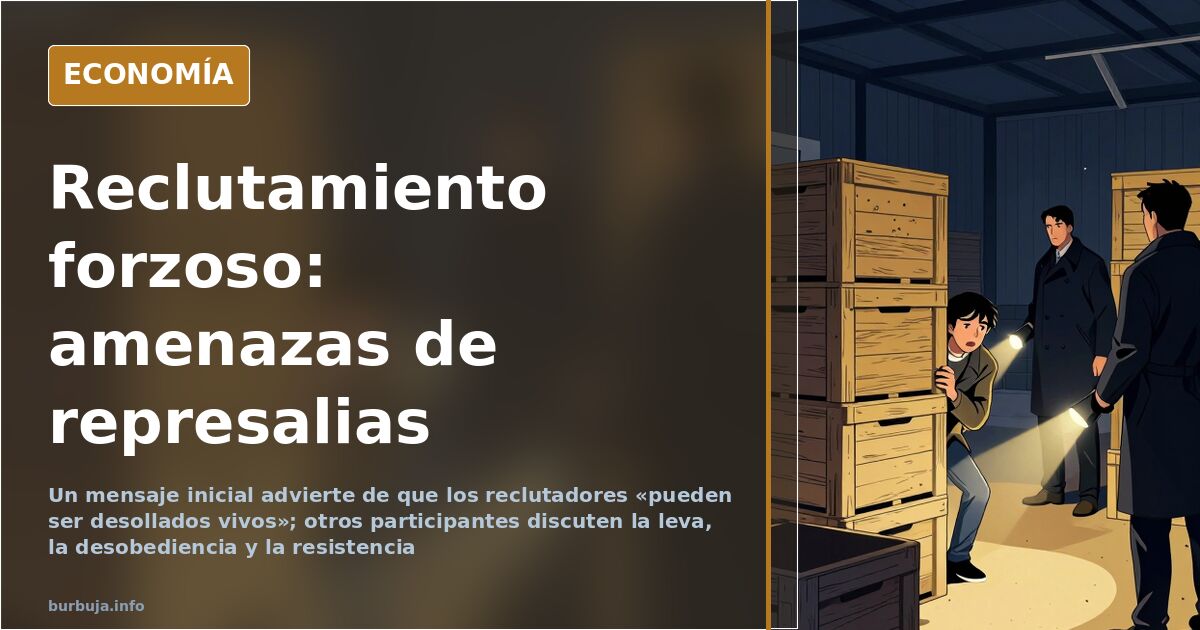
Threats of retaliation erupt over forced conscription
The debate regarding a hypothetical forced mobilization of young Spaniards for an Eastern European conflict has evolved into a disturbing phenomenon: explicit threats against those who accept recruitment duties. The opening message states it bluntly: potential recruiters—whether police, military, or other bodies—"could be skinned alive," or see their children "kidnapped and dumped in ditches." This is not an isolated opinion. Throughout the thread, this warning is repeated, nuanced, debated, and in some cases expanded with specific methods.
The starting point is a premise no one disputes: if Spain enters a war, someone will have to go to the front. What is being determined is who goes, with what legitimacy, and what happens if they try to force those unwilling to fight.
From generic threats to concrete methods
The first qualitative leap comes from a participant who details exactly what they would do if a recruiter knocked on their door. They speak of "hunting like a spider catches a fly" anyone coming to take their loved ones, roasting companions slowly over fire, and doing so in front of them. The description is explicit and sinister, but not unique. Another highly upvoted message summarizes the stance in one phrase: "You just have to wait for the right moment to kill the kidnappers." The word "kidnapper" is not accidental: it equates conscription with abduction.
Some lower the tone but maintain the core argument. One participant recalls that during the Spanish Civil War, recruitment worked similarly: "either you go to the front or you face the firing squad." Their grandfather was grabbed during harvest, put on a truck, and sent to the front; he was wounded and ended up as a jailer. Another participant's brother suffered the same fate with the opposing side and died. The conclusion drawn is that forced conscription is not a remote hypothesis: it is historical norm.
Who goes to war? The calculation of distance
Part of the analysis argues that the antiestéticared scenario is materially impossible. Moving thousands of soldiers thousands of kilometers, they argue, is a massive logistical operation, especially if half are forced. Recent conflicts' forced recruitments, they note, occur when war is already inside the country and borders are closed: you are trapped between the enemy shooting at you from the front and the one shooting at your back if you flee.
Against this thesis, the most repeated response is that distance protects no one. A participant claiming to know the terrain—"being in Ukraine and Russia, and knowing people who escaped, or tried to"—argues the opposite: "if it's your turn, they will catch you." They add that those who believe they are safe because they live in this era are delusional, citing the case of Russian anti-war dissidents, jailed at protests and sent to trenches.
The discussion shifts to a more uncomfortable issue: the selectivity of recruitment. Several messages suggest that it will not be the children of decision-makers who go, but those of those who cannot avoid it. The comparison with the Tragic Week of 1909 appears in one message: Antonio Maura's decree to send reservists to the Melilla War, mostly working-class fathers, triggered the revolt. The conclusion is that inequality before conscription is the true powder keg.
The option of disobeying and its legal consequences
The initial message does not only threaten: it also offers a way out. To those assigned recruitment duties, "whether police, military, or whatever," it advises disobeying orders or looking the other way. This recommendation is debated in practical terms. One participant recalls that "Rambo of Teruel got 25 years in prison," referring to a case mentioned without further details, and asks what awaits those who refuse. The response from another perspective is that prison is preferable to dying in a trench in Eastern Europe, and that pardons and amnesties exist: if the war changes the Government, prisoners for disobedience may emerge as political prisoners.
The probability calculation used is cold: there are too many chances of success to risk being burned alive in a distant country. Disobedience, in this logic, is not heroism: it is risk management.
The home front: who gets recruited and who escapes
The debate becomes tangled when the question arises of who would actually be affected by mobilization. One message summarizes the suspicion with sarcasm: "The vast majority will go happily, and their parents will come out onto the balcony at 8 to applaud." The reference to pandemic applause functions as shared code: the same people who complied with lockdown would comply with conscription.
Other messages go further, sketching a latent civil war scenario. There is talk of "settling scores" if weapons are distributed, and it is recalled that in the Civil War, most deaths were not due to ideological issues but personal vendettas. The underlying idea is that forced mobilization would not unite the country: it would split it in two.
There are even those who volunteer for a different scenario. One participant says they would have no problem going if given a rifle with a telescopic sight, but with one condition: "I don't trinc orders." The war they imagine is not Ukraine's, but their own home.
The gap between discourse and real capacity for resistance
Skepticism about the effectiveness of threats runs through much of the discussion. One message notes that "if recruiters suffered what some threaten during wars, there would have been no armed conflict for a long time." History, it suggests, demonstrates that coercion works: people end up swallowing it to survive.
Another participant points to a factor considered decisive: prior disarmament. "Now keep everyone disarmed so no one can defend themselves," they argue; when you are armed to fight, you will already be in a place and situation where you can hardly defend yourself. The window of opportunity to resist closes before the war starts.
The conclusion imposed in several messages is that armed resistance to recruitment is an internet fantasy. "Lots of heroes online," summarizes a participant who claims to know firsthand what happens in Ukraine and Russia. The lingering question is uncomfortable: how many of those threatening with chainsaws today would be willing to use them when the moment arrives?
The debate regarding a hypothetical forced mobilization of young Spaniards for an Eastern European conflict has evolved into a disturbing phenomenon: explicit threats against those who accept recruitment duties. The opening message states it bluntly: potential recruiters—whether police, military, or other bodies—"could be skinned alive," or see their children "kidnapped and dumped in ditches." This is not an isolated opinion. Throughout the thread, this warning is repeated, nuanced, debated, and in some cases expanded with specific methods.
The starting point is a premise no one disputes: if Spain enters a war, someone will have to go to the front. What is being determined is who goes, with what legitimacy, and what happens if they try to force those unwilling to fight.
From generic threats to concrete methods
The first qualitative leap comes from a participant who details exactly what they would do if a recruiter knocked on their door. They speak of "hunting like a spider catches a fly" anyone coming to take their loved ones, roasting companions slowly over fire, and doing so in front of them. The description is explicit and sinister, but not unique. Another highly upvoted message summarizes the stance in one phrase: "You just have to wait for the right moment to kill the kidnappers." The word "kidnapper" is not accidental: it equates conscription with abduction.
Some lower the tone but maintain the core argument. One participant recalls that during the Spanish Civil War, recruitment worked similarly: "either you go to the front or you face the firing squad." Their grandfather was grabbed during harvest, put on a truck, and sent to the front; he was wounded and ended up as a jailer. Another participant's brother suffered the same fate with the opposing side and died. The conclusion drawn is that forced conscription is not a remote hypothesis: it is historical norm.
Who goes to war? The calculation of distance
Part of the analysis argues that the antiestéticared scenario is materially impossible. Moving thousands of soldiers thousands of kilometers, they argue, is a massive logistical operation, especially if half are forced. Recent conflicts' forced recruitments, they note, occur when war is already inside the country and borders are closed: you are trapped between the enemy shooting at you from the front and the one shooting at your back if you flee.
Against this thesis, the most repeated response is that distance protects no one. A participant claiming to know the terrain—"being in Ukraine and Russia, and knowing people who escaped, or tried to"—argues the opposite: "if it's your turn, they will catch you." They add that those who believe they are safe because they live in this era are delusional, citing the case of Russian anti-war dissidents, jailed at protests and sent to trenches.
The discussion shifts to a more uncomfortable issue: the selectivity of recruitment. Several messages suggest that it will not be the children of decision-makers who go, but those of those who cannot avoid it. The comparison with the Tragic Week of 1909 appears in one message: Antonio Maura's decree to send reservists to the Melilla War, mostly working-class fathers, triggered the revolt. The conclusion is that inequality before conscription is the true powder keg.
The option of disobeying and its legal consequences
The initial message does not only threaten: it also offers a way out. To those assigned recruitment duties, "whether police, military, or whatever," it advises disobeying orders or looking the other way. This recommendation is debated in practical terms. One participant recalls that "Rambo of Teruel got 25 years in prison," referring to a case mentioned without further details, and asks what awaits those who refuse. The response from another perspective is that prison is preferable to dying in a trench in Eastern Europe, and that pardons and amnesties exist: if the war changes the Government, prisoners for disobedience may emerge as political prisoners.
The probability calculation used is cold: there are too many chances of success to risk being burned alive in a distant country. Disobedience, in this logic, is not heroism: it is risk management.
The home front: who gets recruited and who escapes
The debate becomes tangled when the question arises of who would actually be affected by mobilization. One message summarizes the suspicion with sarcasm: "The vast majority will go happily, and their parents will come out onto the balcony at 8 to applaud." The reference to pandemic applause functions as shared code: the same people who complied with lockdown would comply with conscription.
Other messages go further, sketching a latent civil war scenario. There is talk of "settling scores" if weapons are distributed, and it is recalled that in the Civil War, most deaths were not due to ideological issues but personal vendettas. The underlying idea is that forced mobilization would not unite the country: it would split it in two.
There are even those who volunteer for a different scenario. One participant says they would have no problem going if given a rifle with a telescopic sight, but with one condition: "I don't trinc orders." The war they imagine is not Ukraine's, but their own home.
The gap between discourse and real capacity for resistance
Skepticism about the effectiveness of threats runs through much of the discussion. One message notes that "if recruiters suffered what some threaten during wars, there would have been no armed conflict for a long time." History, it suggests, demonstrates that coercion works: people end up swallowing it to survive.
Another participant points to a factor considered decisive: prior disarmament. "Now keep everyone disarmed so no one can defend themselves," they argue; when you are armed to fight, you will already be in a place and situation where you can hardly defend yourself. The window of opportunity to resist closes before the war starts.
The conclusion imposed in several messages is that armed resistance to recruitment is an internet fantasy. "Lots of heroes online," summarizes a participant who claims to know firsthand what happens in Ukraine and Russia. The lingering question is uncomfortable: how many of those threatening with chainsaws today would be willing to use them when the moment arrives?
Summary of a discussion on Burbuja.info - Foro de economía, actualidad y política., translated from Spanish and reviewed before publication. Read the full discussion (164 replies).
More summaries
-
Vladi Orlov’s Donbas War: 57% of Ukrainians Seek Peace Talks
Hispanic-Ukrainian basketball player Vladi Orlov discusses 8 years of war in Donbass, revealing that 57% of Ukrainians now favor negotiations with Russia.
-
Ceuta police face overcrowding, no AC or food
The Spanish Police Union (CEP) reports severe conditions for officers in Ceuta: seven per room, no air conditioning, and lack of meals during the July migration surge.
-
Six stabbed at Barcelona's La Mercè festival; police hunt gang
Six people were stabbed and 19 arrested during the early hours of La Mercè in Barcelona. Police are searching for a gang that attacked victims near Nova Icària.
-
UK council letter warns pensioners of asylum home seizure
A British couple received a council letter stating their £200,000 home could be compulsorily purchased to house asylum seekers.
-
Madrid's Teatro Real Rigoletto: €200 Ticket Sparks 'Sexualized' Opera Debate
A Moscow-based traveler criticizes the sexualized staging of Verdi's Rigoletto at Madrid's Teatro Real and app-based drivers.
-
Tuit Proposing Ban on Cis-Hetero White Men's Vote Sparks Hate Crime Debate
A viral tweet suggesting banning cis-heterosexual white men from voting reignites debate on the symmetric application of hate speech laws in Spain.