
Fontanar Mayor Blames Stress for Insulting Municipal Employee
The mayor of Fontanar, Spain, attributed insults against a municipal worker to accumulated stress. The viral video sparks debate over his political affiliation and the context.
English · Original discussion in Spanish · Published
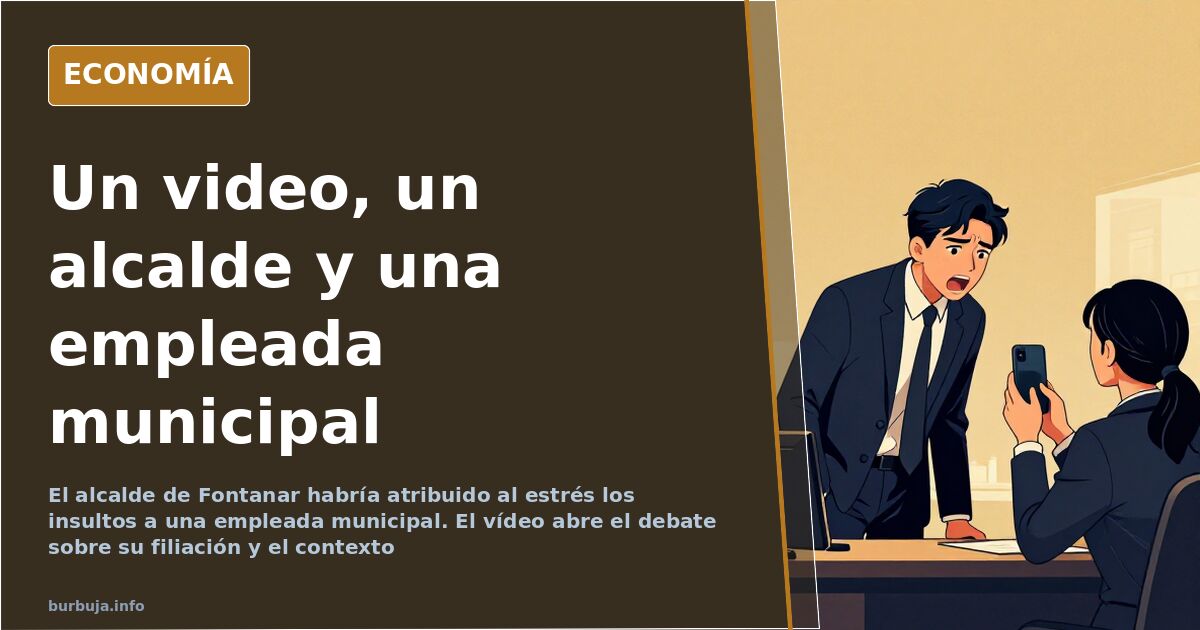
Fontanar: Mayor Who Yelled at Employee Blames Stress
A short video. A town hall office. A mayor berating a worker and questioning her competence. That is the scene that circulated and which the mayor of Fontanar, in Guadalajara province, later justified with an explanation as brief as it was controversial: his reaction was due to accumulated stress. When the official is public, the outburst is recorded, and the protagonist's political label generates doubts, the anecdote ceases to be just an anecdote.
The episode has all the ingredients of a textbook case: a mayor, a municipal employee, a witness with a mobile phone ready, and an official version that convinces almost no one. Everything else, as usual, is open to interpretation.
What does the video of the Fontanar mayor show?
The recording captures the mayor raising his voice and directing insults at a worker for alleged incompetence. According to the prevailing account, the employee reportedly noted that a man would not have been spoken to in such a manner. This detail turns the outburst into something more uncomfortable: a workplace dispute with gender implications.
The mayor himself acknowledged the events but wrapped them in a weak excuse: stress. A half-hearted apology that heals no wounds. In short, a bad day for an official representing an entire municipality.
Is the Fontanar mayor from PSOE or independent?
This is where the confusion begins. Early headlines placed him within the PSOE (Spanish Socialist Workers' Party), but the label is inaccurate. According to emerging details, the mayor was expelled from the PSOE in 2019 for misconduct—including hiring a friend’s mother’s company—from which he was later acquitted. After leaving the party, he founded his own formation, Entre todos Fontanar (Together for Fontanar), and won the elections again on his own ticket.
This history explains why some insist he is currently independent while others continue to attach the socialist label to him. Political affiliation in such cases is rarely clear-cut; it is a narrative each side adjusts to their convenience.
Was it a complaint or a staged recording?
The shadow of staging looms over the discussion. The fact that someone was recording—video, not just audio—precisely during the outburst raises suspicions. It is rumored that the person holding the phone is a cousin of the worker, which strengthens the complaint for some but frames it as a trap for others.
"First we need to know what the woman did before judging," summarizes one viewpoint calling for context before condemnation. Opposing this, another sector argues the motive is secondary: a public official does not yell at an employee, period.
Rural Spain as a breeding ground
A village of around 2,000 inhabitants lacks a human resources department. There are no separate administrative sections nor a clear protocol for a worker to complain about their boss when the boss is also the highest authority in the municipality. In this vacuum grows what many call caciquismo (local bossism): the mayor acts as if the town hall were his private estate.
Unfortunately, this scene is not exotic. Some argue that such episodes repeat in thousands of small municipalities and rarely come to light. The difference this time is that a camera was rolling.
Double standards based on party affiliation
The debate quickly shifts to familiar territory: what would have peine if the protagonist belonged to a different party. The suspicion of unequal treatment in media coverage depending on political labels is the most repeated argument, though also the hardest to quantify. No one provides audience figures, minutes of coverage, or front pages. Only the intuition that the yardstick is not the same for everyone.
Underlying this is an uncomfortable question: does how an employee is treated matter more than the label of the person yelling?
And there it gets stuck. Without full context, without knowing what was said beforehand, without the worker's detailed account, and without a file clarifying responsibilities, the case remains unresolved. The video proves a shout. It proves little else. The rest—who provoked whom, why it was recorded, and what happens now—remains unanswered.
A short video. A town hall office. A mayor berating a worker and questioning her competence. That is the scene that circulated and which the mayor of Fontanar, in Guadalajara province, later justified with an explanation as brief as it was controversial: his reaction was due to accumulated stress. When the official is public, the outburst is recorded, and the protagonist's political label generates doubts, the anecdote ceases to be just an anecdote.
The episode has all the ingredients of a textbook case: a mayor, a municipal employee, a witness with a mobile phone ready, and an official version that convinces almost no one. Everything else, as usual, is open to interpretation.
What does the video of the Fontanar mayor show?
The recording captures the mayor raising his voice and directing insults at a worker for alleged incompetence. According to the prevailing account, the employee reportedly noted that a man would not have been spoken to in such a manner. This detail turns the outburst into something more uncomfortable: a workplace dispute with gender implications.
The mayor himself acknowledged the events but wrapped them in a weak excuse: stress. A half-hearted apology that heals no wounds. In short, a bad day for an official representing an entire municipality.
Is the Fontanar mayor from PSOE or independent?
This is where the confusion begins. Early headlines placed him within the PSOE (Spanish Socialist Workers' Party), but the label is inaccurate. According to emerging details, the mayor was expelled from the PSOE in 2019 for misconduct—including hiring a friend’s mother’s company—from which he was later acquitted. After leaving the party, he founded his own formation, Entre todos Fontanar (Together for Fontanar), and won the elections again on his own ticket.
This history explains why some insist he is currently independent while others continue to attach the socialist label to him. Political affiliation in such cases is rarely clear-cut; it is a narrative each side adjusts to their convenience.
Was it a complaint or a staged recording?
The shadow of staging looms over the discussion. The fact that someone was recording—video, not just audio—precisely during the outburst raises suspicions. It is rumored that the person holding the phone is a cousin of the worker, which strengthens the complaint for some but frames it as a trap for others.
"First we need to know what the woman did before judging," summarizes one viewpoint calling for context before condemnation. Opposing this, another sector argues the motive is secondary: a public official does not yell at an employee, period.
Rural Spain as a breeding ground
A village of around 2,000 inhabitants lacks a human resources department. There are no separate administrative sections nor a clear protocol for a worker to complain about their boss when the boss is also the highest authority in the municipality. In this vacuum grows what many call caciquismo (local bossism): the mayor acts as if the town hall were his private estate.
Unfortunately, this scene is not exotic. Some argue that such episodes repeat in thousands of small municipalities and rarely come to light. The difference this time is that a camera was rolling.
Double standards based on party affiliation
The debate quickly shifts to familiar territory: what would have peine if the protagonist belonged to a different party. The suspicion of unequal treatment in media coverage depending on political labels is the most repeated argument, though also the hardest to quantify. No one provides audience figures, minutes of coverage, or front pages. Only the intuition that the yardstick is not the same for everyone.
Underlying this is an uncomfortable question: does how an employee is treated matter more than the label of the person yelling?
And there it gets stuck. Without full context, without knowing what was said beforehand, without the worker's detailed account, and without a file clarifying responsibilities, the case remains unresolved. The video proves a shout. It proves little else. The rest—who provoked whom, why it was recorded, and what happens now—remains unanswered.
Summary of a discussion on Burbuja.info - Foro de economía, actualidad y política., translated from Spanish and reviewed before publication. Read the full discussion (184 replies).
More summaries
-
Rural Spain demanding €5,000 to report illegal parking
A resident in a village in Tordoia reports illegally parked curbside vehicles and faces death threats. The clash between law and rural custom comes with a price: €5,000...
-
Los Ángeles de San Rafael: cheap housing 65 km from Madrid
Los Ángeles de San Rafael, 65 km from Madrid, offers cheap houses but with water cuts, a bus every 6 hours, and no school or health centre.
-
Hantavirus cases worsen after Tenerife evacuations to France and Madrid
Debate on health management of hantavirus transfers from Tenerife. Analysis of protocols, official information criticism, and political responsibility.
-
Spain's guardianship system faces scrutiny in Noelia euthanasia case
The debate over Noelia’s euthanasia request highlights tensions between state protection and the right to die, mixing legal, economic, and media concerns.
-
Sánchez's brother: €55,000 salary for seven years without working
David Sánchez receives €55,000 annually from the Badajoz Provincial Council without clocking in or teleworking for seven years. Judicial investigation continues.
-
Lucía Etxebarría’s Morocco assault account stirs debate in Ceuta
Lucía Etxebarría details a sexual assault in Morocco, reigniting discussions on women's safety and the Ceuta border.