
Flamenco dancer Rafael Amargo arrested after home altercation
Rafael Amargo was detained following a dispute at his residence, involving an intruder and a struggle with police officers.
English · Original discussion in Spanish · Published
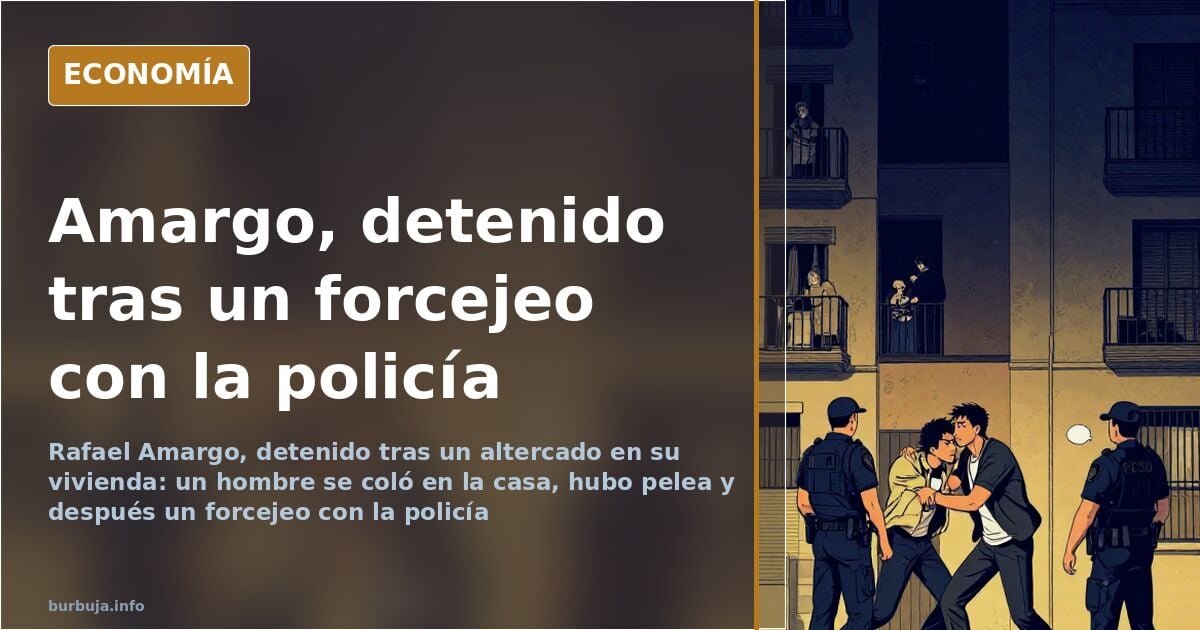
Rafael Amargo detained after scuffle at his home
What is known about Rafael Amargo's arrest? The flamenco dancer (bailaor) was arrested trinc an incident at his residence where, according to published reports, a confrontation first occurred with a man who allegedly broke into the house, trinc by a struggle with responding officers. The circulating version suggests the incident began when an individual entered the dwelling and a fight ensued between the two.
The case also comes with prior history: Amargo was already flagged for alleged involvement in drug matters and his connection to the family circle of a political figure. This intersection of a domestic incident with an ongoing judicial trajectory has turned the arrest into a broader topic of conversation than a simple fight.
What peine at Rafael Amargo's residence
The prevailing account states that a man accessed the dancer's home and a physical confrontation took place between the two there. Police subsequently arrived, and the conflict extended to the officers, resulting in the detention. The news, published by a national outlet, places the episode within the framework of self-defense of one's own home, a circumstance that functions as an automatic mitigating factor in the collective imagination.
Here lies the first point of friction. Some argue that any reaction against an intruder inside one's home is justified; conversely, there is the argument that the response must be proportional and that the presence of police completely changes the legal framework of what occurred. The discussion, therefore, is not just about the act but about where the limit is drawn.
The judicial history dragging down the bailaor
The arrest does not come out of nowhere. Amargo had already been linked to investigations related to drugs and to a specific family environment that public discourse associates with an institutional official. This background causes each new episode to be scrutinized closely and interpretations to multiply.
In this terrain moves a suspicion circulating without any proof: that the incident is part of an orchestrated operation to harm him due to what he might know about third parties. There is no element backing up this hypothesis, and it should be stated clearly: it is speculation, not data. Formulating it does not make it true.
Conflicting readings of the arrest
The episode has generated two distinct currents of analysis. One reads it as a settling of scores between private individuals, a murky matter of drugs and debts ending in blows. Another focuses on the possible implication of the governing party, an accusation launched without providing evidence which, for now, remains in the realm of suspicion.
The most prudent calculation limits itself to the verifiable: a man enters a house, there is a fight, police arrive, and there is a detainee. Everything else—motivations, masterminds, political consequences—is yet to be proven. The distance between what is known and what is asserted is, in this case, enormous.
In the end, the only certainty is that a flamenco dancer with open cases makes headlines again due to an altercation. And theories about who pulled the strings will continue to circulate long after the court archives or does not archive the matter.
What is known about Rafael Amargo's arrest? The flamenco dancer (bailaor) was arrested trinc an incident at his residence where, according to published reports, a confrontation first occurred with a man who allegedly broke into the house, trinc by a struggle with responding officers. The circulating version suggests the incident began when an individual entered the dwelling and a fight ensued between the two.
The case also comes with prior history: Amargo was already flagged for alleged involvement in drug matters and his connection to the family circle of a political figure. This intersection of a domestic incident with an ongoing judicial trajectory has turned the arrest into a broader topic of conversation than a simple fight.
What peine at Rafael Amargo's residence
The prevailing account states that a man accessed the dancer's home and a physical confrontation took place between the two there. Police subsequently arrived, and the conflict extended to the officers, resulting in the detention. The news, published by a national outlet, places the episode within the framework of self-defense of one's own home, a circumstance that functions as an automatic mitigating factor in the collective imagination.
Here lies the first point of friction. Some argue that any reaction against an intruder inside one's home is justified; conversely, there is the argument that the response must be proportional and that the presence of police completely changes the legal framework of what occurred. The discussion, therefore, is not just about the act but about where the limit is drawn.
The judicial history dragging down the bailaor
The arrest does not come out of nowhere. Amargo had already been linked to investigations related to drugs and to a specific family environment that public discourse associates with an institutional official. This background causes each new episode to be scrutinized closely and interpretations to multiply.
In this terrain moves a suspicion circulating without any proof: that the incident is part of an orchestrated operation to harm him due to what he might know about third parties. There is no element backing up this hypothesis, and it should be stated clearly: it is speculation, not data. Formulating it does not make it true.
Conflicting readings of the arrest
The episode has generated two distinct currents of analysis. One reads it as a settling of scores between private individuals, a murky matter of drugs and debts ending in blows. Another focuses on the possible implication of the governing party, an accusation launched without providing evidence which, for now, remains in the realm of suspicion.
The most prudent calculation limits itself to the verifiable: a man enters a house, there is a fight, police arrive, and there is a detainee. Everything else—motivations, masterminds, political consequences—is yet to be proven. The distance between what is known and what is asserted is, in this case, enormous.
In the end, the only certainty is that a flamenco dancer with open cases makes headlines again due to an altercation. And theories about who pulled the strings will continue to circulate long after the court archives or does not archive the matter.
Also available in: Deutsch
Summary of a discussion on Burbuja.info - Foro de economía, actualidad y política., translated from Spanish and reviewed before publication. Read the full discussion (17 replies).
More summaries
-
Spanish flamenco star Rafael Amargo detained in Madrid
El Mundo reports the arrest of flamenco dancer Rafael Amargo and his partner after a late-night altercation at their Madrid home.
-
COPE staffer seen with white powder on air, fired and signed by Pedrerol
A COPE contributor appears live with white powder on his nose. He's fired, but Pedrerol has reportedly offered him a job. Cocaine or donut?
-
Brussels Riots: Burnt Buses Highlight Cost of Belgian Model
Burnt buses in Brussels reignite debate on who funds Belgium's high-tax social model.
-
Navarra's PSOE grants €1.4m to Basque media, Diario de Noticias gets €46k
Call BDNS 896538 distributes €1,446,000 among 27 recipients. Ttipi-Ttapa Fundazioa receives €221,995.98 and Zeroa Multimedia, publisher of Diario de Noticias, gets €46,511.97.
-
Franco's Economy: The Myth of a Better Life Returns
In 2026, the debate on Franco's economic legacy resurfaces, citing four million homes and repression amid AI fears.
-
Musk's Wealth Myth: Viral Video Exposes Liquidity Reality
Less than 0.1% of Elon Musk's fortune is cash. A fake video humiliating a host for demanding donations reveals the paradox of illiquid wealth.