
Fixed mortgages at 2.6% spark Spain's housing price surge
With fixed rates at 2.6% and the Euribor at 3.5%, Spain's housing prices are rising again due to intense bank competition.
English · Original discussion in Spanish · Published
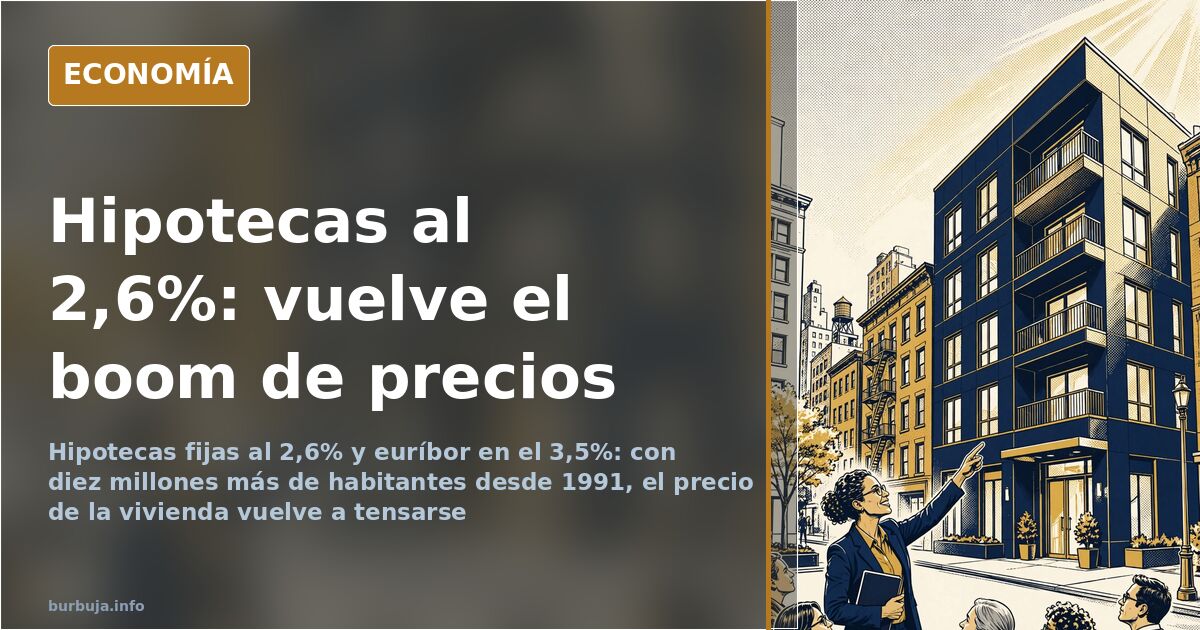
Mortgage war fuels another housing price boom
Spain faces another price cycle driven by bank competition, not buyer euphoria. With the Euribor at 3.5%, some banks offer fixed rates at 2.6% without conditions, making credit cheap for those with salaries and down payments. However, supply, prices, and demographics remain broken.
How much does buying a flat with a 2.6% fixed mortgage cost?
For a flat worth 650,000 euros, banks require 200,000 in capital. The monthly mortgage payment is around 2,400 euros; with taxes, insurance, and community fees, the real bill rises to 2,800 euros. To pass the solvency filter, one must earn at least 6,000 per month. Another way to look at it: 690,000 euros financed over 30 years at 2.6% costs 2,700 monthly, not the 4,000 often cited. The detailed breakdown, including down payment, installments, and taxes, paints a less friendly picture than the bank brochure.
The uncomfortable conclusion is that the mortgage war does not make housing cheaper; it only makes credit accessible to those who could already enter. Those needing 100% financing remain excluded, turning to room rentals where the market charges 600 euros per person, converting entire flats into four contracts.
Why is there talk of a no-real-estate market?
Because supply and demand no longer intersect. Prices are at highs, and buyers lack payment capacity: the two vectors point in different directions. Sales fall, yet operations continue at a pace inconsistent with a collapse narrative. The most repeated diagnosis points to the Euribor as the only real brake; once removed, demand returns.
Another disconcerting data point exists. In nominal terms, housing prices in Spain remain 20% below the bubble peaks. Adjusted for cumulative inflation exceeding 20% in recent years, Spanish property is not expensive: it is cheap in real terms. And with falling rates, this is fuel.
Demographics: ten million more inhabitants since 1991
Spain had 38,872,268 inhabitants in 1991. Now there are 48,592,909. Ten million more in three decades, with a birth rate hitting a minimum of 1.13 children per woman in 1998, never returning to replacement levels.
On this skeleton, two opposing narratives are built. One argues that foreign population influx—millions of entries in three decades—alone explains supply suffocation. The other responds with arithmetic: if total population grew only ten million, figures of fifteen or twenty million do not add up. Neither disputes the essential point: more people compete for the same housing stock, and new construction does not keep pace.
Barcelona as a laboratory: 1,291 flats and 40,000 more neighbors
Barcelona's numbers function as a controlled experiment. In 2023, 1,291 flats were built, a 48.7% decrease from the previous year. Meanwhile, the city reached 1,702,814 inhabitants on January 1, 2024, over 40,000 people in twelve months. Forty thousand new people and 1,300 new flats. This differential cannot be resolved with rhetoric.
The phenomenon repeats in Madrid and any capital with employment. The resulting picture is two cities converted into large metropolitan areas with prohibitive access prices, pushing population toward the periphery and lifelong rental.
The inheritance that does not arrive: from bare ownership to nursing homes
Much generational optimism relied on a simple promise: young people wait to inherit their parents' flats. This is the foundation of the discourse on free housing due to demographic collapse, and it is now cracking.
The argument dismantling it is financial, not ideological. Parents can sell bare ownership and retain usufruct until death; they may need liquidity to pay for dependency care; they may face inheritance taxes taking most of the asset. And they may simply have swapped their flat for care. When heirs reach sixty, they receive an unrenovated property with unresolved life. Meanwhile, investment funds buy at rock-bottom prices to rent afterward: the attributed goal is converting housing into a monthly subscription, including premium rooms.
The map: Murcia is not Madrid, nor Extremadura is the coast
The boom is not uniform. In areas with qualified employment, prices rise against all predictions. In others, the market is frozen: there are seaside villas for 100,000 euros, and inland flats valued at 145,000 euros that practically do not sell even for 40,000. Housing is not a homogeneous asset but a local market with local prices and uneven liquidity.
Here lies the trap of the single discourse. Those looking at the national average see a tense market. Those looking at their town see an aging stock no one wants and an inheritance behaving like a disguised tax on wealth.
With fixed mortgages at 2.6%, the Euribor at 3.5%, and stagnant supply, everything points to prices rising where living is already impossible and staying flat where no one wants to live. The prediction has a heavy caveat: if credit becomes expensive again, the no-market is left without buyers and sellers willing to lower prices. No one has yet explained what happens then.
Spain faces another price cycle driven by bank competition, not buyer euphoria. With the Euribor at 3.5%, some banks offer fixed rates at 2.6% without conditions, making credit cheap for those with salaries and down payments. However, supply, prices, and demographics remain broken.
How much does buying a flat with a 2.6% fixed mortgage cost?
For a flat worth 650,000 euros, banks require 200,000 in capital. The monthly mortgage payment is around 2,400 euros; with taxes, insurance, and community fees, the real bill rises to 2,800 euros. To pass the solvency filter, one must earn at least 6,000 per month. Another way to look at it: 690,000 euros financed over 30 years at 2.6% costs 2,700 monthly, not the 4,000 often cited. The detailed breakdown, including down payment, installments, and taxes, paints a less friendly picture than the bank brochure.
The uncomfortable conclusion is that the mortgage war does not make housing cheaper; it only makes credit accessible to those who could already enter. Those needing 100% financing remain excluded, turning to room rentals where the market charges 600 euros per person, converting entire flats into four contracts.
Why is there talk of a no-real-estate market?
Because supply and demand no longer intersect. Prices are at highs, and buyers lack payment capacity: the two vectors point in different directions. Sales fall, yet operations continue at a pace inconsistent with a collapse narrative. The most repeated diagnosis points to the Euribor as the only real brake; once removed, demand returns.
Another disconcerting data point exists. In nominal terms, housing prices in Spain remain 20% below the bubble peaks. Adjusted for cumulative inflation exceeding 20% in recent years, Spanish property is not expensive: it is cheap in real terms. And with falling rates, this is fuel.
Demographics: ten million more inhabitants since 1991
Spain had 38,872,268 inhabitants in 1991. Now there are 48,592,909. Ten million more in three decades, with a birth rate hitting a minimum of 1.13 children per woman in 1998, never returning to replacement levels.
On this skeleton, two opposing narratives are built. One argues that foreign population influx—millions of entries in three decades—alone explains supply suffocation. The other responds with arithmetic: if total population grew only ten million, figures of fifteen or twenty million do not add up. Neither disputes the essential point: more people compete for the same housing stock, and new construction does not keep pace.
Barcelona as a laboratory: 1,291 flats and 40,000 more neighbors
Barcelona's numbers function as a controlled experiment. In 2023, 1,291 flats were built, a 48.7% decrease from the previous year. Meanwhile, the city reached 1,702,814 inhabitants on January 1, 2024, over 40,000 people in twelve months. Forty thousand new people and 1,300 new flats. This differential cannot be resolved with rhetoric.
The phenomenon repeats in Madrid and any capital with employment. The resulting picture is two cities converted into large metropolitan areas with prohibitive access prices, pushing population toward the periphery and lifelong rental.
The inheritance that does not arrive: from bare ownership to nursing homes
Much generational optimism relied on a simple promise: young people wait to inherit their parents' flats. This is the foundation of the discourse on free housing due to demographic collapse, and it is now cracking.
The argument dismantling it is financial, not ideological. Parents can sell bare ownership and retain usufruct until death; they may need liquidity to pay for dependency care; they may face inheritance taxes taking most of the asset. And they may simply have swapped their flat for care. When heirs reach sixty, they receive an unrenovated property with unresolved life. Meanwhile, investment funds buy at rock-bottom prices to rent afterward: the attributed goal is converting housing into a monthly subscription, including premium rooms.
The map: Murcia is not Madrid, nor Extremadura is the coast
The boom is not uniform. In areas with qualified employment, prices rise against all predictions. In others, the market is frozen: there are seaside villas for 100,000 euros, and inland flats valued at 145,000 euros that practically do not sell even for 40,000. Housing is not a homogeneous asset but a local market with local prices and uneven liquidity.
Here lies the trap of the single discourse. Those looking at the national average see a tense market. Those looking at their town see an aging stock no one wants and an inheritance behaving like a disguised tax on wealth.
With fixed mortgages at 2.6%, the Euribor at 3.5%, and stagnant supply, everything points to prices rising where living is already impossible and staying flat where no one wants to live. The prediction has a heavy caveat: if credit becomes expensive again, the no-market is left without buyers and sellers willing to lower prices. No one has yet explained what happens then.
Summary of a discussion on Burbuja.info - Foro de economía, actualidad y política., translated from Spanish and reviewed before publication. Read the full discussion (220 replies).
More summaries
-
Spain housing prices drop 4.6%, Madrid falls 3.8%
Notaries confirm Madrid's first price drop in nine years at 3.8%, with a national average decline of 4.6%.
-
Retired journalist sleeps in metro with 830 euro pension in Barcelona
Joan-Ignasi Ortuño, 67, earns 830 euros monthly, while Barcelona room rentals average 640. He spent days sleeping on the metro after losing his apartment.
-
Spain's housing market: the end of the safe investment myth
Spain's housing market faces a historic collapse as oversupply, inflation and weakened demand make current prices unsustainable.
-
Sol Campout: Elite Spokespeople and Suspicions of Manipulation
Spokespeople for the Sol campout against the housing crisis reportedly attended United World College and Comillas, according to disseminated data.
-
Alcampo Girona launches Ramadan section, sparking debate
An Alcampo in Girona dedicates space to Ramadan products like couscous and halal meats. The aisle reignites discussions on demographics and consumption.
-
PSOE proposes law to limit popular prosecution in Spain
The PSOE has registered a bill restricting the popular prosecution and expanding judge recusal. It could affect ongoing cases like Begoña Gómez's.