
Five degrees, one year in elevators: Spain’s mismatched civil servant CV
A Madrid civil servant holds an aeronautical engineering degree, MIT master's, and MBA, yet has only one year of private sector experience.
English · Original discussion in Spanish · Published
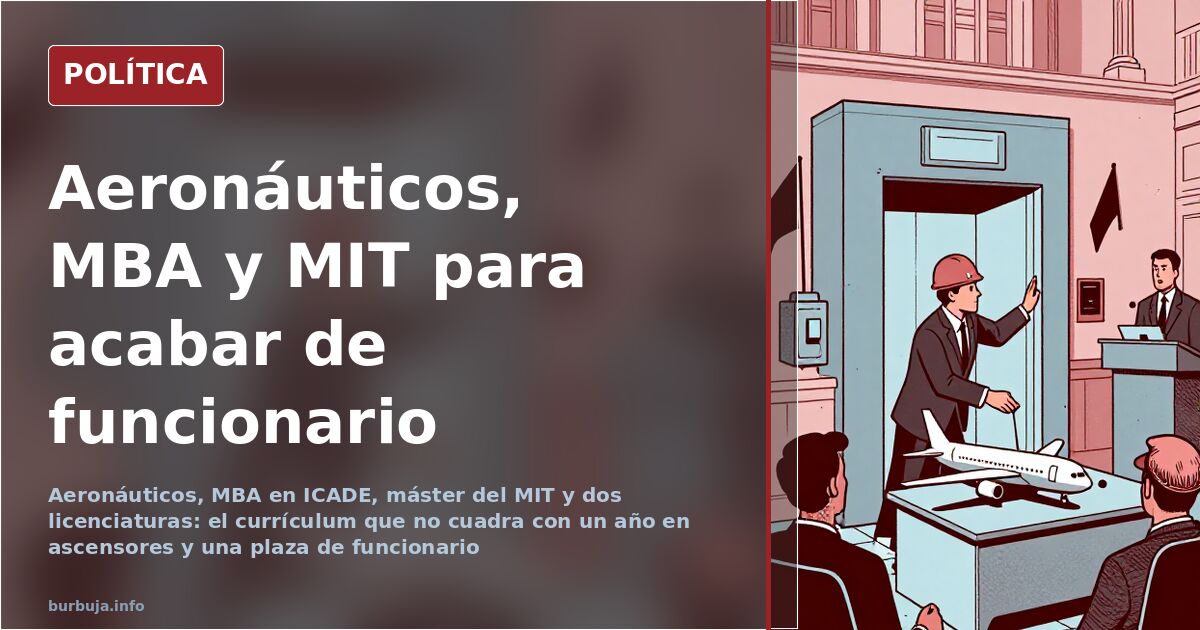
Five degrees, one year in elevators: the mismatched CV
How does someone balance a senior engineering degree, an MBA, an MIT master's, and two bachelor's degrees while holding a public office position? The record currently under scrutiny looks like a textbook case: Aeronautical Engineering in 1989, an MBA from ICADE between 1991 and 1994, an MIT master's in a single academic year (1999-2000), Economics via UNED between 2003 and 2009, and a second bachelor's in Business Administration between 2010 and 2013. In parallel, since 1995, they have held a post in the Madrid public administration. On the professional side, there is no equivalent: just one year at an elevator company and little else. The gap between these two columns is precisely the issue.
Elite qualifications and a flat career path
The years trinc the Aeronautical degree do not match the prestige of the academic record. There is no recorded professional activity for two years. Then appears a single year at Zardoya Otis, where they are already listed as a global project manager, with no prior industry experience and in a field unrelated to aviation. This is trinc by six blank years on the CV until entering the Madrid public administration in 1995.
Within the Administration, the trajectory is continuous: they solidified their role in the Environment department for thirteen years, taking a one-year break to the United States for the master's, and eventually shifting to business promotion. Today, they serve as Head of Citizen Services. It is a stable, comfortable path perfectly compatible with enrolling in new programs every few years.
An MIT master's or a four-hour weekly course?
Here lies one key point. Those who have examined the credential argue it is not strictly from MIT, but rather an associated program with a load of four hours per week, part of the center's executive education offerings. The ironic comparison circulating—likening it to a crafts workshop—clashes with the counterargument: MIT does not give away technical titles, and a diploma bearing that name is not just any piece of paper.
The figure often cited to settle the debate is the tuition fee: around $70,000 per year. This supports the thesis that here, the barrier is economic rather than academic. Spending a year abroad paying that amount, with a public job secured, describes a specific profile.
Handed-out degrees or real merits?
The suspicion that some titles are obtained without attending class pervades the conversation, but it should be separated from verifiable facts: the record is public and the dates align. How it is used is another matter. One school of thought views this accumulation as a status symbol rather than a professional tool.
Another cited case involves a Correos employee, a Philology graduate from a rural family background, who reportedly isolated themselves to study, passed the competitive exam for Group A civil servants, and moved to Social Security. Their phrase, repeated mockingly—"I am a Li-cen-si-a-te in Phi-lo-lo-gy"—summarizes the mechanism: the degree as a social shield. An added reproach: taxpayers fund that study time through the salary.
Why end up as a civil servant with such a record?
Hypotheses abound. The most common points to a wealthy family: someone funding studies, master's degrees, and exams, for whom the public post serves as fixed income and refuge. Another variant suggests the elevator company was a family business, including nepotism, later sold, with the civil service exam as the final destination.
There is also the psychological reading—a brilliant profile with poor social skills and difficulty adapting to the market—and the simplest explanation: boredom, leisure, and a comfortable academic life without bosses or clients. The most benign version notes that scholarships and reserved spots exist for public employees, which would explain the US course without giving up the salary.
The CV companies reject
One view holds that accumulating degrees harms employability rather than improving it. A participant recalled what a hiring manager told them: when a CV arrives with two or three degrees, it goes straight into the trash. The underlying idea is that companies do not seek scholars; they seek staff. To this adds another observation: most aerospace engineering graduates end up in mechanics, appliances, or varied sectors, not aviation.
And a suspicion running in the opposite direction: if someone is truly brilliant, a municipal office won't tolerate them for two months. In Spain, the argument goes, jobs for geniuses are scarce, pushing talent toward permanent posts. A more uncomfortable reading: a country where the most qualified profiles end up as civil servants is not rewarding talent, but recycling it into security.
In short, the record is published and still doesn't add up. Five degrees, one bearing the seal of a world-leading lab, and the current position fits on a single line. Perhaps the problem isn't the CV, but the criteria used to read it.
How does someone balance a senior engineering degree, an MBA, an MIT master's, and two bachelor's degrees while holding a public office position? The record currently under scrutiny looks like a textbook case: Aeronautical Engineering in 1989, an MBA from ICADE between 1991 and 1994, an MIT master's in a single academic year (1999-2000), Economics via UNED between 2003 and 2009, and a second bachelor's in Business Administration between 2010 and 2013. In parallel, since 1995, they have held a post in the Madrid public administration. On the professional side, there is no equivalent: just one year at an elevator company and little else. The gap between these two columns is precisely the issue.
Elite qualifications and a flat career path
The years trinc the Aeronautical degree do not match the prestige of the academic record. There is no recorded professional activity for two years. Then appears a single year at Zardoya Otis, where they are already listed as a global project manager, with no prior industry experience and in a field unrelated to aviation. This is trinc by six blank years on the CV until entering the Madrid public administration in 1995.
Within the Administration, the trajectory is continuous: they solidified their role in the Environment department for thirteen years, taking a one-year break to the United States for the master's, and eventually shifting to business promotion. Today, they serve as Head of Citizen Services. It is a stable, comfortable path perfectly compatible with enrolling in new programs every few years.
An MIT master's or a four-hour weekly course?
Here lies one key point. Those who have examined the credential argue it is not strictly from MIT, but rather an associated program with a load of four hours per week, part of the center's executive education offerings. The ironic comparison circulating—likening it to a crafts workshop—clashes with the counterargument: MIT does not give away technical titles, and a diploma bearing that name is not just any piece of paper.
The figure often cited to settle the debate is the tuition fee: around $70,000 per year. This supports the thesis that here, the barrier is economic rather than academic. Spending a year abroad paying that amount, with a public job secured, describes a specific profile.
Handed-out degrees or real merits?
The suspicion that some titles are obtained without attending class pervades the conversation, but it should be separated from verifiable facts: the record is public and the dates align. How it is used is another matter. One school of thought views this accumulation as a status symbol rather than a professional tool.
Another cited case involves a Correos employee, a Philology graduate from a rural family background, who reportedly isolated themselves to study, passed the competitive exam for Group A civil servants, and moved to Social Security. Their phrase, repeated mockingly—"I am a Li-cen-si-a-te in Phi-lo-lo-gy"—summarizes the mechanism: the degree as a social shield. An added reproach: taxpayers fund that study time through the salary.
Why end up as a civil servant with such a record?
Hypotheses abound. The most common points to a wealthy family: someone funding studies, master's degrees, and exams, for whom the public post serves as fixed income and refuge. Another variant suggests the elevator company was a family business, including nepotism, later sold, with the civil service exam as the final destination.
There is also the psychological reading—a brilliant profile with poor social skills and difficulty adapting to the market—and the simplest explanation: boredom, leisure, and a comfortable academic life without bosses or clients. The most benign version notes that scholarships and reserved spots exist for public employees, which would explain the US course without giving up the salary.
The CV companies reject
One view holds that accumulating degrees harms employability rather than improving it. A participant recalled what a hiring manager told them: when a CV arrives with two or three degrees, it goes straight into the trash. The underlying idea is that companies do not seek scholars; they seek staff. To this adds another observation: most aerospace engineering graduates end up in mechanics, appliances, or varied sectors, not aviation.
And a suspicion running in the opposite direction: if someone is truly brilliant, a municipal office won't tolerate them for two months. In Spain, the argument goes, jobs for geniuses are scarce, pushing talent toward permanent posts. A more uncomfortable reading: a country where the most qualified profiles end up as civil servants is not rewarding talent, but recycling it into security.
In short, the record is published and still doesn't add up. Five degrees, one bearing the seal of a world-leading lab, and the current position fits on a single line. Perhaps the problem isn't the CV, but the criteria used to read it.
Summary of a discussion on Burbuja.info - Foro de economía, actualidad y política., translated from Spanish and reviewed before publication. Read the full discussion (161 replies).
More summaries
-
URGENT: KIOSKERO SEEKS MAYORAL SEAT IN MADRID
A politician runs for the mayoralty of Madrid, criticizing current management and promising a focus on neighborhood issues. Discover his proposals.
-
'Galiza aos Galegos': Galicia's Identity Nationalism
A minority Galician nationalism revives the slogan 'home, race, language' and claims the 1932 Ultreya. Triskeles, camps, and social media.
-
Europe Blames Spain for Ceuta Crisis, Silences Morocco
Italy, Finland and Sweden tighten Schengen borders against Spain while Rabat triggers the crisis without facing any European condemnation.
-
Vox Expels Ortega Smith in Final Internal Purge
Vox expelled co-founder Ortega Smith, continuing a pattern of purges that mirrors Podemos' decline and raises questions about the party's future.
-
Spain's King Felipe VI Christmas speech draws criticism from all sides
King Felipe VI's Christmas address was deemed bland and disconnected amid Spain's coronavirus crisis, with over 13,000 infections and 700 deaths reported.
-
PP Caught in Internal Contradictions in Spain's Extremadura
Spain's PP faces internal confusion over its strategy in the Extremadura region, with unclear messaging causing doubt among supporters.