
First bike: why a 125 beats a 49cc
Experienced riders recommend starting with a 125cc or 250cc instead of a 49cc: more safety, smoother riding and the ability to use motorways. The…
English · Original discussion in Spanish · Published
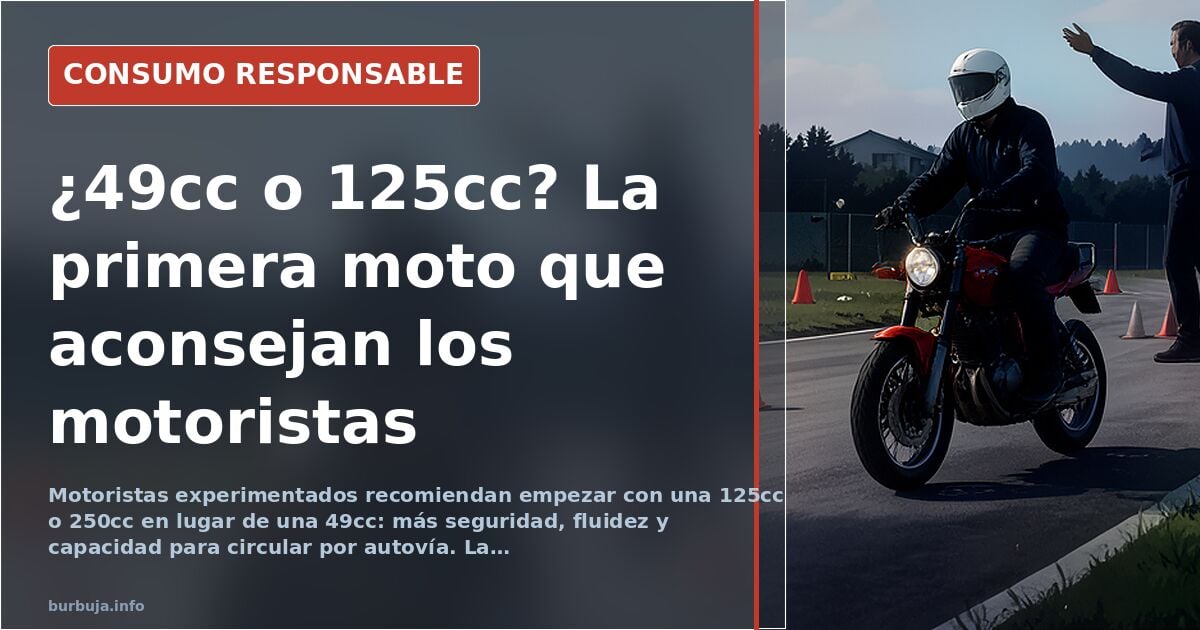
First bike: the 125cc beats the 49cc among riders
The question seems simple: what engine size should someone who has never ridden a motorcycle start with if they want to use it as transport, not as a toy? The answer repeated in experienced riders' circles is clear: at least 125cc. The core argument is not power, but the ability to ride smoothly and safely on fast roads. A 49cc moped cannot enter motorways, falls short on hills and, according to several accounts, creates more risk due to its lack of acceleration than a well-ridden bike with a bigger engine.
Why is a 125cc the most recommended option for beginners?
The consensus among those who have spent years on two wheels is that the 125cc offers the right balance between handling and performance. With a valid category B car licence, many adults can ride one without needing to obtain the A2 motorcycle licence, which removes a major bureaucratic barrier. It also allows riding on motorways and dual carriageways, unthinkable with a 49cc. One rider sums it up: "At least a 125 to ride smoothly, and now with a B licence you can ride a 125, so perfect".
The criticism of the 49cc is blunt: "a 49 is a piece of crap, it doesn't go anywhere and just makes noise". However coarse the language, the technical point is shared: a moped falls short for an adult of average weight, especially when facing hills or road journeys. For purely urban use in small cities, some consider it sufficient, but even then the warning comes that "a bicycle would be better still".
Is it dangerous to start with a 125cc or a 250cc?
The belief that a 125cc is too powerful for a novice is, according to the riders consulted, a myth. "A motorcycle is NOT DANGEROUS; what is dangerous is the rider handling it and the rest of the traffic on the road", one participant maintains. The key lies in training and attitude. Those who defend starting with a 250cc argue that riding school lessons are essential and that a bike with a bigger engine's gearing is more stable and forgiving in case of the unexpected.
Some go further and recommend a 250cc outright, provided proper instruction is received. "I think it's safer to start with a 250 with riding school lessons than to buy a 49cc and start riding on your own", one rider points out. The logic is that formal training makes up for the difference in power. By contrast, heading out on the road with a 49cc without prior instruction is considered "a grave mistake".
Motorcycle or scooter? The layout matters
The choice between a classic motorcycle and a scooter is no small matter. Several participants warn that scooters, with their small wheels and forward riding position, offer less stability in unexpected situations. "I'd rather have a big-wheel motorcycle, with gears and some weight, than a moped or scooter", one rider states. The classic motorcycle, with its large wheel, disc brake and chain, is perceived as safer for learning, even though the scooter wins on urban comfort and carrying capacity.
The scooter, however, has undeniable advantages in the city: lightness, ease of handling and storage compartments. But for those who want to truly learn, a geared motorcycle imposes a more complete learning process. "In case of the unexpected, believe me, you'll be glad to have the stability and forgiveness of a classic motorcycle", an experienced rider concludes.
Which specific models are recommended?
Recommendations for specific models vary. The Honda CBF250 comes up as a popular option for someone nearly 1.90 metres tall looking for a second-hand utility bike. 250cc trail bikes are also mentioned as an alternative for tall people. In the scooter field, the Yamaha 500, the Burgman 250 and the Piaggio MP3 500 are cited, although the latter is a three-wheeler. The Honda Wave 110 is suggested for those who want something simple.
The Chinese brand at €600 generates no enthusiasm: it is compared to "a Dacia Logan sold at the price of a Renault Megane". The general advice is to go for established brands and, if buying second-hand, to have it checked by a trusted mechanic. The Honda CBF250, for example, is described as "a super-utility bike very popular in Asia (a revamped Honda Cub) sold at more than double the price in Europe".
What protection is essential?
Helmet and jacket are taken for granted. Riders add gloves and closed footwear. But the most repeated protective measure is attitude: "The first protective measure is riding style: always defensive, always". A danger zone in learning is pointed out: when the initial antiestéticar is lost but there is not yet enough experience. "The danger zone comes when you stop taking the precautions of a beginner because you're getting the hang of it, but you still don't have enough experience".
The final advice: training and common sense
The conclusion drawn from the shared experiences is that engine size matters less than training and good sense. A 125cc or a 250cc with riding school lessons is safer than a 49cc without instruction. The scooter is comfortable, but the classic motorcycle forgives mistakes better. And above all, as a veteran sums up: "There are two kinds of riders: those who have fallen and those who are yet to fall". Prevention and defensive riding are the best insurance.
The question seems simple: what engine size should someone who has never ridden a motorcycle start with if they want to use it as transport, not as a toy? The answer repeated in experienced riders' circles is clear: at least 125cc. The core argument is not power, but the ability to ride smoothly and safely on fast roads. A 49cc moped cannot enter motorways, falls short on hills and, according to several accounts, creates more risk due to its lack of acceleration than a well-ridden bike with a bigger engine.
Why is a 125cc the most recommended option for beginners?
The consensus among those who have spent years on two wheels is that the 125cc offers the right balance between handling and performance. With a valid category B car licence, many adults can ride one without needing to obtain the A2 motorcycle licence, which removes a major bureaucratic barrier. It also allows riding on motorways and dual carriageways, unthinkable with a 49cc. One rider sums it up: "At least a 125 to ride smoothly, and now with a B licence you can ride a 125, so perfect".
The criticism of the 49cc is blunt: "a 49 is a piece of crap, it doesn't go anywhere and just makes noise". However coarse the language, the technical point is shared: a moped falls short for an adult of average weight, especially when facing hills or road journeys. For purely urban use in small cities, some consider it sufficient, but even then the warning comes that "a bicycle would be better still".
Is it dangerous to start with a 125cc or a 250cc?
The belief that a 125cc is too powerful for a novice is, according to the riders consulted, a myth. "A motorcycle is NOT DANGEROUS; what is dangerous is the rider handling it and the rest of the traffic on the road", one participant maintains. The key lies in training and attitude. Those who defend starting with a 250cc argue that riding school lessons are essential and that a bike with a bigger engine's gearing is more stable and forgiving in case of the unexpected.
Some go further and recommend a 250cc outright, provided proper instruction is received. "I think it's safer to start with a 250 with riding school lessons than to buy a 49cc and start riding on your own", one rider points out. The logic is that formal training makes up for the difference in power. By contrast, heading out on the road with a 49cc without prior instruction is considered "a grave mistake".
Motorcycle or scooter? The layout matters
The choice between a classic motorcycle and a scooter is no small matter. Several participants warn that scooters, with their small wheels and forward riding position, offer less stability in unexpected situations. "I'd rather have a big-wheel motorcycle, with gears and some weight, than a moped or scooter", one rider states. The classic motorcycle, with its large wheel, disc brake and chain, is perceived as safer for learning, even though the scooter wins on urban comfort and carrying capacity.
The scooter, however, has undeniable advantages in the city: lightness, ease of handling and storage compartments. But for those who want to truly learn, a geared motorcycle imposes a more complete learning process. "In case of the unexpected, believe me, you'll be glad to have the stability and forgiveness of a classic motorcycle", an experienced rider concludes.
Which specific models are recommended?
Recommendations for specific models vary. The Honda CBF250 comes up as a popular option for someone nearly 1.90 metres tall looking for a second-hand utility bike. 250cc trail bikes are also mentioned as an alternative for tall people. In the scooter field, the Yamaha 500, the Burgman 250 and the Piaggio MP3 500 are cited, although the latter is a three-wheeler. The Honda Wave 110 is suggested for those who want something simple.
The Chinese brand at €600 generates no enthusiasm: it is compared to "a Dacia Logan sold at the price of a Renault Megane". The general advice is to go for established brands and, if buying second-hand, to have it checked by a trusted mechanic. The Honda CBF250, for example, is described as "a super-utility bike very popular in Asia (a revamped Honda Cub) sold at more than double the price in Europe".
What protection is essential?
Helmet and jacket are taken for granted. Riders add gloves and closed footwear. But the most repeated protective measure is attitude: "The first protective measure is riding style: always defensive, always". A danger zone in learning is pointed out: when the initial antiestéticar is lost but there is not yet enough experience. "The danger zone comes when you stop taking the precautions of a beginner because you're getting the hang of it, but you still don't have enough experience".
The final advice: training and common sense
The conclusion drawn from the shared experiences is that engine size matters less than training and good sense. A 125cc or a 250cc with riding school lessons is safer than a 49cc without instruction. The scooter is comfortable, but the classic motorcycle forgives mistakes better. And above all, as a veteran sums up: "There are two kinds of riders: those who have fallen and those who are yet to fall". Prevention and defensive riding are the best insurance.
Also available in: Deutsch
Summary of a discussion on Burbuja.info - Foro de economía, actualidad y política., translated from Spanish and reviewed before publication. Read the full discussion (90 replies).
More summaries
-
Spain's DGT to mandate course for B-license 125cc riders
Spain's traffic authority will require a mandatory course for driving 125cc motorcycles with a B license, leaving retroactivity unclear.
-
Cheap 125cc bikes: the hidden costs of a 100mph highway cruise
Keeway Superlight, Macbor or Yamaha YBR: which 125cc bike costs under €2,600 and why a 90-100mph cruise on the motorway is the real limit.
-
Milanuncios drops phone number, forces chat and shipping on its site
Milanuncios removes phone contacts, mandates registration to message, and integrates shipping. Sellers report a sharp drop in buyer inquiries.
-
Low-cost barbershops and the decline of the traditional hair salon
Refurbished premises, 7-10 euro haircuts and classic salons closing down: the hair business is being reorganised and not every set of books adds up
-
Mercury in fish: the list that puts tuna and mackerel in doubt
An NRDC list places tuna and mackerel among the fish to avoid due to mercury. Is it reliable? The debate over the source and the real risks.
-
Used petrol car with 150,000 km: bargain or money pit?
A 150,000 km Mégane for €1,200 or a Clio for €1,000 versus a new Sandero at €6,390. Key tips on whether an old petrol engine can handle 40 km a day.