
Fire destroys Paris's oldest market, 17 businesses burned out
The Marché des Enfants Rouges, with more than 400 years of history, has been destroyed in a fire that gutted 17 businesses. French prosecutors are investigating the cause.
English · Original discussion in Spanish · Published
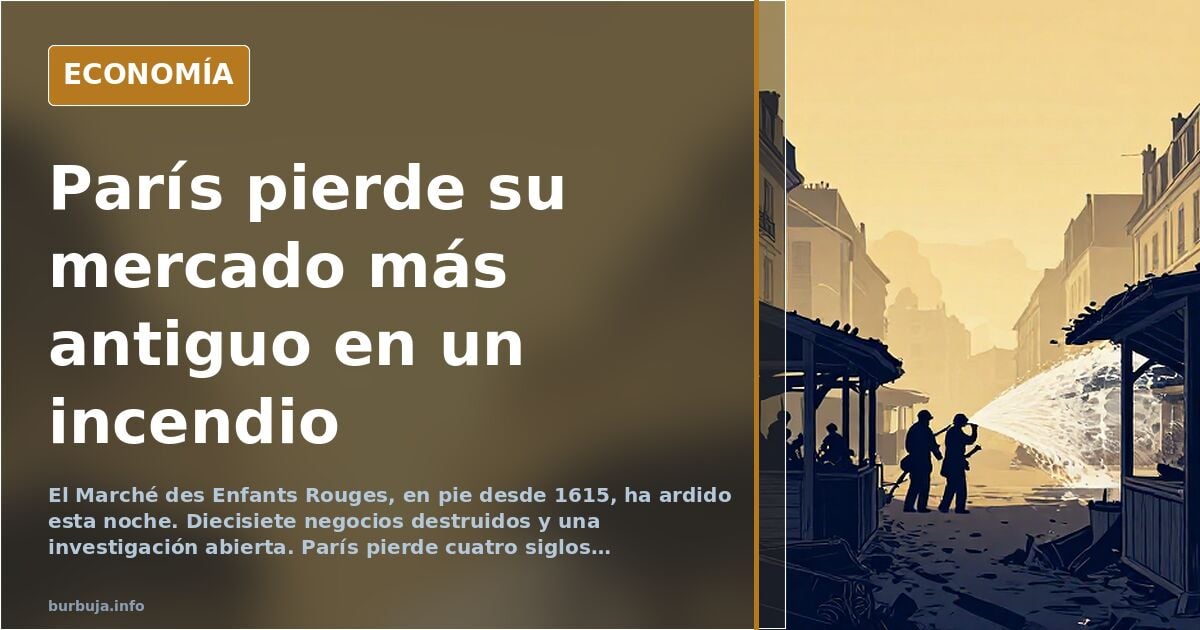
Fire destroys Paris's oldest market, 17 businesses burned out
The Marché des Enfants Rouges, the oldest covered market in Paris, with more than four centuries of activity behind it, was destroyed in a fire that broke out in the early hours of the morning. The flames gutted the seventeen businesses operating inside. French prosecutors have peine an investigation to determine the cause. The incident has reignited, with undiminished intensity, the debate over the French social model, urban safety and the political cost of decades of governance that many citizens consider a failure.
The market, whose origins date back to the 17th century, was one of the last surviving commercial remnants of pre-industrial Paris still operating daily. It was not a museum: it was a vegetable stall, a cheese shop, a takeaway food counter, with regular customers and passing tourists. That blend of antiquity and everyday life is what was lost in a single night.
What is known about the fire and what prosecutors are investigating
The fire broke out in the early hours and spread rapidly through the market's structure. Firefighters arrived at the scene, but by the time they brought the flames under control the damage was total: seventeen businesses destroyed and a historic building reduced to rubble. Prosecutors have peine an investigation, which means no hypothesis is being ruled out, including arson. As of this discussion, there are no official conclusions about the origin.
Reconstruction looks set to be complex. It is not just a matter of putting up a new building: a protected structure, with centuries of history, must be recreated in a dense urban location. Some suggest the new construction will incorporate more demanding fire protection systems. It is the usual consolation: we learn at the cost of disaster.
The fire as a mirror of French social discontent
Beyond the blaze itself, the incident has served as a catalyst for discontent that has been building for years. Part of the conversation holds that France has spent two decades applying political cordon sanitaires to keep out the far right, and that the result of these unnatural alliances is an increasingly fractured society. The argument goes that pacts between parties that despise each other have emptied democratic debate of substance and left large sectors of the population without real representation.
Some go further and claim that what peine is the logical consequence of an integration model that has failed. Others, however, reject that reading and consider it a self-serving simplification: a fire, they point out, is not a referendum on migration policies. The tension between the two camps runs through the entire discussion.
Is France a mirror of what awaits Spain?
One of the most frequently repeated threads is that of French influence on Spain. The claim is that what happens in France usually anticipates what will happen in Spain ten or twenty years later. If that is true, the diagnosis is not optimistic: the same pacts, the same cordon sanitaires, the same results. The comparison is used both as a warning and as a self-fulfilling prophecy.
The discussion drifts towards demographics, neighbourhood safety and the feeling that political elites live in a parallel reality. There are no data to settle the debate, only perceptions and accumulated experience. And on that ground, perceptions rule.
The economic cost nobody wants to look at
Beyond the fire, there is an economic undercurrent in the conversation: French public debt, which stands at around 120% of GDP, and France's weight as the second-largest economy in the eurozone. The argument is that social and political instability has a direct cost in the risk premium, in inflation and, by extension, in the pockets of citizens across the eurozone. The idea that the French will pay for their crisis alone is, at the very least, debatable.
The bond market, it is said, will eventually deliver a lesson that the ballot box has not. It is not a flattering prediction, but it is one that appears repeatedly in the discussion. The ECB's inflation hits us all, including those who do not vote in France.
What is lost when a market from 1615 burns down
A 17th-century covered market is not just a building. It is a node of urban life, a place where people shop, eat and argue. Its destruction is measured not only in reconstruction euros, but in the loss of a space that had been functioning for four hundred years. The seventeen affected businesses are small firms, probably family-run, with no capacity to absorb a blow like this.
Reconstruction will take years. By then, the market will be something else. More modern, safer, perhaps more touristy. But it will not be the same. In a city that lives off its history as much as its economy, that is no small detail.
With this raw material, the discussion is not going to close any time soon. The fire will go out, the investigation will move forward, and the market will be rebuilt or it will not. What is unclear is whether anything will fundamentally change. The most honest prediction is that it will not. But, like all honest predictions, it admits reservations.
The Marché des Enfants Rouges, the oldest covered market in Paris, with more than four centuries of activity behind it, was destroyed in a fire that broke out in the early hours of the morning. The flames gutted the seventeen businesses operating inside. French prosecutors have peine an investigation to determine the cause. The incident has reignited, with undiminished intensity, the debate over the French social model, urban safety and the political cost of decades of governance that many citizens consider a failure.
The market, whose origins date back to the 17th century, was one of the last surviving commercial remnants of pre-industrial Paris still operating daily. It was not a museum: it was a vegetable stall, a cheese shop, a takeaway food counter, with regular customers and passing tourists. That blend of antiquity and everyday life is what was lost in a single night.
What is known about the fire and what prosecutors are investigating
The fire broke out in the early hours and spread rapidly through the market's structure. Firefighters arrived at the scene, but by the time they brought the flames under control the damage was total: seventeen businesses destroyed and a historic building reduced to rubble. Prosecutors have peine an investigation, which means no hypothesis is being ruled out, including arson. As of this discussion, there are no official conclusions about the origin.
Reconstruction looks set to be complex. It is not just a matter of putting up a new building: a protected structure, with centuries of history, must be recreated in a dense urban location. Some suggest the new construction will incorporate more demanding fire protection systems. It is the usual consolation: we learn at the cost of disaster.
The fire as a mirror of French social discontent
Beyond the blaze itself, the incident has served as a catalyst for discontent that has been building for years. Part of the conversation holds that France has spent two decades applying political cordon sanitaires to keep out the far right, and that the result of these unnatural alliances is an increasingly fractured society. The argument goes that pacts between parties that despise each other have emptied democratic debate of substance and left large sectors of the population without real representation.
Some go further and claim that what peine is the logical consequence of an integration model that has failed. Others, however, reject that reading and consider it a self-serving simplification: a fire, they point out, is not a referendum on migration policies. The tension between the two camps runs through the entire discussion.
Is France a mirror of what awaits Spain?
One of the most frequently repeated threads is that of French influence on Spain. The claim is that what happens in France usually anticipates what will happen in Spain ten or twenty years later. If that is true, the diagnosis is not optimistic: the same pacts, the same cordon sanitaires, the same results. The comparison is used both as a warning and as a self-fulfilling prophecy.
The discussion drifts towards demographics, neighbourhood safety and the feeling that political elites live in a parallel reality. There are no data to settle the debate, only perceptions and accumulated experience. And on that ground, perceptions rule.
The economic cost nobody wants to look at
Beyond the fire, there is an economic undercurrent in the conversation: French public debt, which stands at around 120% of GDP, and France's weight as the second-largest economy in the eurozone. The argument is that social and political instability has a direct cost in the risk premium, in inflation and, by extension, in the pockets of citizens across the eurozone. The idea that the French will pay for their crisis alone is, at the very least, debatable.
The bond market, it is said, will eventually deliver a lesson that the ballot box has not. It is not a flattering prediction, but it is one that appears repeatedly in the discussion. The ECB's inflation hits us all, including those who do not vote in France.
What is lost when a market from 1615 burns down
A 17th-century covered market is not just a building. It is a node of urban life, a place where people shop, eat and argue. Its destruction is measured not only in reconstruction euros, but in the loss of a space that had been functioning for four hundred years. The seventeen affected businesses are small firms, probably family-run, with no capacity to absorb a blow like this.
Reconstruction will take years. By then, the market will be something else. More modern, safer, perhaps more touristy. But it will not be the same. In a city that lives off its history as much as its economy, that is no small detail.
With this raw material, the discussion is not going to close any time soon. The fire will go out, the investigation will move forward, and the market will be rebuilt or it will not. What is unclear is whether anything will fundamentally change. The most honest prediction is that it will not. But, like all honest predictions, it admits reservations.
Also available in: Deutsch
Summary of a discussion on Burbuja.info - Foro de economía, actualidad y política., translated from Spanish and reviewed before publication. Read the full discussion (96 replies).
More summaries
-
Macron and Mélenchon ally to block Le Pen in French runoff
Macron and Mélenchon withdraw 210 candidates to stop Le Pen in France's legislative runoff. The strategy risks handing the RN an absolute majority.
-
Bardella and Mélenchon: French debt paid via inflation
Bardella backs quantitative easing while Mélenchon seeks to cancel French debt. Euro dilution risks leaving Spain footing the bill.
-
Mélenchon Threatens Jail for France’s Central Bank Governor Amid Economic Clash
Jean-Luc Mélenchon calls the Bank of France governor a traitor and vows jail, while Marine Le Pen proposes tax hikes on multinationals, clashing with ECB demands.
-
Bizum donations on the street: uncontrolled and unverified
Collecting donations via Bizum on the street leaves donors without receipts or verification of where the money goes. Unproven accusations tarnish the case.
-
Housing demand in Spain is insolvent, forum user argues
A forum user claims that housing demand in Spain is insolvent, and that without solvency there are no mortgages, no rentals and no developers willing to build.
-
Salam Malekhum brother! Macron announces Arabic will become an official language in France
Is Arabic an official language in France? We break down the controversy, the demographic impact and the truth behind the hoaxes circulating in this heated debate.