
Finland's Anti-Harassment Dance Backfires, Angering Aggressors
A Finnish TikTok dance campaign intended to deter street harassment reportedly irritated aggressors instead of stopping them, raising questions about its effectiveness.
English · Original discussion in Spanish · Published
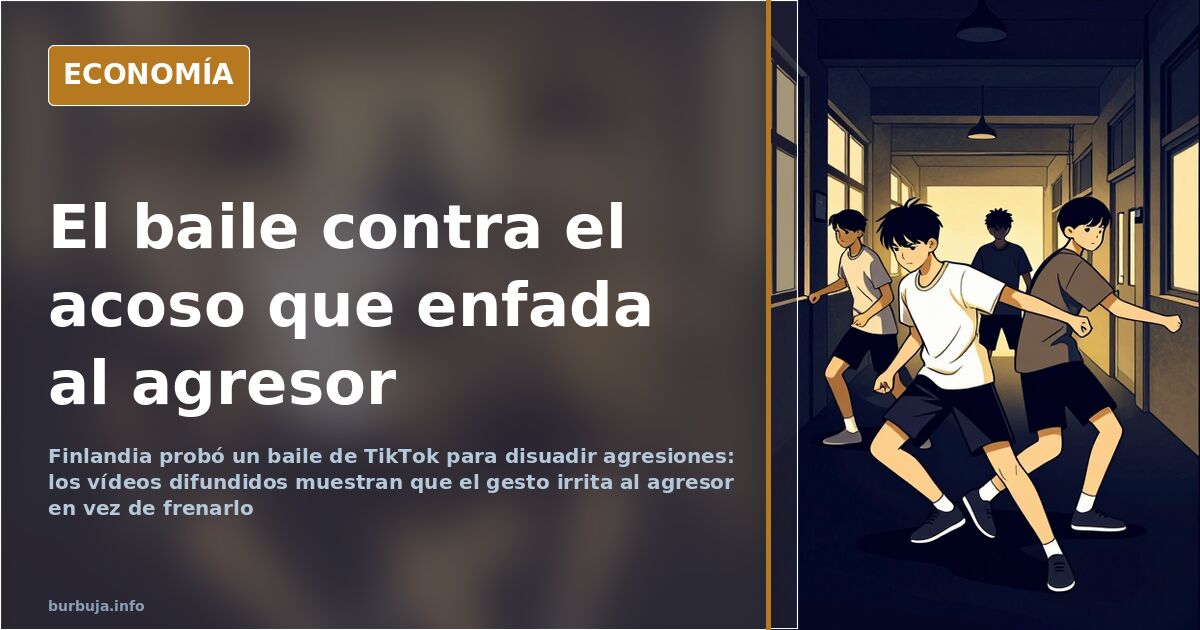
Finland Tests Viral Dance to Curb Street Harassment
A man approaches with intentions a couple interprets as hostile. The reaction isn't screaming or calling the police: both start dancing. This is the scene captured in videos circulating about the Finnish campaign, and according to viewers, the outcome was the aggressor’s anger, not their retreat. The anecdote condenses the problem: an instrument designed to defuse violence that, at best, leaves it intact.
The initiative is simple to describe but hard to believe. A group of Finnish creators designed a viral TikTok dance with a specific function: for victims to perform it upon detecting someone with uncertain intentions, so that the aggressor, seeing themselves reflected in the gesture, would recognize their own actions and stop. Its promoters, according to circulating accounts, were absolutely convinced it would work. Whoever first shared the video claimed to have verified it before publishing.
What Is the Finnish Anti-Street Harassment Dance?
It is simply a choreographed step attributed with a deterrent capacity that hasn’t been demonstrated anywhere. The logic behind it is the same as other protocols based on symbolic gestures: making aggression visible so the aggressor feels singled out. In practice, the videos themselves show the opposite, antiestéticaturing an aggressor more irritated by the dance rather than stopped by it.
There is a detail that worsens the disconnect. The materials circulated are not recent. When the issue resurfaced, the most repeated response was the same: this video is old; they don’t even dance anymore. Meaning, the experiment was abandoned or transformed without anyone announcing it. And no one has published a single measurement of its efficacy since then.
Spain’s Purple Points and Their Danced Version
The inevitable comparison is with purple points, victim support devices deployed in Spain during festivals and events. The official page of the Ministry of Equality, violenciagenero.igualdad.gob.es, presents them as information and accompaniment resources, not as deterrent measures. There lies the fundamental difference: some attend after; the dance aims to prevent before.
Here we have purple points, one reply to the video ironically noted, linking to the ministry’s website. The parallel holds in one point: both rely on public signaling as a tool. And in another: neither acts on the cause. The gap between the gesture and the effect is exactly the distance separating policy from a tweet.
Norway, Sweden, and the Nordic Model’s Wear
The issue has peine comparisons among Nordic countries, where the most uncomfortable data appear. Norway nearly doubles Sweden’s GDP per capita, despite sharing neighborhood and sustaining diverging migration models. Part of the audience assumes Swedish and Finnish decline and openly asks about Norway, as if it were the only one holding up.
Finland also bears the weight of its NATO entry, a strategic shift some read as a symptom that security—both physical and perceived—has ceased to be taken for granted in the region. The dance campaign fits this climate: a country seeking symbolic answers to problems played out in police and migration spheres.
Dance Yes, Dance No: Two Readings
The majority reaction is rejection, not just aesthetic. Some argue the project is childish and treats the population as if it needed choreographies for safety issues; others see proof of an approach prioritizing image over results. The second objection is harsher: if the dance doesn’t deter, the victim remains alone facing their aggressor.
At the other extreme, part of the analysis defends that the dance isn’t the problem, but the symptom. Their argument is that the initiative arises because classic responses—more police presence, more effective convictions—are perceived as insufficient or slow. The incivil route appears in conversation as an alternative: identifying the aggressor and applying the law, without intermediate choreography.
And there is a third group admitting they watched the video on loop due to its absurd nature. Laughing at the instrument fixes nothing, but explains why it went viral, and not precisely for what its authors intended. The blind spot of all positions is the same: none discuss how many assaults the gesture prevents, because there are no figures.
The Result No One Measured
The video will keep circulating because it’s funny, and there lies the miscalculation. A project designed to prevent assaults ended up converted into entertainment, with the alleged aggressor angrier than before. Creators trusted the viral effect; the viral effect arrived, but reversed. Until a serious measurement of its efficacy exists, the fight will remain a dance.
A man approaches with intentions a couple interprets as hostile. The reaction isn't screaming or calling the police: both start dancing. This is the scene captured in videos circulating about the Finnish campaign, and according to viewers, the outcome was the aggressor’s anger, not their retreat. The anecdote condenses the problem: an instrument designed to defuse violence that, at best, leaves it intact.
The initiative is simple to describe but hard to believe. A group of Finnish creators designed a viral TikTok dance with a specific function: for victims to perform it upon detecting someone with uncertain intentions, so that the aggressor, seeing themselves reflected in the gesture, would recognize their own actions and stop. Its promoters, according to circulating accounts, were absolutely convinced it would work. Whoever first shared the video claimed to have verified it before publishing.
What Is the Finnish Anti-Street Harassment Dance?
It is simply a choreographed step attributed with a deterrent capacity that hasn’t been demonstrated anywhere. The logic behind it is the same as other protocols based on symbolic gestures: making aggression visible so the aggressor feels singled out. In practice, the videos themselves show the opposite, antiestéticaturing an aggressor more irritated by the dance rather than stopped by it.
There is a detail that worsens the disconnect. The materials circulated are not recent. When the issue resurfaced, the most repeated response was the same: this video is old; they don’t even dance anymore. Meaning, the experiment was abandoned or transformed without anyone announcing it. And no one has published a single measurement of its efficacy since then.
Spain’s Purple Points and Their Danced Version
The inevitable comparison is with purple points, victim support devices deployed in Spain during festivals and events. The official page of the Ministry of Equality, violenciagenero.igualdad.gob.es, presents them as information and accompaniment resources, not as deterrent measures. There lies the fundamental difference: some attend after; the dance aims to prevent before.
Here we have purple points, one reply to the video ironically noted, linking to the ministry’s website. The parallel holds in one point: both rely on public signaling as a tool. And in another: neither acts on the cause. The gap between the gesture and the effect is exactly the distance separating policy from a tweet.
Norway, Sweden, and the Nordic Model’s Wear
The issue has peine comparisons among Nordic countries, where the most uncomfortable data appear. Norway nearly doubles Sweden’s GDP per capita, despite sharing neighborhood and sustaining diverging migration models. Part of the audience assumes Swedish and Finnish decline and openly asks about Norway, as if it were the only one holding up.
Finland also bears the weight of its NATO entry, a strategic shift some read as a symptom that security—both physical and perceived—has ceased to be taken for granted in the region. The dance campaign fits this climate: a country seeking symbolic answers to problems played out in police and migration spheres.
Dance Yes, Dance No: Two Readings
The majority reaction is rejection, not just aesthetic. Some argue the project is childish and treats the population as if it needed choreographies for safety issues; others see proof of an approach prioritizing image over results. The second objection is harsher: if the dance doesn’t deter, the victim remains alone facing their aggressor.
At the other extreme, part of the analysis defends that the dance isn’t the problem, but the symptom. Their argument is that the initiative arises because classic responses—more police presence, more effective convictions—are perceived as insufficient or slow. The incivil route appears in conversation as an alternative: identifying the aggressor and applying the law, without intermediate choreography.
And there is a third group admitting they watched the video on loop due to its absurd nature. Laughing at the instrument fixes nothing, but explains why it went viral, and not precisely for what its authors intended. The blind spot of all positions is the same: none discuss how many assaults the gesture prevents, because there are no figures.
The Result No One Measured
The video will keep circulating because it’s funny, and there lies the miscalculation. A project designed to prevent assaults ended up converted into entertainment, with the alleged aggressor angrier than before. Creators trusted the viral effect; the viral effect arrived, but reversed. Until a serious measurement of its efficacy exists, the fight will remain a dance.
Summary of a discussion on Burbuja.info - Foro de economía, actualidad y política., translated from Spanish and reviewed before publication. Read the full discussion (165 replies).
More summaries
-
Enerparc's Viral Debt: From $33,000 Million to $33.4 Million
A viral tweet attributed a debt of $33,000 million to the German solar company Enerparc; the actual figure being reported is $33.4 million.
-
Madrid Pride: €15,000 Public Spending Under Scrutiny
Madrid Pride faces renewed controversy over €15,000 in public funds for adult-oriented content, reigniting the debate on spending.
-
Spain's PSOE sues Vox leader Abascal for hate speech
The Spanish Socialist Workers' Party (PSOE) has filed a complaint with the Prosecutor's Office against Santiago Abascal and Vox for alleged hate crimes.
-
Canary Islands: Why migrant boat returns are stalled
Forum debate claims authorities can intercept boats but choose not to, citing NGO profits, EU distribution failures, and comparisons with US migration.
-
Spain's CEOE proposes raising retirement age to 70
The Spanish employers' association CEOE suggests delaying retirement to 70 and requiring 40 years of contributions for full pensions; the Círculo de Empresarios goes further, proposing 72.
-
Spanish police officer with low salary and Tesla highlights debt crisis
A Spanish national police officer earning €2,000 net owns a Tesla and expensive gear, illustrating how debt sustains the middle-class lifestyle in Spain.