
Finland grants US military access, raising sovereignty concerns
New deal gives US troops jurisdictional immunity in 15 Finnish zones, ending neutrality for security guarantees.
English · Original discussion in Spanish · Published
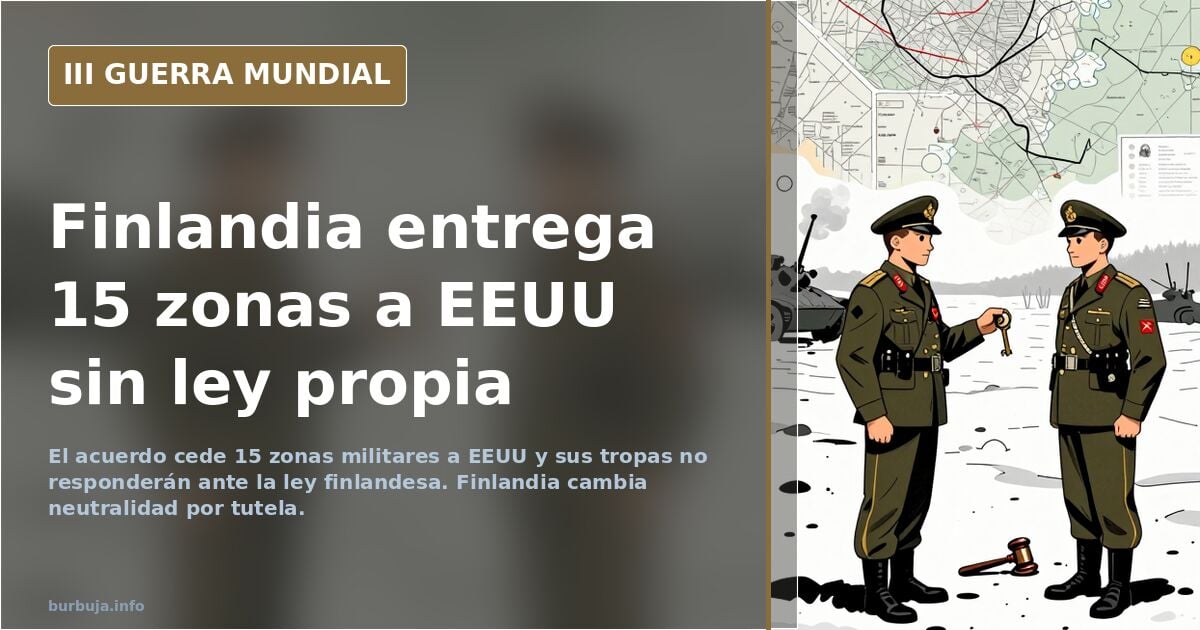
Finland opens territory to US forces without local law
Finland no longer holds full authority within its borders. The approved agreement grants the United States Army control over 15 military zones, where troops can move freely across the country and will not be subject to Finnish national law. Presented as a security reinforcement against Russia, the text places the nation halfway between an ally and a host without its own jurisdiction. Finland is a NATO member, and its neutrality is history. What remains to be settled is the price. And that price has an uncomfortable name: sovereignty.
What granting 15 military zones to the US implies
The core of the agreement is a regime of legal privileges. According to circulating drafts, US forces operating in these areas will fall outside the reach of Finnish courts. This scheme is compared in public debate to one Spain has known for nearly seventy years: a state hands over land and operational sovereignty in exchange for supposed protection. In practice, some call it cooperation, others call it agreed occupation. The difference is not semantic; it defines who commands inside a base and who is accountable for what happens there.
The detail of extraterritoriality—that foreign uniformed personnel do not appear before local judges—is what turned a technical agreement into a national controversy. When sovereign soil ceases to be under sovereign jurisdiction, the word sovereignty begins to sound like a loan. Some argue that without such legal shielding, no country would send troops; opposing arguments weigh that this shield is always signed in favor of those sending them.
The Spanish precedent: US bases since 1956
Spain has maintained a US military presence on its territory since 1956. That link, forged during the Cold War, functioned for decades as a strategic guarantee to Washington and also as an inexhaustible source of internal controversy. The comparison with Finland imposes itself naturally: whoever cedes bases cedes part of command. The question hanging over Helsinki is whether today’s toll is higher or lower than that of seventy years ago.
For the Baltic states, which also rushed to join NATO after the collapse of the Soviet bloc, the argument is identical. Those sharing a border with Russia do not negotiate neutrality: they negotiate survival. However, the fine print of such agreements is rarely read aloud.
From the Winter War to Finlandization
Finland earned its military fruta through hard struggle. During the Winter War, an army vastly inferior in numbers stood up to the USSR and made them pay for every kilometer. Analysis circulating recently suggests that the Soviet embarrassment at that time encouraged Hitler to launch his eastern campaign. Whether due to that or other reasons, the country emerged from the conflict with a unique status.
That status was dubbed Finlandization: formal neutrality, limited autonomy, and great caution toward the neighbor. As one participant recalls, during the Cold War, the USSR respected Finland even after it had fought alongside Germany. It was not full freedom, but negotiated survival, and it worked for more than half a century. Others argue, however, that today, with a Russia smaller and less expansive than the USSR, the country has decided to burn that legacy and seek shelter under the Atlantic umbrella.
Why does Finland join NATO?
Because neutrality ceased to seem like a guarantee. After the invasion of Ukraine, half of Eastern Europe rushed to take refuge in the Atlantic Alliance, and Finland, bordering Russia, was no exception. A repeated argument is that merely sharing a border with Moscow puts one in the crosshairs, with pretexts appearing as needed: denazification, protecting minorities, correcting historical grievances.
The objection is not minor either. Finland does not provide decisive resources nor awaken obvious territorial ambitions; there was no clear geostrategic advantage in invading it. By joining NATO, the country moved from neutral neighbor to declared threat in Moscow’s eyes, and now adds another friction point: land ceded to a foreign army with its own legal privileges.
Betrayed neutrality or justified antiestéticar
The issue divides into two irreconcilable narratives. One argues that Finland has thrown away a century of neutrality and painted a target on its back: it was the country that bothered no one, and now it is the Atlantic vanguard. Another responds that neutrality never protected those with something to lose, that Russia invades when it can, not when it suits, and that the best deterrent is an armed ally.
Both currents share, however, an uncomfortable diagnosis: the decision was made with antiestéticar as the main advisor. And antiestéticar, like debt, is paid with interest.
It remains to be seen if the Atlantic umbrella compensates for the sovereignty surrendered. Predictably, given precedents, the 15 zones will become a stable and difficult-to-reverse presence: bases rarely dismantle themselves. But it is wise not to close the forecast. If anything teaches us about Baltic history, it is that large allies change priorities while small ones pay the bill. Finland has placed its bet. The bill has not yet arrived.
Finland no longer holds full authority within its borders. The approved agreement grants the United States Army control over 15 military zones, where troops can move freely across the country and will not be subject to Finnish national law. Presented as a security reinforcement against Russia, the text places the nation halfway between an ally and a host without its own jurisdiction. Finland is a NATO member, and its neutrality is history. What remains to be settled is the price. And that price has an uncomfortable name: sovereignty.
What granting 15 military zones to the US implies
The core of the agreement is a regime of legal privileges. According to circulating drafts, US forces operating in these areas will fall outside the reach of Finnish courts. This scheme is compared in public debate to one Spain has known for nearly seventy years: a state hands over land and operational sovereignty in exchange for supposed protection. In practice, some call it cooperation, others call it agreed occupation. The difference is not semantic; it defines who commands inside a base and who is accountable for what happens there.
The detail of extraterritoriality—that foreign uniformed personnel do not appear before local judges—is what turned a technical agreement into a national controversy. When sovereign soil ceases to be under sovereign jurisdiction, the word sovereignty begins to sound like a loan. Some argue that without such legal shielding, no country would send troops; opposing arguments weigh that this shield is always signed in favor of those sending them.
The Spanish precedent: US bases since 1956
Spain has maintained a US military presence on its territory since 1956. That link, forged during the Cold War, functioned for decades as a strategic guarantee to Washington and also as an inexhaustible source of internal controversy. The comparison with Finland imposes itself naturally: whoever cedes bases cedes part of command. The question hanging over Helsinki is whether today’s toll is higher or lower than that of seventy years ago.
For the Baltic states, which also rushed to join NATO after the collapse of the Soviet bloc, the argument is identical. Those sharing a border with Russia do not negotiate neutrality: they negotiate survival. However, the fine print of such agreements is rarely read aloud.
From the Winter War to Finlandization
Finland earned its military fruta through hard struggle. During the Winter War, an army vastly inferior in numbers stood up to the USSR and made them pay for every kilometer. Analysis circulating recently suggests that the Soviet embarrassment at that time encouraged Hitler to launch his eastern campaign. Whether due to that or other reasons, the country emerged from the conflict with a unique status.
That status was dubbed Finlandization: formal neutrality, limited autonomy, and great caution toward the neighbor. As one participant recalls, during the Cold War, the USSR respected Finland even after it had fought alongside Germany. It was not full freedom, but negotiated survival, and it worked for more than half a century. Others argue, however, that today, with a Russia smaller and less expansive than the USSR, the country has decided to burn that legacy and seek shelter under the Atlantic umbrella.
Why does Finland join NATO?
Because neutrality ceased to seem like a guarantee. After the invasion of Ukraine, half of Eastern Europe rushed to take refuge in the Atlantic Alliance, and Finland, bordering Russia, was no exception. A repeated argument is that merely sharing a border with Moscow puts one in the crosshairs, with pretexts appearing as needed: denazification, protecting minorities, correcting historical grievances.
The objection is not minor either. Finland does not provide decisive resources nor awaken obvious territorial ambitions; there was no clear geostrategic advantage in invading it. By joining NATO, the country moved from neutral neighbor to declared threat in Moscow’s eyes, and now adds another friction point: land ceded to a foreign army with its own legal privileges.
Betrayed neutrality or justified antiestéticar
The issue divides into two irreconcilable narratives. One argues that Finland has thrown away a century of neutrality and painted a target on its back: it was the country that bothered no one, and now it is the Atlantic vanguard. Another responds that neutrality never protected those with something to lose, that Russia invades when it can, not when it suits, and that the best deterrent is an armed ally.
Both currents share, however, an uncomfortable diagnosis: the decision was made with antiestéticar as the main advisor. And antiestéticar, like debt, is paid with interest.
It remains to be seen if the Atlantic umbrella compensates for the sovereignty surrendered. Predictably, given precedents, the 15 zones will become a stable and difficult-to-reverse presence: bases rarely dismantle themselves. But it is wise not to close the forecast. If anything teaches us about Baltic history, it is that large allies change priorities while small ones pay the bill. Finland has placed its bet. The bill has not yet arrived.
Also available in: Deutsch
Summary of a discussion on Burbuja.info - Foro de economía, actualidad y política., translated from Spanish and reviewed before publication. Read the full discussion (151 replies).
More summaries
-
Kyiv Bridges Under Attack: Urban Experts Warn of Critical Infrastructure Collapse
Urban planning expert Dmytro Vespalov explains why Kyiv's bridges and water systems are vulnerable targets in the ongoing war.
-
Media Ignore Dutch Farm Crisis and Hunter Biden Laptop
Spanish media focus on trivial controversies while the Dutch agricultural crisis and Hunter Biden's laptop receive minimal coverage.
-
Is the Russian military truly obsolete?
Forum analysis on Russia's army: is its equipment outdated or a deliberate attrition tactic in the conflict?
-
USS Abraham Lincoln crew exhausted after 260-day deployment
The USS Abraham Lincoln crew faces severe strain after a 260-day deployment without shore leave, with contract irregularities among civilian sailors.
-
Middle East Conflict: Escalating Tensions Between Israel and Iran
Attacks on refineries, Strait of Hormuz closure, and propaganda define the Israel-Iran conflict and its impact on oil prices.
-
Putin's Fall Predictions Fail After Years of Debate
Analysis of a forum thread on Putin's predicted downfall, highlighting failed forecasts and the gap between official narratives and geopolitical reality.