
Finland breaks 77 years of neutrality to join NATO
Finland ends 77 years of neutrality to join NATO, sparking debate over whether security comes from deterrence or dependence on the alliance.
English · Original discussion in Spanish · Published
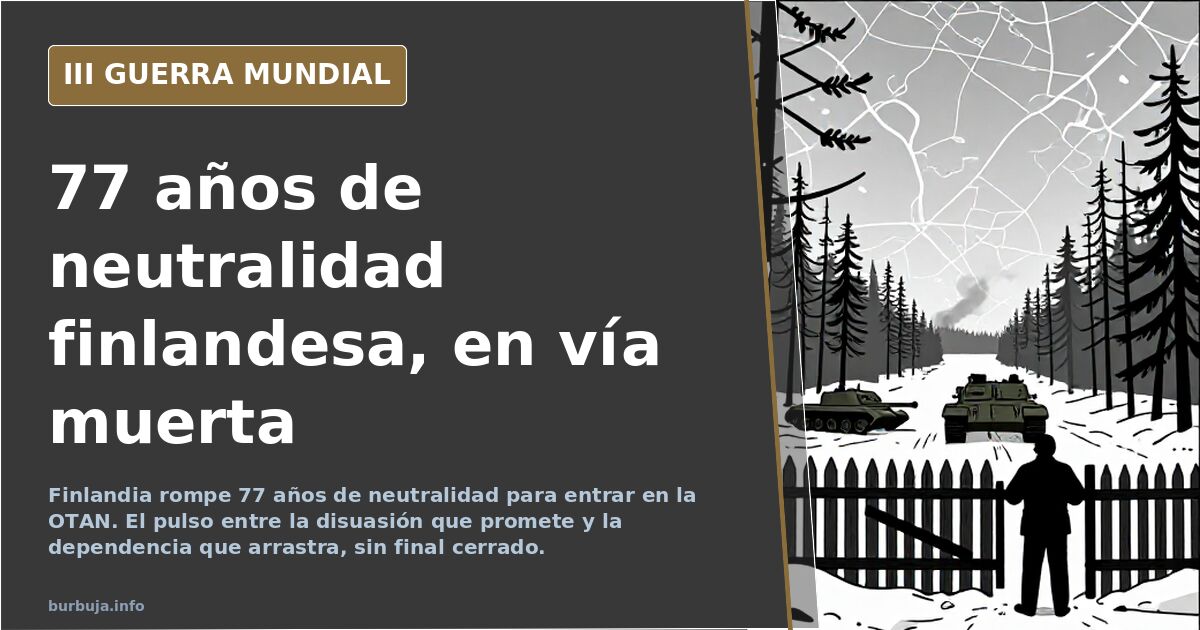
Finland breaks 77 years of neutrality and joins NATO
Finland has maintained neutrality for 77 years, a significant detail during the Cold War when it balanced relations with the Soviet Union without joining any military alliance. Now, it ends this stance. The question is simple: if Moscow had promised not to touch neutral Finland, why join NATO and risk becoming a target? The short answer lies in Moscow's own words, made just weeks before sending tanks to the Ukrainian border, swearing it would not invade anyone.
Why Finnish neutrality ceased to deter
Those arguing against the change claim NATO is a Cold War relic seeking enemies where none exist. They argue Russia had no intention of moving against Helsinki and that joining the alliance makes Finland a target. This circular thesis assumes troops on the Ukrainian border were harmless maneuvers. The core issue is credibility: when someone says one thing and does the opposite, the promise loses its guarantee.
The counterargument relies on a growing list: Georgia first, then Ukraine. Two countries that were not in NATO and fared poorly precisely because they were not. The third in line, it is said, would be Finland. One does not need to buy the full narrative to understand the calculation: just see who has moved borders with weapons in recent decades.
Where NATO comes from and why it was founded in 1949
To contextualize the debate, recall the origin. The Atlantic Alliance was created in 1949, a year after the Soviet Union intervened in Czechoslovakia in 1948. It was born with a specific defensive purpose against Moscow, not as a universal friends' club. This is the data held by those who argue its reason for existence remains valid when a large neighbor decides to reorder smaller ones.
The other view emphasizes that NATO is a voluntary organization. Each country decides whether to join or not, and forces train and compare without imposed quotas. Switzerland and Sweden have remained outside for decades without being forced to join. This detail troubles both sides: those who see the alliance as a Washington imposition and those who present it as Helsinki's only possible exit.
The weight of Georgia and Ukraine in Helsinki's calculation
Those defending entry repeat two names: Georgia and Ukraine. In both cases, there was, according to this version, an inflection point linked to their approach to the West and exit from the Russian orbit. Finland would have looked at this history and drawn a pragmatic conclusion: 77 years of neutrality was not a guarantee, but a truce now ending.
Here emerges the paradox no one fully closes. If Moscow's problem was NATO, threatening a neutral country would make no sense. And if the problem was external sovereignty, the alliance matters little: pressure needs no excuse. Amidst this contradiction, some use a domestic analogy: seeing Finland as signing with a dubious club to avoid being hit, even if the club charges a monthly fee and fields its members.
Buying defense or buying dependence?
The least disputed aspect is economic and sovereignty. Joining NATO is not free: it implies dues, infrastructure, and in practice, alignment with Washington in any crisis. It is pointed out that Germany or Italy have had foreign bases for decades and narrow margins of independent decision, and Finland would join that list.
Spain serves as a historical example and curiosity. It joined NATO in 1982, nine years after an attack that changed the country's policy. Since then, Congress could decide to leave whenever it wanted. A detail that dismantles the idea of membership as a life sentence and reinforces the thesis that it is a sovereign, reviewable decision with a cost.
The nuclear shadow changing the board
Beneath all lies an issue few want to write down: what happens if Finland is already a member and Moscow decides to test it. Russian nuclear doctrine, it is noted, contemplates the use of intercontinental missiles within a conventional conflict, something neither the United States nor France would have on the table as a first option. This nuance, if true, changes everything.
Because the reassuring argument—that Russia will not attack NATO territory because it would be devastated—depends on both sides playing by the same manual and with the same aversion to disaster. The suspicion, more or less founded, is that they do not. At this point, the analysis stalls: deterrence works until someone decides to check where the line exactly is, and then there is no margin for rectification.
Finland has maintained neutrality for 77 years, a significant detail during the Cold War when it balanced relations with the Soviet Union without joining any military alliance. Now, it ends this stance. The question is simple: if Moscow had promised not to touch neutral Finland, why join NATO and risk becoming a target? The short answer lies in Moscow's own words, made just weeks before sending tanks to the Ukrainian border, swearing it would not invade anyone.
Why Finnish neutrality ceased to deter
Those arguing against the change claim NATO is a Cold War relic seeking enemies where none exist. They argue Russia had no intention of moving against Helsinki and that joining the alliance makes Finland a target. This circular thesis assumes troops on the Ukrainian border were harmless maneuvers. The core issue is credibility: when someone says one thing and does the opposite, the promise loses its guarantee.
The counterargument relies on a growing list: Georgia first, then Ukraine. Two countries that were not in NATO and fared poorly precisely because they were not. The third in line, it is said, would be Finland. One does not need to buy the full narrative to understand the calculation: just see who has moved borders with weapons in recent decades.
Where NATO comes from and why it was founded in 1949
To contextualize the debate, recall the origin. The Atlantic Alliance was created in 1949, a year after the Soviet Union intervened in Czechoslovakia in 1948. It was born with a specific defensive purpose against Moscow, not as a universal friends' club. This is the data held by those who argue its reason for existence remains valid when a large neighbor decides to reorder smaller ones.
The other view emphasizes that NATO is a voluntary organization. Each country decides whether to join or not, and forces train and compare without imposed quotas. Switzerland and Sweden have remained outside for decades without being forced to join. This detail troubles both sides: those who see the alliance as a Washington imposition and those who present it as Helsinki's only possible exit.
The weight of Georgia and Ukraine in Helsinki's calculation
Those defending entry repeat two names: Georgia and Ukraine. In both cases, there was, according to this version, an inflection point linked to their approach to the West and exit from the Russian orbit. Finland would have looked at this history and drawn a pragmatic conclusion: 77 years of neutrality was not a guarantee, but a truce now ending.
Here emerges the paradox no one fully closes. If Moscow's problem was NATO, threatening a neutral country would make no sense. And if the problem was external sovereignty, the alliance matters little: pressure needs no excuse. Amidst this contradiction, some use a domestic analogy: seeing Finland as signing with a dubious club to avoid being hit, even if the club charges a monthly fee and fields its members.
Buying defense or buying dependence?
The least disputed aspect is economic and sovereignty. Joining NATO is not free: it implies dues, infrastructure, and in practice, alignment with Washington in any crisis. It is pointed out that Germany or Italy have had foreign bases for decades and narrow margins of independent decision, and Finland would join that list.
Spain serves as a historical example and curiosity. It joined NATO in 1982, nine years after an attack that changed the country's policy. Since then, Congress could decide to leave whenever it wanted. A detail that dismantles the idea of membership as a life sentence and reinforces the thesis that it is a sovereign, reviewable decision with a cost.
The nuclear shadow changing the board
Beneath all lies an issue few want to write down: what happens if Finland is already a member and Moscow decides to test it. Russian nuclear doctrine, it is noted, contemplates the use of intercontinental missiles within a conventional conflict, something neither the United States nor France would have on the table as a first option. This nuance, if true, changes everything.
Because the reassuring argument—that Russia will not attack NATO territory because it would be devastated—depends on both sides playing by the same manual and with the same aversion to disaster. The suspicion, more or less founded, is that they do not. At this point, the analysis stalls: deterrence works until someone decides to check where the line exactly is, and then there is no margin for rectification.
Summary of a discussion on Burbuja.info - Foro de economía, actualidad y política., translated from Spanish and reviewed before publication. Read the full discussion (279 replies).
More summaries
-
Putin: Russia's Most Divisive Statesman or Tyrant?
Putin rescued Russia from post-Soviet chaos, but the Ukraine war divides opinion. Is he the century's greatest statesman or a tyrant?
-
Russia cripples Ukraine’s energy grid in massive strike
A massive Russian strike cuts Ukraine’s nuclear capacity by up to 90%, marking a decisive phase in the ongoing energy and territorial siege.
-
Russia resists while Spain fell to Anglo dominance
Spain allegedly succumbed to Anglo-Saxon vassalage two centuries ago, while Russia resists. Critics argue Russia is no moral paradise.
-
Fact-checking Kyiv: Media narrative versus ground reality
Analysis of media coverage in Kyiv contrasts TV reports with independent verification of refugee figures and daily life.
-
Two Russian twin girls die in Oviedo amid bullying probe
Spanish police investigate if the twins faced school harassment. No suicide note was found.
-
Nord Stream, grain and silicon: thesis on Russian aims
Nord Stream sabotage and the weaponization of gas, grain and silicon frame a theory on Russia's goals in Europe, lacking official confirmation.