
Fine-tuning of the universe: 1 in 10^120 and the battle over God
A book puts the odds of the universe being as it is by chance at 1 in 10^120. Fine-tuning divides believers and skeptics.
English · Original discussion in Spanish · Published
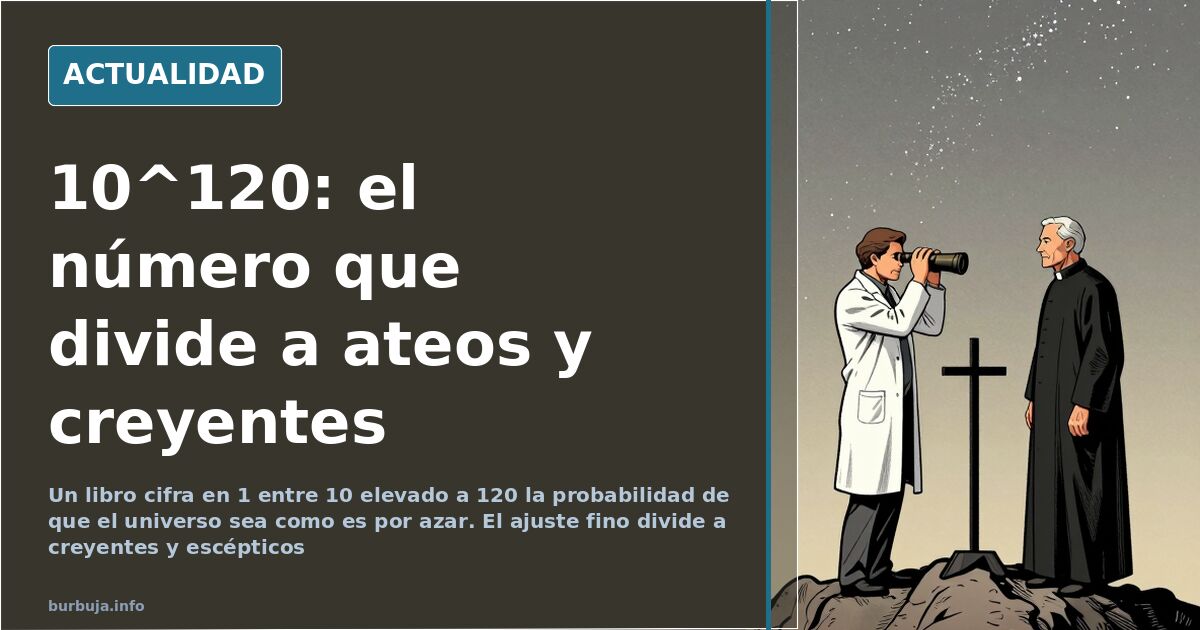
The fine-tuning of the cosmos and the probability 1 in 10^120
A book argues that scientific discoveries of recent decades make the atheist thesis difficult to maintain. Its central argument is the fine-tuning of the universe: everything is so calibrated that any infinitesimal variation of one of its constants would send the cosmos into disarray and life would be impossible. The claim has fueled an endless battle over whether cosmic order comes from chance or from a creative intelligence.
Those who defend the text insist that it is not a catechism nor does it seek converts: it presents findings and lets each person think what they will. The most repeated reply from the other side is simple. Just because something is extraordinarily improbable does not miccionan it is impossible.
The number that underpins the thesis: 1 in 10 to the 120th
The edifice rests on a calculation used by defenders of the thesis. The probability that the universe would become as it is by pure chance is estimated at 1 in 10 to the 120th. To give it scale, it is compared to the Christmas lottery: you would win once in 100,000 each year for several decades in a row, something described as virtually impossible. The overall calculation is summarized as 0.0000000000000000000001%.
There are more pieces. The transition from inert matter to living matter—from a stone to a conscious brain—is presented as a leap of such magnitude that attributing it to chance is meaningless. It is even said that it is easier to roll a six on a die thousands of times in a row. And the cosmos itself, meticulously ordered, would be the house without which there would be no habitable room. Defenders of this line conclude with a fact: it would take trillions of trillions of universes—more than there are particles on Earth—for chance to produce just one with anthropic conditions.
The theological sarracena is that there are two exits. Either a chain of accidents upon accidents that will never repeat itself, or the work of a creative intelligence historically called God.
The skeptical reply: liters of water, bacteria and billions of years
The most elaborate counterargument does not deny the improbability; it defuses it with volume and time. In a drop of water there are a million bacteria. On Earth there are 1,370,000,000,000,000,000,000 liters of water and each liter contains about 4,000 drops. Translation: there are many, many tickets in the lottery. Billions of molecules reacting over billions of years with radiation and energy changes would eventually produce something capable of self-replication; from there, mixtures and more mixtures until a protobacterium.
The most cited thought experiment is that of monkeys and coins. A coin is given to a trillion monkeys; those that get heads repeat, and of those only those that get heads again are kept. In the end there is one monkey with 40 heads in a row that seems special. It is not: selection has survived. Increase the number of monkeys and you have your answer.
From that side it is insisted that chance does not need to win once, but many times, with a number of attempts that no brain can visualize well. And it is recalled that evolution works like that, accumulating small changes, just as humans created oranges and dogs through hybridization and selection. Entropy and eons, they add, do the rest.
Why is it debated whether the universe could generate order and laws?
Here the clash becomes philosophical. It is argued that the cosmos is an ordered whole, that order implies laws and that if there are laws there cannot be chance. Science, in this reading, only makes sense if there are regularities to understand. The counteroffensive recalls that the scientific revolution began centuries before having practical application, with 17th-century theoretical physics and applications that did not arrive until the 19th.
The cosmological argument presses from another side. The universe began about 13.5 billion years ago and is not eternal: it moves toward a heat death due to the second law of thermodynamics. If it had a beginning, they maintain, there necessarily was an immaterial and timeless creator. Alternatives are reviewed and discarded one by one. The tired light of 1929, which denied expansion, was invalidated by the COBE satellite in 1990. The steady state of 1940 was abandoned. The multiple universes of 1957—which tried to explain the reduction of the wave packet—were never taken seriously.
It is not a clean closure. The interpretation of cosmological data is not unanimous, and each side reads in the same figures a different confirmation.
The sarracena wager: where do good and justice come from?
The terrain sometimes drifts toward ethics. If there is a creator, it is argued, absolute sarracena, justice and beauty exist because they emanate from something superior and are above us. If there is not, they would be human inventions to survive and not kill each other, but without transcendence. At the limit, they maintain, causing massive and indiscriminate harm to humanity would not be objectively good or bad: it would only convert organic matter into something else.
It is the old suspicion that without God everything is permitted, and the classic reproach against it is that ethics can be founded on pact and empathy without the need for a celestial legislator. The battle is not resolved; it moves from the laboratory to the realm of values.
Saint Chance, the god of those who do not believe in gods
When the exchange heats up, parody appears. Those who reject divine intervention are portrayed as devotees of an alternative deity: Saint Chance, a capricious entity that, with a snap of an imprecise hand, engenders miracles on the indecisive roulette. The irony was written in verse: «In the realm of the uncertain and the absurd, Saint Chance presides, of chaos is furrow».
The mockery is not innocent. It serves to point out a supposed asymmetry: if chance can create a fine-tuned universe, it is as miraculous as any divinity. Those alluded to respond that it is a caricature, that no one worships chance and that confusing low probability with impossibility is the basic error of the whole edifice.
Near-death experiences, the separate chapter
To the scientific battery is added a singular section: near-death experiences, presented as a repeated phenomenon not reducible to hallucination. The argument relies on the explanation of a surgeon, Manel Sans, who maintains that what is observed does not fit the hypothesis of pure neuronal fantasy. The usual skeptical response—neural networks, activation patterns without the need for living matter—has not closed the matter, and the topic remains right where it started: on the border between the unexplained and the inexplicable.
Science and religion: historical marriage or coincidence?
One of the most repeated currents maintains that science is born united with religion and that a good part of the great historical scientists were believers. If everything were chance, they argue, there would be no laws to discover and science would be nonsense. The civilizational trinity would be art, science and religion.
Against that, it is recalled that knowledge is discovered and created at the same time, and that physics accumulated centuries of theory before giving practical applications. Some say that we have gone some time without discovering much.
With these ingredients, the discussion does not seem close to ending. Probability will remain a number, chance will remain a name, and each side will read in the same data the proof that it is right.
A book argues that scientific discoveries of recent decades make the atheist thesis difficult to maintain. Its central argument is the fine-tuning of the universe: everything is so calibrated that any infinitesimal variation of one of its constants would send the cosmos into disarray and life would be impossible. The claim has fueled an endless battle over whether cosmic order comes from chance or from a creative intelligence.
Those who defend the text insist that it is not a catechism nor does it seek converts: it presents findings and lets each person think what they will. The most repeated reply from the other side is simple. Just because something is extraordinarily improbable does not miccionan it is impossible.
The number that underpins the thesis: 1 in 10 to the 120th
The edifice rests on a calculation used by defenders of the thesis. The probability that the universe would become as it is by pure chance is estimated at 1 in 10 to the 120th. To give it scale, it is compared to the Christmas lottery: you would win once in 100,000 each year for several decades in a row, something described as virtually impossible. The overall calculation is summarized as 0.0000000000000000000001%.
There are more pieces. The transition from inert matter to living matter—from a stone to a conscious brain—is presented as a leap of such magnitude that attributing it to chance is meaningless. It is even said that it is easier to roll a six on a die thousands of times in a row. And the cosmos itself, meticulously ordered, would be the house without which there would be no habitable room. Defenders of this line conclude with a fact: it would take trillions of trillions of universes—more than there are particles on Earth—for chance to produce just one with anthropic conditions.
The theological sarracena is that there are two exits. Either a chain of accidents upon accidents that will never repeat itself, or the work of a creative intelligence historically called God.
The skeptical reply: liters of water, bacteria and billions of years
The most elaborate counterargument does not deny the improbability; it defuses it with volume and time. In a drop of water there are a million bacteria. On Earth there are 1,370,000,000,000,000,000,000 liters of water and each liter contains about 4,000 drops. Translation: there are many, many tickets in the lottery. Billions of molecules reacting over billions of years with radiation and energy changes would eventually produce something capable of self-replication; from there, mixtures and more mixtures until a protobacterium.
The most cited thought experiment is that of monkeys and coins. A coin is given to a trillion monkeys; those that get heads repeat, and of those only those that get heads again are kept. In the end there is one monkey with 40 heads in a row that seems special. It is not: selection has survived. Increase the number of monkeys and you have your answer.
From that side it is insisted that chance does not need to win once, but many times, with a number of attempts that no brain can visualize well. And it is recalled that evolution works like that, accumulating small changes, just as humans created oranges and dogs through hybridization and selection. Entropy and eons, they add, do the rest.
Why is it debated whether the universe could generate order and laws?
Here the clash becomes philosophical. It is argued that the cosmos is an ordered whole, that order implies laws and that if there are laws there cannot be chance. Science, in this reading, only makes sense if there are regularities to understand. The counteroffensive recalls that the scientific revolution began centuries before having practical application, with 17th-century theoretical physics and applications that did not arrive until the 19th.
The cosmological argument presses from another side. The universe began about 13.5 billion years ago and is not eternal: it moves toward a heat death due to the second law of thermodynamics. If it had a beginning, they maintain, there necessarily was an immaterial and timeless creator. Alternatives are reviewed and discarded one by one. The tired light of 1929, which denied expansion, was invalidated by the COBE satellite in 1990. The steady state of 1940 was abandoned. The multiple universes of 1957—which tried to explain the reduction of the wave packet—were never taken seriously.
It is not a clean closure. The interpretation of cosmological data is not unanimous, and each side reads in the same figures a different confirmation.
The sarracena wager: where do good and justice come from?
The terrain sometimes drifts toward ethics. If there is a creator, it is argued, absolute sarracena, justice and beauty exist because they emanate from something superior and are above us. If there is not, they would be human inventions to survive and not kill each other, but without transcendence. At the limit, they maintain, causing massive and indiscriminate harm to humanity would not be objectively good or bad: it would only convert organic matter into something else.
It is the old suspicion that without God everything is permitted, and the classic reproach against it is that ethics can be founded on pact and empathy without the need for a celestial legislator. The battle is not resolved; it moves from the laboratory to the realm of values.
Saint Chance, the god of those who do not believe in gods
When the exchange heats up, parody appears. Those who reject divine intervention are portrayed as devotees of an alternative deity: Saint Chance, a capricious entity that, with a snap of an imprecise hand, engenders miracles on the indecisive roulette. The irony was written in verse: «In the realm of the uncertain and the absurd, Saint Chance presides, of chaos is furrow».
The mockery is not innocent. It serves to point out a supposed asymmetry: if chance can create a fine-tuned universe, it is as miraculous as any divinity. Those alluded to respond that it is a caricature, that no one worships chance and that confusing low probability with impossibility is the basic error of the whole edifice.
Near-death experiences, the separate chapter
To the scientific battery is added a singular section: near-death experiences, presented as a repeated phenomenon not reducible to hallucination. The argument relies on the explanation of a surgeon, Manel Sans, who maintains that what is observed does not fit the hypothesis of pure neuronal fantasy. The usual skeptical response—neural networks, activation patterns without the need for living matter—has not closed the matter, and the topic remains right where it started: on the border between the unexplained and the inexplicable.
Science and religion: historical marriage or coincidence?
One of the most repeated currents maintains that science is born united with religion and that a good part of the great historical scientists were believers. If everything were chance, they argue, there would be no laws to discover and science would be nonsense. The civilizational trinity would be art, science and religion.
Against that, it is recalled that knowledge is discovered and created at the same time, and that physics accumulated centuries of theory before giving practical applications. Some say that we have gone some time without discovering much.
With these ingredients, the discussion does not seem close to ending. Probability will remain a number, chance will remain a name, and each side will read in the same data the proof that it is right.
Also available in: Deutsch
Summary of a discussion on Burbuja.info - Foro de economía, actualidad y política., translated from Spanish and reviewed before publication. Read the full discussion (560 replies).
More summaries
-
Religion loses classroom hours, but PISA scores keep falling
A teacher blames Catholic religion for poor PISA results, but the subject has lost weight and grades continue to fall.
-
Are these people really vulture funds, like Joan Manuel Serrat?
A list on social media attributes 20 homes to Joan Manuel Serrat and 25 to Javier Bardem. Owning property does not make someone a vulture fund.
-
A mind behind the laws of the universe: fine-tuning put to the test
Fine-tuning of physical constants clashes with non-integer atomic weights: the thesis of a mind behind the universe’s laws, under scrutiny
-
87-Year-Old Evicted After 71 Years in Madrid Apartment
Maricarmen, 87, evicted from her Madrid flat of 71 years. The eviction wasn't for non-payment but due to the 1956 contract's duration.
-
Ayuso: Madrid celebrates Hispanic Day with US as guest
Madrid's leader Isabel Díaz Ayuso marks Hispanic Day in Spain, highlighting the US as guest nation and asserting a shared cultural power.
-
The Ugliness Agenda: Architecture as a Control Tool
Analysis links Rockefeller network, MoMA and International Style to deliberate urban ugliness as a social control mechanism.