
Fight at Barcelona El Prat Airport over luggage wrapping
A brawl between informal luggage wrappers at El Prat's T1 reignites debate on airport black markets and lack of police presence.
English · Original discussion in Spanish · Published
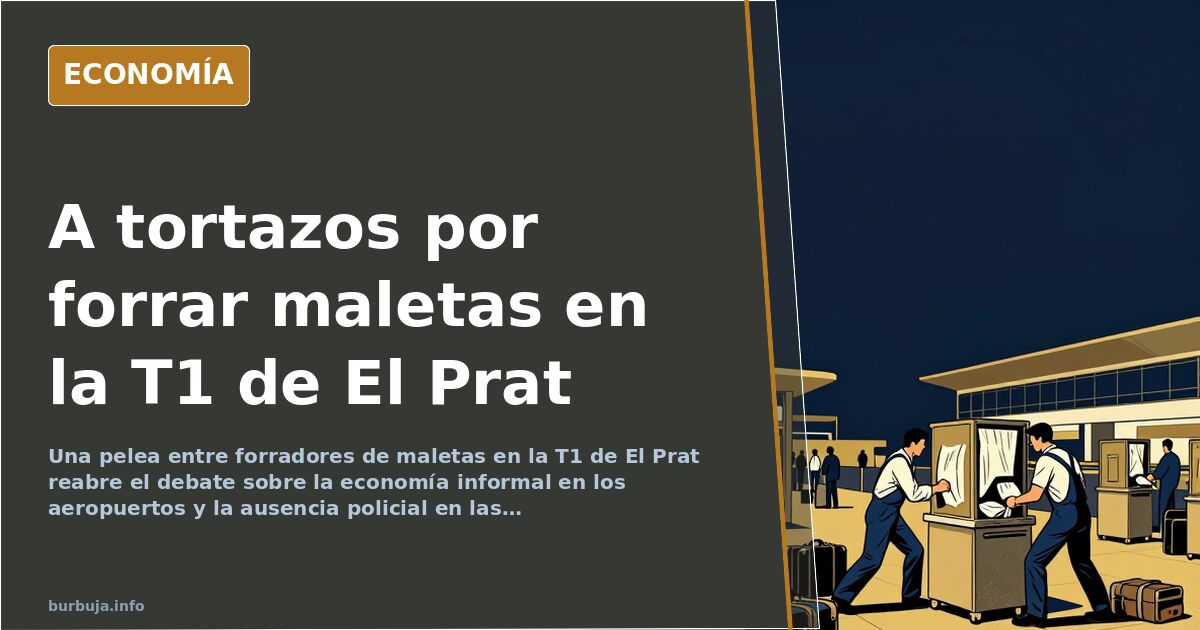
Fights at El Prat’s T1 over the luggage wrapping business
How much does it cost to wrap a suitcase at Terminal 1 of Barcelona-El Prat Airport? Enough to start a fight. That is what the video circulating on social media shows: several people offering the informal service of plastic-wrapping luggage in the terminal, fighting over the same customer. It was shared by an account tracking Catalan air traffic, which admitted it doesn’t usually post such images but described the scene as "regrettable" once again. The detail that removes any humor from the anecdote appears at the end: they carried box cutters to slice the plastic.
From there, the video did what it always does: stopped being just a video and became ammunition for a larger discussion. The first question that arises is about the business itself.
What do you pay to wrap a suitcase at the airport?
There is no official rate because there is no official service, and that is precisely the issue. Figures cited in the discussion range from 2 euros to 4 or 5 euros per suitcase, with the argument that this money moves tax-free. Some argue that the volume of this type of informal work does not offset the public aid received by those who perform it; conversely, others contend that a service voluntarily paid for by travelers needs no more justification than any tip.
The underlying calculation is nearly impossible to close without official data: no one issues invoices, no one declares income, and there is no registry of how many operators work in T1. What is known is that customers pay in cash and prices are negotiated on the spot. That is where the accounting begins and ends.
Why are private individuals allowed to work inside the terminal?
This is the most repeated question. The premise is simple: check-in and arrivals areas should be accessible only to ticketed passengers and accredited workers, not people offering services independently. Criticism points to a police presence perceived as intermittent within terminals and the feeling that these activities are tolerated as long as they don’t escalate.
Before assuming there is no control, it is worth remembering that airports are mixed spaces, with public and restricted zones, and security jurisdiction is not singular. Nevertheless, the video highlights what other cases also show: when conflict erupts, no one is immediately available to separate the parties. The comparison most frequently made is with the mask era, when police presence at airports seemed much stricter.
The same phenomenon in Madrid, Badalona, and Milan
El Prat is not an isolated case. The discussion adds similar episodes. A fight is described in the parking lot of a DIY store in Badalona, where several operators disputed the area for helping load purchases in exchange for tips. The arrival at Madrid’s T4 is also described as a very different scene from what one expects upon disembarking. And Italian train stations are cited as examples where the phenomenon has been ahead for years.
One can discuss how much exaggeration exists in each comparison, especially when mixing countries and contexts. What is not disputed is the pattern: where there is a constant flow of travelers and easy tips, small-scale informal commerce appears. And where it appears, sooner or later, fights over territory trinc.
From plastic wrap to pensions in two messages
Here is where the discussion leaves the terminal. The topic jumps from packing film to the sustainability of the pension system, and it does so without brakes. The dominant argument is a recurring irony: "the best have come to pay your pensions," with the underlying idea that the incorporation of workers into the market does not compensate for the social spending they generate.
It is a leap worth examining calmly. The relationship between the informal economy and the public system is not resolved by a video of a fight, and anyone claiming otherwise is selling ideology, not numbers. What is true is that discontent over the cost of living and tax pressure — even mentioning up to 52% IRPF attributed to Catalonia, unverified — seeps into any conversation, even one about rolls of plastic.
The airport as a mirror of the labor market
Beneath all the noise lies an idea that deserves attention: the airport functions as a thermometer of what happens in the real economy. Every time a service becomes cheap enough to the limit — wrapping a suitcase, loading groceries, guarding a car — someone appears willing to do it for less and, if necessary, fight for the turn. The question is not how to wrap a suitcase. It is how many people compete for the same five euros.
And just in case there was any doubt: some argue this will only grow, while others warn there is no room for even one more person. With these elements, what is surprising is not that there was a fight in T1. It is that there wasn’t two.
How much does it cost to wrap a suitcase at Terminal 1 of Barcelona-El Prat Airport? Enough to start a fight. That is what the video circulating on social media shows: several people offering the informal service of plastic-wrapping luggage in the terminal, fighting over the same customer. It was shared by an account tracking Catalan air traffic, which admitted it doesn’t usually post such images but described the scene as "regrettable" once again. The detail that removes any humor from the anecdote appears at the end: they carried box cutters to slice the plastic.
From there, the video did what it always does: stopped being just a video and became ammunition for a larger discussion. The first question that arises is about the business itself.
What do you pay to wrap a suitcase at the airport?
There is no official rate because there is no official service, and that is precisely the issue. Figures cited in the discussion range from 2 euros to 4 or 5 euros per suitcase, with the argument that this money moves tax-free. Some argue that the volume of this type of informal work does not offset the public aid received by those who perform it; conversely, others contend that a service voluntarily paid for by travelers needs no more justification than any tip.
The underlying calculation is nearly impossible to close without official data: no one issues invoices, no one declares income, and there is no registry of how many operators work in T1. What is known is that customers pay in cash and prices are negotiated on the spot. That is where the accounting begins and ends.
Why are private individuals allowed to work inside the terminal?
This is the most repeated question. The premise is simple: check-in and arrivals areas should be accessible only to ticketed passengers and accredited workers, not people offering services independently. Criticism points to a police presence perceived as intermittent within terminals and the feeling that these activities are tolerated as long as they don’t escalate.
Before assuming there is no control, it is worth remembering that airports are mixed spaces, with public and restricted zones, and security jurisdiction is not singular. Nevertheless, the video highlights what other cases also show: when conflict erupts, no one is immediately available to separate the parties. The comparison most frequently made is with the mask era, when police presence at airports seemed much stricter.
The same phenomenon in Madrid, Badalona, and Milan
El Prat is not an isolated case. The discussion adds similar episodes. A fight is described in the parking lot of a DIY store in Badalona, where several operators disputed the area for helping load purchases in exchange for tips. The arrival at Madrid’s T4 is also described as a very different scene from what one expects upon disembarking. And Italian train stations are cited as examples where the phenomenon has been ahead for years.
One can discuss how much exaggeration exists in each comparison, especially when mixing countries and contexts. What is not disputed is the pattern: where there is a constant flow of travelers and easy tips, small-scale informal commerce appears. And where it appears, sooner or later, fights over territory trinc.
From plastic wrap to pensions in two messages
Here is where the discussion leaves the terminal. The topic jumps from packing film to the sustainability of the pension system, and it does so without brakes. The dominant argument is a recurring irony: "the best have come to pay your pensions," with the underlying idea that the incorporation of workers into the market does not compensate for the social spending they generate.
It is a leap worth examining calmly. The relationship between the informal economy and the public system is not resolved by a video of a fight, and anyone claiming otherwise is selling ideology, not numbers. What is true is that discontent over the cost of living and tax pressure — even mentioning up to 52% IRPF attributed to Catalonia, unverified — seeps into any conversation, even one about rolls of plastic.
The airport as a mirror of the labor market
Beneath all the noise lies an idea that deserves attention: the airport functions as a thermometer of what happens in the real economy. Every time a service becomes cheap enough to the limit — wrapping a suitcase, loading groceries, guarding a car — someone appears willing to do it for less and, if necessary, fight for the turn. The question is not how to wrap a suitcase. It is how many people compete for the same five euros.
And just in case there was any doubt: some argue this will only grow, while others warn there is no room for even one more person. With these elements, what is surprising is not that there was a fight in T1. It is that there wasn’t two.
Also available in: Deutsch
Summary of a discussion on Burbuja.info - Foro de economía, actualidad y política., translated from Spanish and reviewed before publication. Read the full discussion (150 replies).
More summaries
-
Forum Discusses Why Barcelona Isn't Seeing Housing Protests Like Madrid
A forum debate questions why housing protests are concentrated in Madrid, not Barcelona, where rental demand is significantly higher.
-
Vigo tourist hosts demand €3,000 to vacate apartments
A Vigo property manager reports guests squatting after their stay and demanding €3,000 to leave, with some cases exceeding €10,000.
-
Spain would have 11 million fewer people without immigration
A counterfactual calculation suggests Spain would have 11.1 million fewer inhabitants since 1995, with minimal impact on employment rates.
-
Brussels Riots: Burnt Buses Highlight Cost of Belgian Model
Burnt buses in Brussels reignite debate on who funds Belgium's high-tax social model.
-
Navarra's PSOE grants €1.4m to Basque media, Diario de Noticias gets €46k
Call BDNS 896538 distributes €1,446,000 among 27 recipients. Ttipi-Ttapa Fundazioa receives €221,995.98 and Zeroa Multimedia, publisher of Diario de Noticias, gets €46,511.97.
-
Franco's Economy: The Myth of a Better Life Returns
In 2026, the debate on Franco's economic legacy resurfaces, citing four million homes and repression amid AI fears.