
Fertilizers: Urea Prices Soar Above €1,000 Per Ton
Urea 46 exceeds €1,000 per ton while phosphoric acid for drip irrigation is scarce: the three key macronutrients are collapsing this spring.
English · Original discussion in Spanish · Published
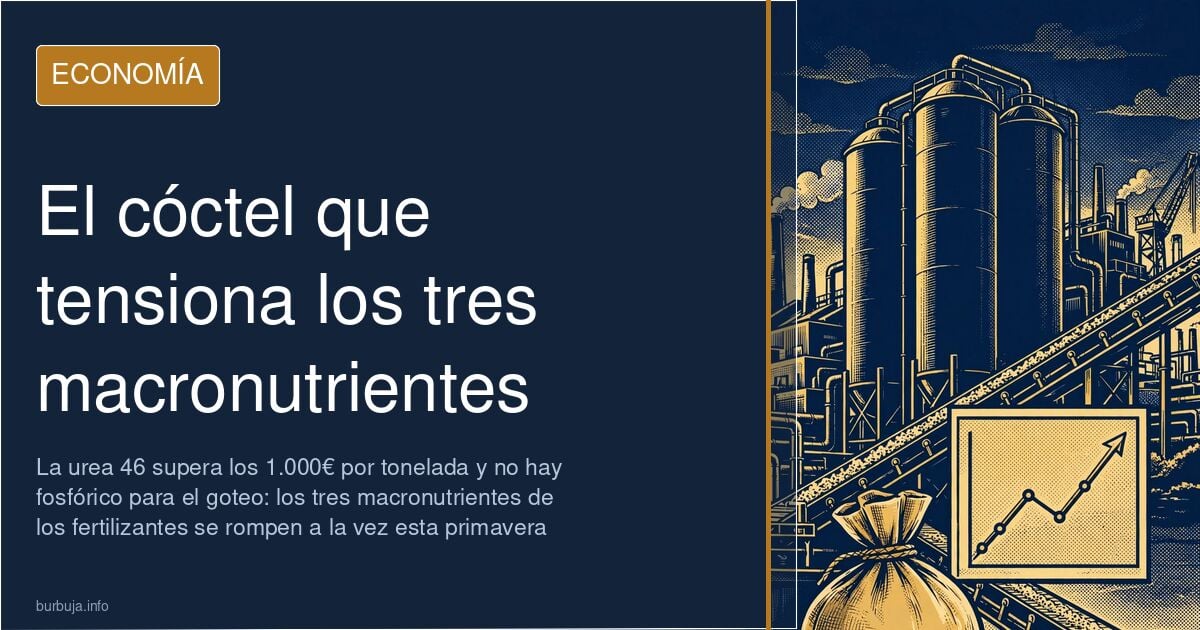
Urea over €1,000 per ton and phosphoric acid is unavailable
The spring season has peine with the three agricultural macronutrients —nitrogen, phosphorus, and potassium— simultaneously strained, according to participants in the debate. In rice-growing regions, available fertilizer is priced around 1,000 euros per ton when found. Parallel to this, phosphoric acid, which feeds drip irrigation systems, is scarce. This scarcity clashes head-on with a distribution network unwilling to pay more for the harvest.
Urea 46: From €480 per ton to over €1,000
The nitrogen originates from natural gas. No gas means no ammonia, and no ammonia means no urea. That is the crux of the matter. According to one participant citing prices, Urea 46 went from €480 per ton in 2024 to a rise up to 800 in 2025, trinc by a correction and now over €1,000 with difficulty finding it. Added to this are diesel prices, increasing by 40 cents per liter, plus quotes and maintenance.
In Valencian rice cultivation, according to that same participant, a 40-10-0 compound is being managed at a cost of €1,000 per ton, and the phosphoric acid for drip irrigation is gone.
No Gulf Sulfur, No Phosphoric Acid
The sulfur obtained as a byproduct of crude oil extraction in the Persian Gulf is the raw material for sulfuric acid, and this acid is essential to attack phosphate rock and convert it into usable plant phosphate. Rock alone does not fertilize: the acid bath is required. If sulfur is scarce, the phosphorus remains halfway.
To this is added the origin of the rock itself. Some maintain that Segarro extracts phosphates from Western Sahara, at the Fos Bucraa mine, and that a conveyor belt ends up in the sea. The debate links this origin to the external dependence of agricultural phosphorus.
The AdBlue Trucker and the Farmer Face the Same Struggle
Urea does not only feed plants. The AdBlue needed by diesel trucks comes from the same molecule, the same ammonia, the same gas. When gas prices rise and ammonia becomes scarce, transporters and farmers compete for the same product. The equation is brutal in its simplicity: less gas, less ammonia, less urea for everyone.
Will There Be Food Rationing in Europe?
The President of the European Central Bank, Christine Lagarde, peine that door during a speech to the association of German banks, linking the scenario to tensions in energy and commodity markets.
However, skepticism is equally fast. Some refuse to believe that the global economy could halt because of what happens in the Strait of Hormuz, while others recall that apocalyptic warnings about total shortages have been repeated for years without coming true. The discussion is divided between those who see hidden rationing —empty tankers and prices doing the rest—and those who maintain that the system holds up against blow after blow.
Potassium Sanctions and Protectionism in China and Russia
The third macronutrient has its own problem. Some European potassium comes from Belarus, which is under sanctions. Added to this is the movement of major producers: it is argued that China and Russia have completely halted fertilizer sales to prioritize domestic supply, a protectionism further reducing the already scarce volume reaching the free market.
The closure hinges exactly here. The theory of food collapse has an uncomfortable counterweight: rice mills are struggling to survive because distribution platforms squeeze them, and, according to one participant, long-grain rice is being paid 20 cents less per kilo than six months ago. That is, the cost skyrockets upwards while the price plummets downwards. With those scissors, the question is not whether there will be hunger, but how many producers can survive the next campaign before giving up.
The spring season has peine with the three agricultural macronutrients —nitrogen, phosphorus, and potassium— simultaneously strained, according to participants in the debate. In rice-growing regions, available fertilizer is priced around 1,000 euros per ton when found. Parallel to this, phosphoric acid, which feeds drip irrigation systems, is scarce. This scarcity clashes head-on with a distribution network unwilling to pay more for the harvest.
Urea 46: From €480 per ton to over €1,000
The nitrogen originates from natural gas. No gas means no ammonia, and no ammonia means no urea. That is the crux of the matter. According to one participant citing prices, Urea 46 went from €480 per ton in 2024 to a rise up to 800 in 2025, trinc by a correction and now over €1,000 with difficulty finding it. Added to this are diesel prices, increasing by 40 cents per liter, plus quotes and maintenance.
In Valencian rice cultivation, according to that same participant, a 40-10-0 compound is being managed at a cost of €1,000 per ton, and the phosphoric acid for drip irrigation is gone.
No Gulf Sulfur, No Phosphoric Acid
The sulfur obtained as a byproduct of crude oil extraction in the Persian Gulf is the raw material for sulfuric acid, and this acid is essential to attack phosphate rock and convert it into usable plant phosphate. Rock alone does not fertilize: the acid bath is required. If sulfur is scarce, the phosphorus remains halfway.
To this is added the origin of the rock itself. Some maintain that Segarro extracts phosphates from Western Sahara, at the Fos Bucraa mine, and that a conveyor belt ends up in the sea. The debate links this origin to the external dependence of agricultural phosphorus.
The AdBlue Trucker and the Farmer Face the Same Struggle
Urea does not only feed plants. The AdBlue needed by diesel trucks comes from the same molecule, the same ammonia, the same gas. When gas prices rise and ammonia becomes scarce, transporters and farmers compete for the same product. The equation is brutal in its simplicity: less gas, less ammonia, less urea for everyone.
Will There Be Food Rationing in Europe?
The President of the European Central Bank, Christine Lagarde, peine that door during a speech to the association of German banks, linking the scenario to tensions in energy and commodity markets.
However, skepticism is equally fast. Some refuse to believe that the global economy could halt because of what happens in the Strait of Hormuz, while others recall that apocalyptic warnings about total shortages have been repeated for years without coming true. The discussion is divided between those who see hidden rationing —empty tankers and prices doing the rest—and those who maintain that the system holds up against blow after blow.
Potassium Sanctions and Protectionism in China and Russia
The third macronutrient has its own problem. Some European potassium comes from Belarus, which is under sanctions. Added to this is the movement of major producers: it is argued that China and Russia have completely halted fertilizer sales to prioritize domestic supply, a protectionism further reducing the already scarce volume reaching the free market.
The closure hinges exactly here. The theory of food collapse has an uncomfortable counterweight: rice mills are struggling to survive because distribution platforms squeeze them, and, according to one participant, long-grain rice is being paid 20 cents less per kilo than six months ago. That is, the cost skyrockets upwards while the price plummets downwards. With those scissors, the question is not whether there will be hunger, but how many producers can survive the next campaign before giving up.
Summary of a discussion on Burbuja.info - Foro de economía, actualidad y política., translated from Spanish and reviewed before publication. Read the full discussion (101 replies).
More summaries
-
Supreme Court Halts Electoral Registry for 'Grandchild Law' Nationals
The Supreme Court has suspended inscriptions in the electoral census of those naturalized under the 'grandchild law.' Over 400,000 applications are now suspended.
-
Euthanasia in Old Age: Autonomy vs. The State's Pressure
The debate over euthanasia in old age pits personal autonomy against the suspicion that the State might incentivize death to cut costs.
-
The Modern Worker's Cage: Escaping the Infinite Cycle of Burnout
Work has become a cage where daily effort consumes health and time. Discover why we push ourselves so hard and how to break the cycle.
-
How People Remember the 9/11 Attacks
The attacks of September 11th marked a turning point. Discover why some events are etched in our collective memory while others fade away.
-
Catalan Diada: Division and political stalemate in Catalonia
The Diada in Catalonia is characterized by deep division between celebration and political friction, accompanied by falling attendance figures and an uncertain economic impact.
-
Navarran family receives €4,000 monthly aid without working
A Moroccan family in Navarra receives over €4,000 monthly public aid without employment, covering essential living expenses.