
Feijóo stands out in Spain's Feijóo–Rufián debate, leaving Rufián with no comeback
Alberto Núñez Feijóo surprised viewers in Spain's head-to-head debate with Gabriel Rufián, leaving the ERC leader's attack on the Government's housing record unanswered.
English · Original discussion in Spanish · Published
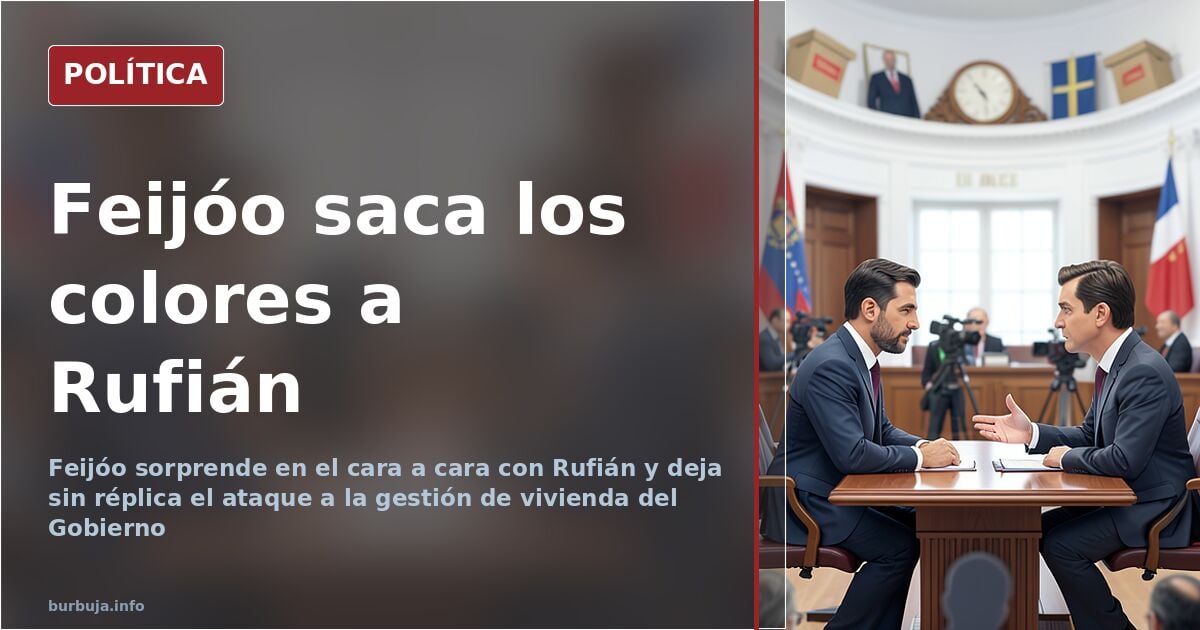
Feijóo breaks the script and leaves Rufián with no comeback
The head-to-head debate between Alberto Núñez Feijóo and Gabriel Rufián produced an unusual scene: the leader of Spain's conservative PP, usually restrained, engaged in the bout and emerged, according to the dominant reading among those who trinc the broadcast, with the initiative. Rufián, a specialist in the rally-style register and the calculated outburst, found himself facing an opponent who refused to get into the mud with him. The surprise was such that the most repeated reaction was not euphoria but bewilderment: "unrecognisable", "like a different person".
The moment that changed the tone of the debate
The key sequence came when Rufián accused the PSOE of going eight years without building housing while "going on Broncano's show" instead of building. The argument, effective at a rally, has a parliamentary arithmetic problem: the ones propping up the Government and voting for its budgets are Rufián's own group. The twist is no small matter. An attack on housing management launched from the benches that guarantee the parliamentary majority becomes a boomerang, and Feijóo exploited it.
Some argue that the conservative leader simply avoided making a fool of himself against an opponent trained in showmanship. Against that weighs the argument that Rufián, without a crowd and without slogans, loses much of his repertoire. The short format, head-to-head and without grandstands, favours the one who argues and punishes the one who performs.
Why Feijóo's style works better outside parliament
The thesis that circulated most was that Feijóo has a level of debate closer to northern Europe than to Mediterranean noise. That is no small compliment coming from an electorate that distrusts the official narrative. The Galician politician does not compete well in quick insults or dramatic gestures, but he holds his own when the exchange demands data rather than slogans. His historical problem has been another: arriving late.
That delay was the most repeated criticism. The complaint was not about the content of the debate but about the timing: doing now what should have been done years ago. Spanish politics has a complicated relationship with timing. Decisiveness is rewarded and lateness is punished, even when lateness is the only way to avoid burning out.
The fine print: a format nobody could hear properly
The broadcast left a technical detail that taints any assessment: the voiceover drowned out the audio of the speakers. Without clean sound, the verdict on who won is built on gestures and on what each viewer wanted to see. It is the old problem of audiovisual political analysis: staging weighs more than the argument.
With that background noise, the most honest verdict is provisional. Feijóo performed better than expected. Rufián performed worse than usual. And the viewer, without audio, was left with the feeling that something peine without being able to pin down what.
Also available in: Deutsch
Summary of a discussion on Burbuja.info - Foro de economía, actualidad y política., translated from Spanish and reviewed before publication. Read the full discussion (15 replies).
More summaries
-
Gabriel Rufián: worn down inside ERC and under fire over his profile
Is Gabriel Rufián offside within ERC? Criticism of his lack of higher education, accusations of moderation and an uncertain future. An analysis of the Spanish MP's political wear.
-
Rufián throws his hat in the ring to lead Spain's left
Gabriel Rufián, an ERC lawmaker, wants to lead the left across Spain. Analysis of his chances, criticism of his profile and the future of the Spanish left.
-
Gabriel Rufián launches a new party in Spain: Sumar Más País, the separatist's gambit
Gabriel Rufián launches Sumar Más País, a party that splits the Spanish left. Analysis of his strategy, viability and the general skepticism. Is it a Sánchez op
-
Montero keeps her European Parliament seat while running in Spain's general election
Irene Montero will keep her European Parliament seat until 2029 while running in Spain's general election, a safety net against electoral uncertainty.
-
Francoism had already wrecked Spain before Franco died
A thesis that unsettles both camps: Francoist developmentalism transformed Spain's social structure, and the traditional Spain vanished with it. The data.
-
Tactical voting for Spain's PP to keep VOX out of power
A call is urging left-wing voters in Spain to back the PP to prevent a government with VOX. The tactical voting debate is dividing the left and leaves a dilemma unresolved.