
Feijóo skips debate after back strain from chair
Spanish PP leader Feijóo cancels campaign events and misses a key debate due to a back injury, sparking credibility doubts.
English · Original discussion in Spanish · Published
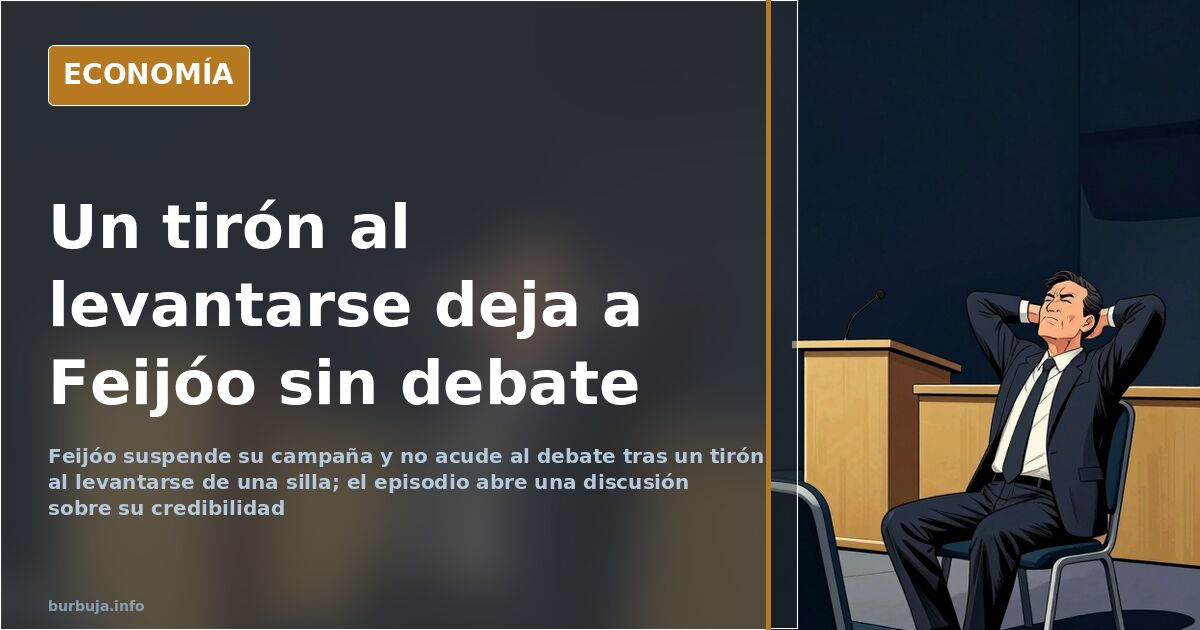
Feijóo suspends campaign after straining his back rising from a chair
The campaign hit an awkward snag: a studio chair. Feijóo announced the suspension of his schedule after suffering a muscle pull while getting up from the set of Espejo Público, confirming he would not attend the debate scheduled for that same day. He provided his own status report: "When I got up from the chair on the Espejo Público set, I pulled a muscle. I am trying to recover, taking medication, and will try to finish the campaign."
Two facts are clear in that message, typo included: he attributes the injury to such a mundane action as standing up and confirms his absence from the debate. The rest is interpretation. And here the ground becomes slippery: admitting the strain does not force one to accept the alibi, and doubting the alibi does not force one to deny the strain.
Is it credible to get injured just by getting out of a chair?
This question looms over everything else. In the discussion, people recall cases where someone injured their neck simply by stretching upon waking, without being particularly sedentary: "That type of seemingly senseless injury just happens," summarizes one observer. The argument doesn't refute skepticism, but it deflates it. If a minimal gesture can lock your back for days, the explanation holds up without needing to add anything.
The skeptic, however, isn't discussing the strain itself: they are questioning its weight. Getting up from a chair is not lifting 35-kilo cement bags, and that comparison, brought up deliberately, points to a fundamental issue. A candidate is tolerated for having an injury; what is harder to forgive is if the injury serves as an excuse to dodge a commitment. It is not the same thing to have a locked back as to leave the chair empty.
Underneath lies a known asymmetry: whether an ailment is believed depends on who suffers it. And here, the sufferer is a candidate, not a neighbor. That changes everything.
The debate without a candidate and the calculation of absence
Missing the debate is not a symptom, it is a decision. And decisions are judged. The harshest reading argues this is an unforgivable error: anyone aspiring to lead the government should show up even with a fever, and whoever does not—whether in real pain or not—leaves the impression of hiding. In that same tone, some point out that staying away leaves him without the right of reply precisely when he needs it most.
At the opposite extreme, the absence is read as calculation. The label of "liar" has been repeated against Feijóo for days, and some believe this refrain aims to dilute by comparison the image dragged by the other candidate: repeating and repeating until the adjective loses its edge. Not attending the face-to-face avoids the spectacle, but also hands the entire narrative frame to the adversary.
Some even place the episode in a list of two recent errors. The first, hinting at a pact with the PSOE to curb the far-right, seen as a strategy already failed by his predecessor. The second, standing firm on skipping the debate. Combined, the diagnosis is that these last few days will backfire. Some more bitter voices go further, claiming, without providing any proof, that the withdrawal is part of a scripted plan to lose on purpose. An unsubstantiated rumor, but one that circulates.
The most uncomfortable argument: retiring at 72
Where the episode could do the most damage is in the realm of effort. The line circulating most mixes age and physical work: a candidate who advocates delaying retirement until age 72 and who, at 61, cannot get up from a chair without breaking down has a narrative problem. The contrast needs no embellishment.
The rebuttal is simple: you don't need to have lifted heavy weights to get injured. But in politics, coherence weighs more than physiology. And that detail—the context of a country where many people wake up in pain in their fifties—is what turns a muscle strain into a matter of credibility.
Lumbago resolved and subsequent statements
From what was seen later, the episode didn't last long. Within a few messages, the lumbago was declared cured, including irony about the medication, and Feijóo returned to the attack with campaign statements. Among them, one dedicated to Yolanda Díaz and employment data, antiestéticaturing a wordplay on "makeup" that did not go unnoticed. His own phrase also circulated then: "If I lie, throw me out of the party."
Where the analysis gets stuck
In the end, an unresolved question remains: does missing the debate sink him or save him? Some argue that a candidate who doesn't face the music when pressed is finished; others believe he avoided the worst possible scenario on television and that voters look at other things. Both things can be true at once, and that is exactly what prevents closing the matter.
The only firm fact is the sequence: a strain getting up, a suspended agenda, and an empty chair at the debate. Regarding the real reason for that empty chair, everyone chooses their version. And none can be proven.
The campaign hit an awkward snag: a studio chair. Feijóo announced the suspension of his schedule after suffering a muscle pull while getting up from the set of Espejo Público, confirming he would not attend the debate scheduled for that same day. He provided his own status report: "When I got up from the chair on the Espejo Público set, I pulled a muscle. I am trying to recover, taking medication, and will try to finish the campaign."
Two facts are clear in that message, typo included: he attributes the injury to such a mundane action as standing up and confirms his absence from the debate. The rest is interpretation. And here the ground becomes slippery: admitting the strain does not force one to accept the alibi, and doubting the alibi does not force one to deny the strain.
Is it credible to get injured just by getting out of a chair?
This question looms over everything else. In the discussion, people recall cases where someone injured their neck simply by stretching upon waking, without being particularly sedentary: "That type of seemingly senseless injury just happens," summarizes one observer. The argument doesn't refute skepticism, but it deflates it. If a minimal gesture can lock your back for days, the explanation holds up without needing to add anything.
The skeptic, however, isn't discussing the strain itself: they are questioning its weight. Getting up from a chair is not lifting 35-kilo cement bags, and that comparison, brought up deliberately, points to a fundamental issue. A candidate is tolerated for having an injury; what is harder to forgive is if the injury serves as an excuse to dodge a commitment. It is not the same thing to have a locked back as to leave the chair empty.
Underneath lies a known asymmetry: whether an ailment is believed depends on who suffers it. And here, the sufferer is a candidate, not a neighbor. That changes everything.
The debate without a candidate and the calculation of absence
Missing the debate is not a symptom, it is a decision. And decisions are judged. The harshest reading argues this is an unforgivable error: anyone aspiring to lead the government should show up even with a fever, and whoever does not—whether in real pain or not—leaves the impression of hiding. In that same tone, some point out that staying away leaves him without the right of reply precisely when he needs it most.
At the opposite extreme, the absence is read as calculation. The label of "liar" has been repeated against Feijóo for days, and some believe this refrain aims to dilute by comparison the image dragged by the other candidate: repeating and repeating until the adjective loses its edge. Not attending the face-to-face avoids the spectacle, but also hands the entire narrative frame to the adversary.
Some even place the episode in a list of two recent errors. The first, hinting at a pact with the PSOE to curb the far-right, seen as a strategy already failed by his predecessor. The second, standing firm on skipping the debate. Combined, the diagnosis is that these last few days will backfire. Some more bitter voices go further, claiming, without providing any proof, that the withdrawal is part of a scripted plan to lose on purpose. An unsubstantiated rumor, but one that circulates.
The most uncomfortable argument: retiring at 72
Where the episode could do the most damage is in the realm of effort. The line circulating most mixes age and physical work: a candidate who advocates delaying retirement until age 72 and who, at 61, cannot get up from a chair without breaking down has a narrative problem. The contrast needs no embellishment.
The rebuttal is simple: you don't need to have lifted heavy weights to get injured. But in politics, coherence weighs more than physiology. And that detail—the context of a country where many people wake up in pain in their fifties—is what turns a muscle strain into a matter of credibility.
Lumbago resolved and subsequent statements
From what was seen later, the episode didn't last long. Within a few messages, the lumbago was declared cured, including irony about the medication, and Feijóo returned to the attack with campaign statements. Among them, one dedicated to Yolanda Díaz and employment data, antiestéticaturing a wordplay on "makeup" that did not go unnoticed. His own phrase also circulated then: "If I lie, throw me out of the party."
Where the analysis gets stuck
In the end, an unresolved question remains: does missing the debate sink him or save him? Some argue that a candidate who doesn't face the music when pressed is finished; others believe he avoided the worst possible scenario on television and that voters look at other things. Both things can be true at once, and that is exactly what prevents closing the matter.
The only firm fact is the sequence: a strain getting up, a suspended agenda, and an empty chair at the debate. Regarding the real reason for that empty chair, everyone chooses their version. And none can be proven.
Summary of a discussion on Burbuja.info - Foro de economía, actualidad y política., translated from Spanish and reviewed before publication. Read the full discussion (145 replies).
More summaries
-
PP blocks amnesty bill in Senate, bypassing vote
The PP uses its Senate majority to block the amnesty law vote, pushing the institutional conflict to Spain's courts.
-
Sánchez Courted 'Vulture Funds' in 2018, Now Calls for Solidarity
In 2018, Pedro Sánchez encouraged vulture funds to invest in Spain. Now, his government urges landlords to show solidarity and lower rents.
-
Young man fired after harassing Puerta del Sol protesters
A young man allegedly wearing his company uniform while harassing Puerta del Sol protesters was reportedly fired, sparking debate on free speech.
-
Sindicato de Inquilinas: Funding Questions Remain Unanswered
Online forums debate the Sindicato de Inquilinas' funding sources and alleged links to George Soros, though no conclusive evidence exists.
-
Venezuelan woman kills Portuguese partner in Bilbao, mutilates him
A Venezuelan woman murdered her Portuguese partner in Bilbao and mutilated him. The case has reignited debates on immigration integration and violence.
-
Data Centers: 11,000 Facilities Amid Financial Doubts
Reports suggest 11,000 global data centers are built for demand 50 times higher than actual usage.