
February SD Digital TV Shutdown: Old Set-Top Boxes and CRTs Lose Signal
The SD digital TV shutdown arrives in February: old and CRT TVs lose signal. A 20 euro decoder is the cheapest solution.
English · Original discussion in Spanish · Published
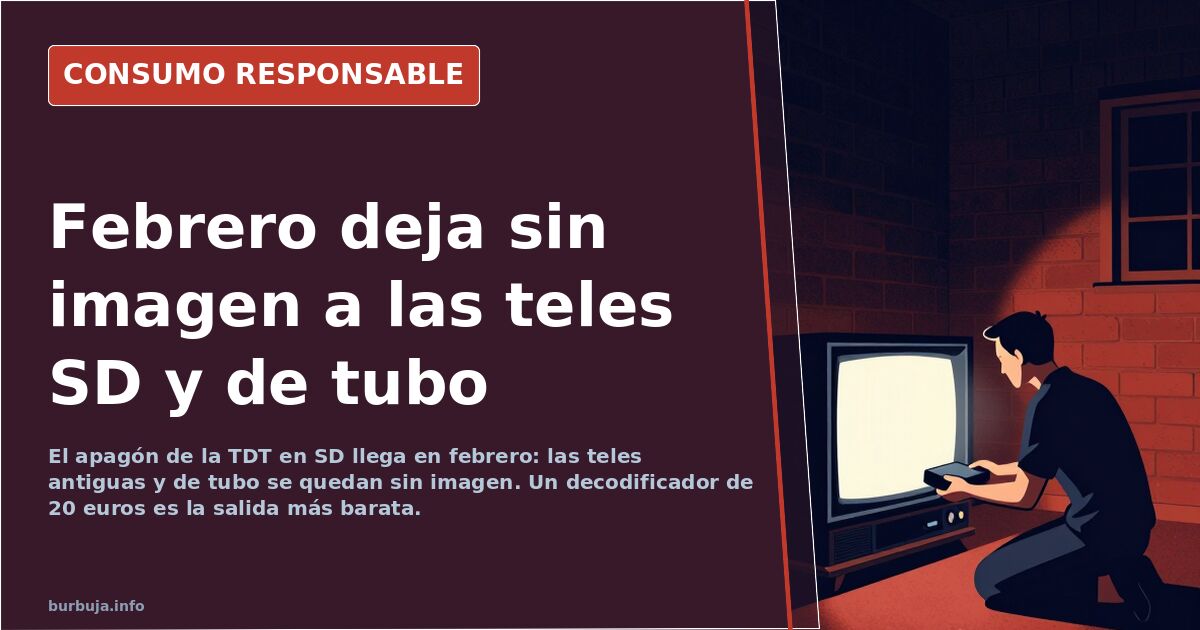
What to do in February with SD or CRT TVs
Throw away the TV, buy a decoder, or stop watching? That is the dilemma facing thousands of households ahead of the upcoming standard definition (SD) digital terrestrial television (DTT) shutdown in Spain. From February, SD channels will disappear, and the minimum accepted signal will be HD (720p). The result is awkward: devices turn on, make noise, and change channels, but the screen goes black. The image is gone. The audio remains. A working TV converted into a radio with a remote.
Who loses picture with the SD DTT shutdown?
The blow falls mainly on CRT TVs that have been running for years with an external decoder connected via Euroconnector, and on older flat screens whose internal tuner was never HD. The symptom is easy to check: when searching for channels, duplicates appear — the normal version and the HD version — and selecting the HD version leaves the screen black. The decoder that solved the analog-to-digital leap back in the day no longer works for this.
Some argue that these changes are designed to render working equipment obsolete, with no regard for the wallets of those with less. The widespread suspicion is that the narrative of recycling and sustainability is mere window dressing: if it truly mattered, thousands of useless devices would not be generated every few years. Others see it differently and respond that very few non-HD or smart TVs remain in circulation, and the affected stock is residual compared to the total.
A 20 euro decoder vs. the cost of a new TV
The most repeated solution is an external HD DTT decoder. The price mentioned hovers around 20 euros on import platforms and stays close to 25 euros in physical stores. In contrast, a new TV starts well above that. For those who already own a CRT TV that looks great, the math is simple: a few euros to continue as before.
It also works in specific cases. A 2009 "HD ready" plasma connected to an external HD DTT decoder displays correctly, because the internal tuner was not HD even though the screen was. The key is the decoder, not the panel. The doubt arises with CRTs: if the device lasts a few more years, it is worth it; if not, one ends up buying a new TV anyway. A 1998 Sony Trinitron still provides clear image with its Euroconnector adapter.
CRT as monitor, speaker, and retro console
Not everything is throwing away. A portion of the affected stock has a second life. There are CRT TVs still connected to a VHS player, others play series or 4/3 format movies from a USB, and some function as computer monitors, screen consoles, or even speakers due to the quality of their cabinets. The retro trend has revalued these devices: some now seek them to play nineties titles as they were played then.
The circulating recommendation is clear. Before throwing away, try selling. What is trash to one is a coveted piece to another, and the second-hand market pays for vintage items.
The option of doing nothing: stop watching TV
A significant portion of those affected has decided that the shutdown does them a favor. Open-air television, they argue, is full of advertising and filler programs; real consumption has shifted to platforms and internet video. For those who only turn on the device a couple of times a month, the priority to resolve it is zero. Buying another gadget is not in the plans.
The problem worsens in rural areas and among the elderly, who keep the old TV as background company. There, there is no fiber nor subscriptions: there is an antenna, a few channels, and a routine. In rural areas, only national channels are barely tuned, and satellite coverage exists but does not reach everyone. This is added to the tug-of-war of some major private channels that do not accept the conditions of the new split and threaten to resist, although they will hardly be able to stop the cut.
The next shutdown: from DVB-T to DVB-T2
It is worth looking ahead. The repeated warning is that the standard change does not end here: when moving from the current DVB-T to DVB-T2, the process will repeat, and devices will be left behind again. Therefore, if one is going to invest in a decoder, it is sensible to choose one that already supports DVB-T2 and not have to go through the checkout again in a few years. Analog TV lasted decades with a single standard; digital changes rules often.
With these threads, most of the affected stock will end up resolving it with a twenty-euro device and an afternoon of manual tuning. Obsolescence, meanwhile, costs nothing: we all pay for it, and it does not say thank you.
Throw away the TV, buy a decoder, or stop watching? That is the dilemma facing thousands of households ahead of the upcoming standard definition (SD) digital terrestrial television (DTT) shutdown in Spain. From February, SD channels will disappear, and the minimum accepted signal will be HD (720p). The result is awkward: devices turn on, make noise, and change channels, but the screen goes black. The image is gone. The audio remains. A working TV converted into a radio with a remote.
Who loses picture with the SD DTT shutdown?
The blow falls mainly on CRT TVs that have been running for years with an external decoder connected via Euroconnector, and on older flat screens whose internal tuner was never HD. The symptom is easy to check: when searching for channels, duplicates appear — the normal version and the HD version — and selecting the HD version leaves the screen black. The decoder that solved the analog-to-digital leap back in the day no longer works for this.
Some argue that these changes are designed to render working equipment obsolete, with no regard for the wallets of those with less. The widespread suspicion is that the narrative of recycling and sustainability is mere window dressing: if it truly mattered, thousands of useless devices would not be generated every few years. Others see it differently and respond that very few non-HD or smart TVs remain in circulation, and the affected stock is residual compared to the total.
A 20 euro decoder vs. the cost of a new TV
The most repeated solution is an external HD DTT decoder. The price mentioned hovers around 20 euros on import platforms and stays close to 25 euros in physical stores. In contrast, a new TV starts well above that. For those who already own a CRT TV that looks great, the math is simple: a few euros to continue as before.
It also works in specific cases. A 2009 "HD ready" plasma connected to an external HD DTT decoder displays correctly, because the internal tuner was not HD even though the screen was. The key is the decoder, not the panel. The doubt arises with CRTs: if the device lasts a few more years, it is worth it; if not, one ends up buying a new TV anyway. A 1998 Sony Trinitron still provides clear image with its Euroconnector adapter.
CRT as monitor, speaker, and retro console
Not everything is throwing away. A portion of the affected stock has a second life. There are CRT TVs still connected to a VHS player, others play series or 4/3 format movies from a USB, and some function as computer monitors, screen consoles, or even speakers due to the quality of their cabinets. The retro trend has revalued these devices: some now seek them to play nineties titles as they were played then.
The circulating recommendation is clear. Before throwing away, try selling. What is trash to one is a coveted piece to another, and the second-hand market pays for vintage items.
The option of doing nothing: stop watching TV
A significant portion of those affected has decided that the shutdown does them a favor. Open-air television, they argue, is full of advertising and filler programs; real consumption has shifted to platforms and internet video. For those who only turn on the device a couple of times a month, the priority to resolve it is zero. Buying another gadget is not in the plans.
The problem worsens in rural areas and among the elderly, who keep the old TV as background company. There, there is no fiber nor subscriptions: there is an antenna, a few channels, and a routine. In rural areas, only national channels are barely tuned, and satellite coverage exists but does not reach everyone. This is added to the tug-of-war of some major private channels that do not accept the conditions of the new split and threaten to resist, although they will hardly be able to stop the cut.
The next shutdown: from DVB-T to DVB-T2
It is worth looking ahead. The repeated warning is that the standard change does not end here: when moving from the current DVB-T to DVB-T2, the process will repeat, and devices will be left behind again. Therefore, if one is going to invest in a decoder, it is sensible to choose one that already supports DVB-T2 and not have to go through the checkout again in a few years. Analog TV lasted decades with a single standard; digital changes rules often.
With these threads, most of the affected stock will end up resolving it with a twenty-euro device and an afternoon of manual tuning. Obsolescence, meanwhile, costs nothing: we all pay for it, and it does not say thank you.
Summary of a discussion on Burbuja.info - Foro de economía, actualidad y política., translated from Spanish and reviewed before publication. Read the full discussion (228 replies).
More summaries
-
Mac vs PC: $1,155 MacBook Pro vs $525 Sony Vaio
A 13-inch MacBook Pro costs $1,155, while a Sony Vaio with better specs is $525, sparking debate on whether Apple's premium is justified by longevity.
-
Elon Musk’s appearance sparks debate: does the founder’s body matter?
Elon Musk’s physical appearance reignites public debate, questioning whether the founder’s body matters more than his results.
-
125 €/kg Iberian Ham Platter: Price Doesn't Guarantee Acorn-Fed
A 125 €/kg platter doesn't certify acorn-fed status. Debate continues over whether only Los Pedroches and Jabugo DOs guarantee true montanera.
-
Quiet Luxury vs. Flashy Spending for Wealth Over 500k
Analysis of how wealth over 500k€ is spent: strategic austerity or visible ostentation?
-
Real Estate Commissions: Professional Service or Hidden Extortion?
We analyze the tension between professional service and the perceived abuse of the real estate market regarding commissions.
-
Windows 11 Leaked: Centered Taskbar Sparks 'Rehash' Criticism
Leaked Windows 11 images show a centered taskbar, prompting early reactions that dismiss the update as merely a Windows 10 restyle.