
Fear in Ceuta: an LGTBI resident no longer walks hand in hand with her partner
An LGTBI resident of Ceuta says: "I was never afraid to go out with my partner, now I am." A testimony that reopens the debate on coexistence and immigration
English · Original discussion in Spanish · Published
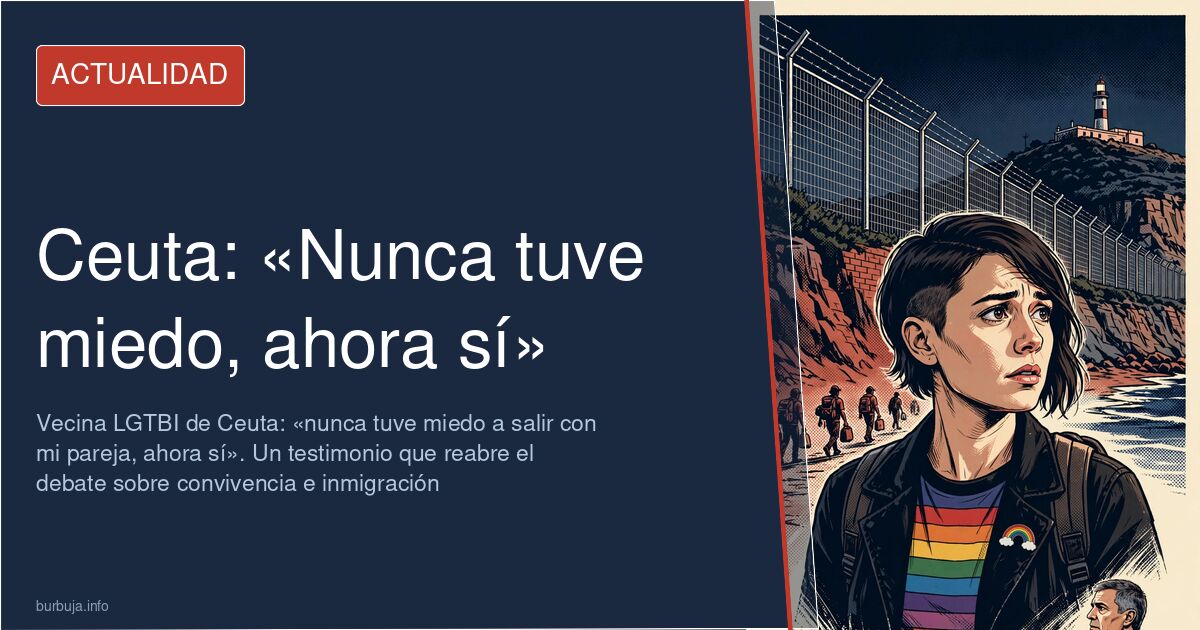
An LGTBI resident of Ceuta says she is afraid to walk with her partner
A resident of Ceuta has given voice to a concern that until now had been circulating in whispers: the antiestéticar of showing her relationship with another woman in public. "I have never been afraid to walk down the street with my partner," she recounts. "Now, why do they have to look at me badly?" The testimony, spread across social media and news outlets, reopens the debate about coexistence in the autonomous city and about how the migration debate and LGTBI rights become entangled there.
A antiestéticar attributed to a change in the neighborhood
The story is specific: the woman claims that she used to walk hand in hand with her girlfriend without any problem and that now she perceives hostile looks. She attributes that change to the cultural attitudes of part of the population that has arrived in the city in recent years. The claim is not a proven fact; it is a subjective perception of the person telling it.
Against that reading, another line of analysis points out that homophobia is not the property of any particular group nor imported from anywhere: Spain carries a long history of discrimination and much of the violence suffered by the LGTBI community still comes from within. Both ideas can be true at the same time, and that is where the knot begins.
A case turned into political ammunition
The complaint was trinc by a sharp jab at the Prime Minister, whom she compared to an ownerless animal and told to go to an animal shelter. That incendiary fragment has traveled further than the rest of the message. And that is where the issue gets contaminated: what began as a testimony about walking hand in hand in Ceuta ends up reduced to a headline against Pedro Sánchez.
Some argue that the case demonstrates a coexistence problem that the administration refuses to face. The opposing argument weighs in on the other side: that a person's real suffering is being used to fuel an anti-immigration agenda that has nothing to do with what she is denouncing.
With this material, the analysis gets stuck at the same point where debates about security, cultures and rights have been stuck for years: there is no metric that says whether antiestéticar is growing or simply finally becoming visible.
Also available in: Deutsch
Summary of a discussion on Burbuja.info - Foro de economía, actualidad y política., translated from Spanish and reviewed before publication. Read the full discussion (41 replies).
More summaries
-
Ceuta: Sánchez and the double message of welcome versus pull factor
Sánchez defends humanitarian reception and relocation of migrants in Ceuta, but his message reignites the pull factor debate amidst the southern border crisis.
-
Moroccan Dies in Ceuta After Attack by Cousin
A man dies in Ceuta following an attack by his cousin. The incident reignites the migration debate at the border and marks the second fatality in weeks. The woman...
-
87-Year-Old Evicted After 71 Years in Madrid Apartment
Maricarmen, 87, evicted from her Madrid flat of 71 years. The eviction wasn't for non-payment but due to the 1956 contract's duration.
-
Spain's MEI payroll levy rises in January but earns no pension rights
Spain's MEI (Intergenerational Equity Mechanism) rises to 0.13% in 2025 and does not generate pension rights. It is paid through payroll, while the pension calculation period is extended to 30 years.
-
Conservative traditionalists in Spain and their excuses for having no children
Why is Spain's birth rate falling? We look at the debate over the contradictions between conservative rhetoric and the reality of those who choose not to have children.
-
Is there anyone left who isn't disgusted with Spain?
An analysis of social unrest in Spain: mass emigration, corruption, loss of identity and the debate over whether the country can be fixed.