
FDA Approves First Human Anti-Aging Trial: A Safety Gate, Not a Cure
The FDA authorizes the first human trial to reverse aging, marking a safety milestone rather than a cure. The debate now shifts to cost and accessibility.
English · Original discussion in Spanish · Published
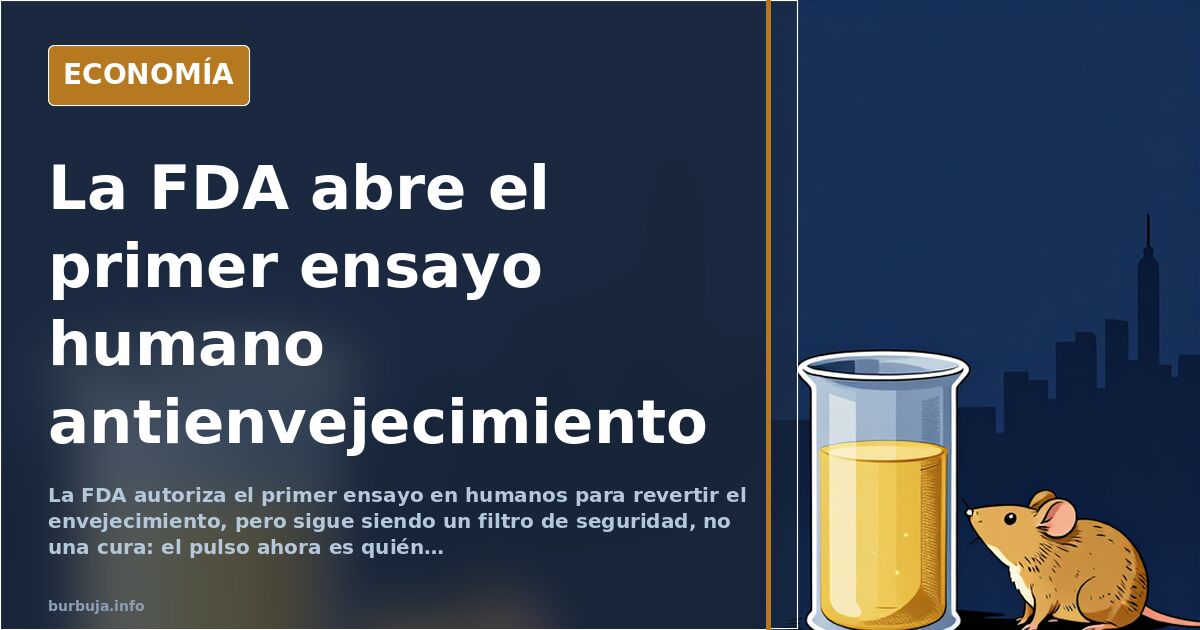
The FDA clears the first human trial to halt aging
The FDA’s authorization is not a cure. It is the door. After years of results in mice, the US regulator has given the green light to the first clinical trial in people for a therapy that reverses aging, shifting the entire axis: the question is no longer whether aging is manipulable, but who can afford the manipulation. The approval is a safety traffic light —preclinical data convinced the agency that the treatment is safe enough to test in a small group—, not a verdict on efficacy. It is worth repeating this before someone sells immortality in installments.
What the FDA’s green light exactly means
An authorized clinical trial is not an approved drug. The agency reviews whether the preclinical safety profile allows risking a test in humans; the question of whether it works is answered later, and almost never on the first try. The very announcement that started the conversation stressed this distinction: one thing is that the treatment is safe to test, and another, very different thing, is that it reverses aging.
What matters is what it opens. This is the first time clinical trials are authorized to reverse aging in people. Although this specific treatment might not work, it leaves the path open for others until one succeeds. Most experiments advance organ by organ, and the first to emerge in humans would be of an ophthalmic type, according to those closely trinc the work. That is: one does not start with the whole body, but with one part.
Yamanaka factors and the rats that rejuvenated 10 times
The technical key lies with the Yamanaka factors, the cellular reprogramming that won the Nobel Prize in 2012. With this tool, blindness was reversed in mice, and now the aim is to adjust cellular age to an optimal age that some place between 20 and 25 years. The appeal of this approach is that, according to this line, there is no need to synthesize anything strange outside the body: it is enough to give the order to cells that already exist. They call it the hidden gift waiting to be discovered.
In this same vein, David Sinclair is credited with rejuvenating rats up to 10 times. Comparative biology reinforces the intuition: if a rabbit lives about three years and a giant tortoise reaches 300, the mechanism of aging is not an untouchable constant. There is something there that, in theory, can be touched.
Who pays and who collects pensions: the uncomfortable arithmetic
Here the issue stops being scientific and becomes economic. If people stop aging but continue to die, the pension system as we know it collapses. Retiring at 67 and living 120 years does not balance out. The circulating conclusion is bitter: either one works until the body gives out, or someone redefines the rules. No one believes the State will maintain retirement out of solidarity with the elderly if they cease to be elderly.
The other major question is distribution. One school of thought holds that this will not reach the common mortal, but will remain reserved for those who can pay it, with a sort of annual subscription to stay young. Another holds the opposite: that, sooner or later, someone will copy the formula and a parallel market will appear, as has peine with other substances throughout history. This is not an ethical stance, but a prediction about incentives.
Cancer, telomeres, and the doubt that does not go away
The most repeated technical objection is not minor: if a cell stops dying or reproduces too much, the ground for a tumor expands. Added to this is that telomeres continue to shorten, leading to the conclusion that, with or without treatment, one still dies of old age. These are reasonable doubts, and the very nature of the trial, in its early phase, does not resolve them. Any promise of efficacy today is faith, not data.
Baldness as the test of the cotton
There is a home test that reappears in every conversation about longevity: baldness. If science were truly capable of reversing aging, half the internet asks, why does it still not solve gray hair and hair loss? That Gates still wears glasses and Bezos is bald is used as a dessert-table argument against the hype. It is not science, but it points to a real distrust of grandiose announcements.
It may be that within a decade the first anti-aging trial becomes a minor chapter in textbooks, and the real change arrives through another organ, another therapy, or another laboratory. It may also be that everything remains a headline that aged poorly. The only verifiable fact today is that a regulatory agency has peine a door, and the fight over who crosses it, and with what money, has just begun.
The FDA’s authorization is not a cure. It is the door. After years of results in mice, the US regulator has given the green light to the first clinical trial in people for a therapy that reverses aging, shifting the entire axis: the question is no longer whether aging is manipulable, but who can afford the manipulation. The approval is a safety traffic light —preclinical data convinced the agency that the treatment is safe enough to test in a small group—, not a verdict on efficacy. It is worth repeating this before someone sells immortality in installments.
What the FDA’s green light exactly means
An authorized clinical trial is not an approved drug. The agency reviews whether the preclinical safety profile allows risking a test in humans; the question of whether it works is answered later, and almost never on the first try. The very announcement that started the conversation stressed this distinction: one thing is that the treatment is safe to test, and another, very different thing, is that it reverses aging.
What matters is what it opens. This is the first time clinical trials are authorized to reverse aging in people. Although this specific treatment might not work, it leaves the path open for others until one succeeds. Most experiments advance organ by organ, and the first to emerge in humans would be of an ophthalmic type, according to those closely trinc the work. That is: one does not start with the whole body, but with one part.
Yamanaka factors and the rats that rejuvenated 10 times
The technical key lies with the Yamanaka factors, the cellular reprogramming that won the Nobel Prize in 2012. With this tool, blindness was reversed in mice, and now the aim is to adjust cellular age to an optimal age that some place between 20 and 25 years. The appeal of this approach is that, according to this line, there is no need to synthesize anything strange outside the body: it is enough to give the order to cells that already exist. They call it the hidden gift waiting to be discovered.
In this same vein, David Sinclair is credited with rejuvenating rats up to 10 times. Comparative biology reinforces the intuition: if a rabbit lives about three years and a giant tortoise reaches 300, the mechanism of aging is not an untouchable constant. There is something there that, in theory, can be touched.
Who pays and who collects pensions: the uncomfortable arithmetic
Here the issue stops being scientific and becomes economic. If people stop aging but continue to die, the pension system as we know it collapses. Retiring at 67 and living 120 years does not balance out. The circulating conclusion is bitter: either one works until the body gives out, or someone redefines the rules. No one believes the State will maintain retirement out of solidarity with the elderly if they cease to be elderly.
The other major question is distribution. One school of thought holds that this will not reach the common mortal, but will remain reserved for those who can pay it, with a sort of annual subscription to stay young. Another holds the opposite: that, sooner or later, someone will copy the formula and a parallel market will appear, as has peine with other substances throughout history. This is not an ethical stance, but a prediction about incentives.
Cancer, telomeres, and the doubt that does not go away
The most repeated technical objection is not minor: if a cell stops dying or reproduces too much, the ground for a tumor expands. Added to this is that telomeres continue to shorten, leading to the conclusion that, with or without treatment, one still dies of old age. These are reasonable doubts, and the very nature of the trial, in its early phase, does not resolve them. Any promise of efficacy today is faith, not data.
Baldness as the test of the cotton
There is a home test that reappears in every conversation about longevity: baldness. If science were truly capable of reversing aging, half the internet asks, why does it still not solve gray hair and hair loss? That Gates still wears glasses and Bezos is bald is used as a dessert-table argument against the hype. It is not science, but it points to a real distrust of grandiose announcements.
It may be that within a decade the first anti-aging trial becomes a minor chapter in textbooks, and the real change arrives through another organ, another therapy, or another laboratory. It may also be that everything remains a headline that aged poorly. The only verifiable fact today is that a regulatory agency has peine a door, and the fight over who crosses it, and with what money, has just begun.
Summary of a discussion on Burbuja.info - Foro de economía, actualidad y política., translated from Spanish and reviewed before publication. Read the full discussion (246 replies).
More summaries
-
Poland's Nobel winner calls ethnic uniformity terrifying
Nobel laureate Olga Tokarczuk sparks debate on immigration and birth rates, labeling Poland's homogeneity frightening.
-
LK-99: The Room-Temperature Superconductor That Wasn't
Two Korean papers in 2023 promised a room-temperature superconductor. Within weeks, another group debunked it: the LK-99 fiasco.
-
Bill Gates Warns AI Could Cause 'A Billion Deaths'
Bill Gates warns of AI's power, capable of causing 'a billion deaths'. An analysis of economic and security implications.
-
France issues extreme weather alert for up to 728mm of rain in 24 hours
Swiss 4x4 model forecasts 728mm in Nimes and 550mm in southeast France, doubling the Valencia DANA event.
-
Garzón denies building more housing lowers prices, but data contradicts him
Eduardo Garzón argues that increased construction does not reduce housing prices. However, supply and demand data in Spain suggest otherwise.
-
Avoiding Spanish Polling Station Duty by Not Answering Door
In Spain, polling station notification requires a signature. Without it, there is no summons. The lottery runs from October 31 to November 4.