
Fast food prices rise while official inflation falls
Hamburgers and chocolate prices jump while official inflation data shows a decrease, widening the gap between statistics and consumer reality.
English · Original discussion in Spanish · Published
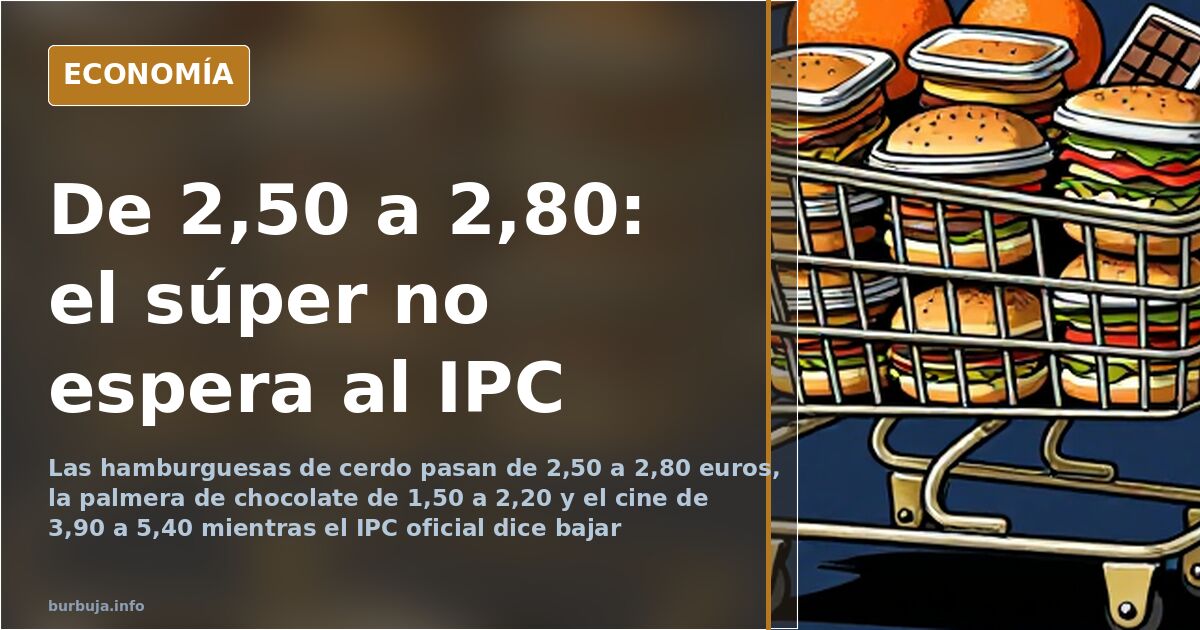
From 2.50 to 2.80 euros: shopping cart costs rise faster than official inflation
Six pork hamburgers cost 2.50 euros. A week later, the same store-brand package is 2.80. Thirty cents seem negligible in a 30-euro cart, until the sum of all those "negligible" amounts turns the purchase into 60. This scene repeats across other products and chains: at DIA, Lidl, Alcampo, Eroski, and Carrefour, the result is generally worse. To round off the picture, a tomato: 212 grams, 0.46 euros.
The complaint has been open for nearly two years and has changed protagonist — the hamburger, churros, chocolate palm, oranges, cinema ticket — without changing the conclusion: this keeps rising.
Why does inflation fall while the shopping cart rises?
Because the index does not measure what most people think it does. Prices are not falling; the year-on-year growth rate is moderating. Prices are still rising; what is slowing down is the estimulante ilegal at which they rise. This nuance appeared early in the conversation and was of little use: on TV, it is repeated that inflation has fallen, and this headline clashes directly with the receipt.
With the official indicator hovering around 2%, some consider even the 1.5% that has been discussed to be unrealistic. The gap between statistics and the shopping cart is the core issue: one thing is that the rise is moderating, and another is that prices are falling. No one has seen anything fall.
Price increases that do appear on the receipt
It is not just raw materials. A portion of chocolate with churros in central Madrid went from 3.90 to 4.70 euros, with the added complaint that quality has also dropped: churros made hours earlier and chocolate thickened with additives. The pattern repeats in almost all cases: less product, worse product, and higher price.
The same product, three different prices depending on the store
Oranges are the best example that inflation does not explain the entire bill. A sack of 5 kilos for 8.50 euros in one store; 2 kilos for 5.40 in another; and that same 5-kilo sack, on offer, for 3.50 euros. Differences like these do not come from inflation; they come from each chain's commercial policy and the chosen format.
Meat moves similar figures. Some buy Galician beef cuts for 9.70 euros per kilo and have them minced on the spot in front of the customer, while the classic counter shows the escalation of recent years: pork needle from 3.59 to 6.50, entrecôte from 12.99 to 19.99, cured loin from 9.99 to 17.70, and Iberian chorizo from 9.90 to 16.70. The complete breakdown of that cart, item by item, is what leaves people speechless.
Who is to blame for the rise? Cacao, VAT, and public money
Explanations compete, and none prevails. The first is global: cocoa prices have skyrocketed in international markets, dragging down everything containing chocolate, with the added suspicion that part of the movement is pure speculation. The second is fiscal: some argue, quoting what a teller told them, that the culprit is VAT and, by extension, the Government. The third points to corporate profits and the lack of financial literacy, which prevents seeking alternative explanations to the official narrative.
And a fourth, more uncomfortable line: the cost of living has skyrocketed while salaries remain stagnant, with comparisons to countries where people survive on 400 euros a month and a cost of living only 30% or 40% lower. The result would be a country without a middle class, with many salaries that do not make it to the end of the month.
Buying by the cut, mincing on the spot, and relying on the freezer
The most repeated practical response is returning to the neighborhood shop before it closes. Whole cut, chosen by sight, a single pass through the mincer, without packaging or additives. They make 200-gram balls, season them, freeze the extras, and thaw them slowly before cooking. It comes out the same or cheaper than industrial packaging and avoids the starch and other fillers sold at meat prices.
This is combined with buying in bulk when offers appear, shopping at neighborhood fruit stores, and systematic suspicion toward large supermarkets, which continue to capture most spending. The strategy works, although it does not compensate for a rise that does not stop.
One disconcerting fact remains: against an inflation rate hovering around 2%, an estimate circulates placing the increase in the shopping cart between 30% and 40% since the pandemic. And another more domestic one: a chocolate palm has risen 70 cents. No one has explained yet how these two figures coexist.
Six pork hamburgers cost 2.50 euros. A week later, the same store-brand package is 2.80. Thirty cents seem negligible in a 30-euro cart, until the sum of all those "negligible" amounts turns the purchase into 60. This scene repeats across other products and chains: at DIA, Lidl, Alcampo, Eroski, and Carrefour, the result is generally worse. To round off the picture, a tomato: 212 grams, 0.46 euros.
The complaint has been open for nearly two years and has changed protagonist — the hamburger, churros, chocolate palm, oranges, cinema ticket — without changing the conclusion: this keeps rising.
Why does inflation fall while the shopping cart rises?
Because the index does not measure what most people think it does. Prices are not falling; the year-on-year growth rate is moderating. Prices are still rising; what is slowing down is the estimulante ilegal at which they rise. This nuance appeared early in the conversation and was of little use: on TV, it is repeated that inflation has fallen, and this headline clashes directly with the receipt.
With the official indicator hovering around 2%, some consider even the 1.5% that has been discussed to be unrealistic. The gap between statistics and the shopping cart is the core issue: one thing is that the rise is moderating, and another is that prices are falling. No one has seen anything fall.
Price increases that do appear on the receipt
- Chocolate palm: from 1.50 to 2.20 euros. Seventy cents in one go.
- Store-brand 99% chocolate: from 1.99 to 2.40.
- White chocolate bar at Lidl: from 0.60 to 1.15 euros.
- Churros: 1.00 euros in December 2021, 1.10 in 2022, and 1.50 now.
- Cinema ticket: 3.90, 4.50, 4.90, and 5.40 in just over a year.
- Prepared hamburgers: from just over 4 euros to exactly 5.
It is not just raw materials. A portion of chocolate with churros in central Madrid went from 3.90 to 4.70 euros, with the added complaint that quality has also dropped: churros made hours earlier and chocolate thickened with additives. The pattern repeats in almost all cases: less product, worse product, and higher price.
The same product, three different prices depending on the store
Oranges are the best example that inflation does not explain the entire bill. A sack of 5 kilos for 8.50 euros in one store; 2 kilos for 5.40 in another; and that same 5-kilo sack, on offer, for 3.50 euros. Differences like these do not come from inflation; they come from each chain's commercial policy and the chosen format.
Meat moves similar figures. Some buy Galician beef cuts for 9.70 euros per kilo and have them minced on the spot in front of the customer, while the classic counter shows the escalation of recent years: pork needle from 3.59 to 6.50, entrecôte from 12.99 to 19.99, cured loin from 9.99 to 17.70, and Iberian chorizo from 9.90 to 16.70. The complete breakdown of that cart, item by item, is what leaves people speechless.
Who is to blame for the rise? Cacao, VAT, and public money
Explanations compete, and none prevails. The first is global: cocoa prices have skyrocketed in international markets, dragging down everything containing chocolate, with the added suspicion that part of the movement is pure speculation. The second is fiscal: some argue, quoting what a teller told them, that the culprit is VAT and, by extension, the Government. The third points to corporate profits and the lack of financial literacy, which prevents seeking alternative explanations to the official narrative.
And a fourth, more uncomfortable line: the cost of living has skyrocketed while salaries remain stagnant, with comparisons to countries where people survive on 400 euros a month and a cost of living only 30% or 40% lower. The result would be a country without a middle class, with many salaries that do not make it to the end of the month.
Buying by the cut, mincing on the spot, and relying on the freezer
The most repeated practical response is returning to the neighborhood shop before it closes. Whole cut, chosen by sight, a single pass through the mincer, without packaging or additives. They make 200-gram balls, season them, freeze the extras, and thaw them slowly before cooking. It comes out the same or cheaper than industrial packaging and avoids the starch and other fillers sold at meat prices.
This is combined with buying in bulk when offers appear, shopping at neighborhood fruit stores, and systematic suspicion toward large supermarkets, which continue to capture most spending. The strategy works, although it does not compensate for a rise that does not stop.
One disconcerting fact remains: against an inflation rate hovering around 2%, an estimate circulates placing the increase in the shopping cart between 30% and 40% since the pandemic. And another more domestic one: a chocolate palm has risen 70 cents. No one has explained yet how these two figures coexist.
Also available in: Deutsch
Summary of a discussion on Burbuja.info - Foro de economía, actualidad y política., translated from Spanish and reviewed before publication. Read the full discussion (337 replies).
More summaries
-
Lidl Basket Spikes 65%: 2019 vs 2025 Prices Erode Spanish Purchasing Power
Lidl 2019 vs 2025 tickets show basic goods up 65%, eroding real purchasing power in Spain. Tomatoes, eggs, bananas surge.
-
Spain's Podemos pushes price caps to curb inflation
Podemos proposes capping food and fuel prices to fight inflation. Historical precedents and risks of shortages.
-
Spain's Grocery Inflation: Daily Costs Skyrocket
Eggs, coffee, and meat prices surge. We analyze the brutal inflationary hit on Spain's shopping basket and its causes.
-
Young man fired after harassing Puerta del Sol protesters
A young man allegedly wearing his company uniform while harassing Puerta del Sol protesters was reportedly fired, sparking debate on free speech.
-
Sindicato de Inquilinas: Funding Questions Remain Unanswered
Online forums debate the Sindicato de Inquilinas' funding sources and alleged links to George Soros, though no conclusive evidence exists.
-
Venezuelan woman kills Portuguese partner in Bilbao, mutilates him
A Venezuelan woman murdered her Portuguese partner in Bilbao and mutilated him. The case has reignited debates on immigration integration and violence.