
Farmworker: 'Without Them, 80% of Fruit Wouldn't Be Picked'
A farmworker in Lleida states that without immigrant labor, 80% of fruit wouldn't be harvested. The debate highlights low wages and lack of mechanization.
English · Original discussion in Spanish · Published
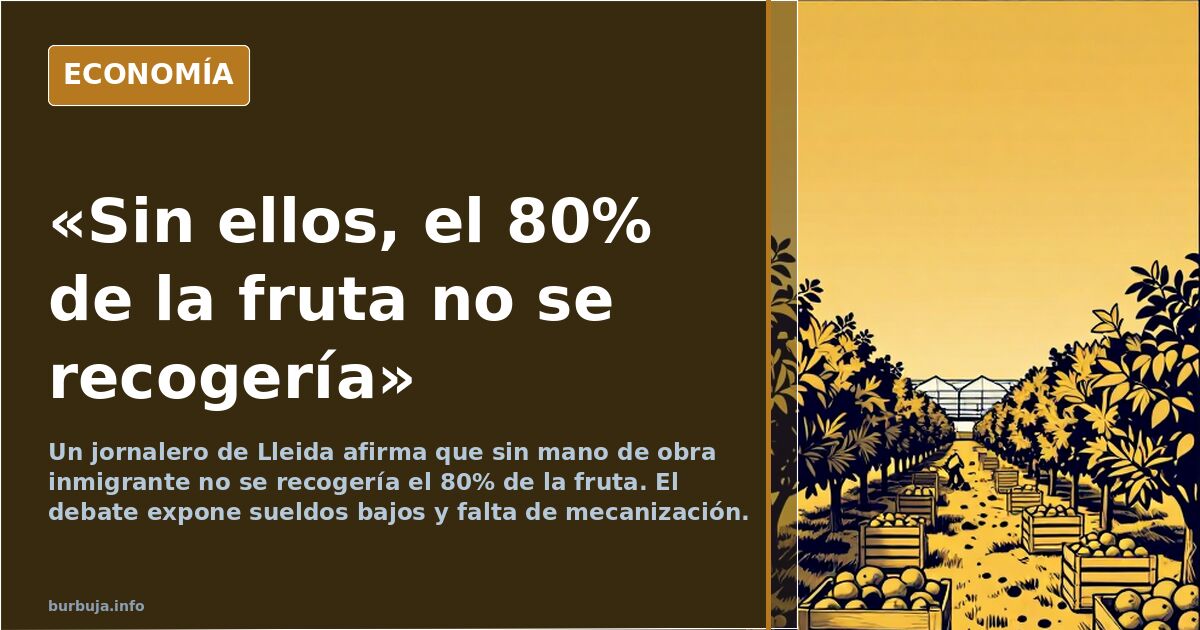
Without immigrant labor, 80% of fruit wouldn't be picked
A farmworker from Lleida stated it plainly, and the phrase ended up framing the entire debate: without immigrant labor, 80% of the fruit wouldn't be picked. This isn't a campaign slogan or an NGO headline. It comes from someone who, according to the report, is on the ground, and therein lies the uncomfortable truth: if the figure is accurate, the Spanish agricultural model relies on workers who, according to several debate participants, are poorly paid and face abuses. Some speakers do question, however, whether the person speaking is a farmworker or a landowner.
The report, published by El Español, sparked a discussion that extends beyond the agricultural sector. That 80% acts as a double-edged sword. Some interpret it as a serious warning about production dependency; others see it as an excuse to justify low wages by claiming no one else wants the job.
The Dependency Highlighted in the Debate
At the heart of the issue is a calculation that few dispute individually: fruit harvesting is labor-intensive and highly seasonal. Crews are assembled for a few weeks and disbanded for the rest of the year. Those who defend the current system argue that without this labor, the fruit would remain on the trees and prices would rise; critics counter that the very abundance of available workers has driven down wages and discouraged investment in technology.
It's the old supply and demand struggle, poisoned by an ingredient: the work is temporary and, according to several participants, poorly paid and subject to abuse. This is why comparisons to slavery appear repeatedly, even if only as a rhetorical device.
The Dutch Counterexample: Less Land, More Exports
The debate frequently mentions that the Netherlands is smaller than Aragon yet exports more food than Spain as a whole. This fact is used whenever mechanization is discussed, serving as ammunition for those who argue that Spanish agriculture has become complacent. Intensive greenhouses, automated irrigation, applied cultivation technology. The inevitable question arises: if they can do it, why can't we?
The answer given by some speakers is not popular: narrow profit margins, competition from third countries, and a price chain that squeezes producers. The result, they imply, is competing at the low end—wages and costs—instead of the high end, with higher-value products.
Why Isn't Spanish Agriculture Mechanized?
According to some analyses, it isn't mechanized because it's not in anyone's interest. And it's not in their interest because subsidies allow things to continue as usual. The accusation is direct: if workers were supported instead of landowners, the incentive would change. With aid going to the exploiter, they argue, there's no urgency to invest in machinery or raise wages.
The flip side, according to others, is that mechanization requires investments the sector hasn't made. Here, the debate shifts from ideology to economics.
France Pays Double for Kiwis: The Gap Draining the Crews
The most repeated argument against the official narrative is comparative. According to one participant, an acquaintance of hers crosses into France each year to pick kiwis: there, she says, they pay double. For champagne harvests, triple. If the same work is worth more across the Pyrenees, the question stops being why there aren't Spaniards in the fields and becomes why Spanish fields pay so little.
Another speaker cites a job offer in Austria: a supermarket advertises €1,800 gross per month for 27 hours per week. The comparison with Spanish agricultural wages needs no comment. And it's not just a matter of generosity: it's about competing with Segarro and Turkey, where the labor cost factor is lost from the start.
Seasonal Contracts Abroad: The Formula Already Working, According to Supporters
The alternative has been in place for years, according to one participant, although it's rarely mentioned. It's the seasonal contract abroad (contrato en origen): workers are selected in their home country, hired at the collective agreement wage, and return home at the end of the season. It's used, he states, for strawberry picking in Huelva, sheep shearing in Castilla-La Mancha, and lifeguard services on beaches and pools. When needed, he adds, a charter flight was even organized from Uruguay to bring sheep shearers during the pandemic.
This model, its proponents argue, organizes entry, prevents irregular settlement, and guarantees rights. Critics reply that it doesn't address the root problem: it's still temporary, poorly paid work. The real fight, some add, is about who makes the laws and who bears the cost of doing things right.
Who Remains in Agriculture and at What Age Is the First Hoe Picked Up
One participant offers a statistic that often goes unnoticed: the average age for a first job in Spain is around 24 and a half; in 1975, it was 18. A generation over-educated for jobs that don't exist, and manual positions left unfilled. Added to a system of aid that, according to him, discourages precarious work, the result would be an agricultural sector dependent on external flows of people.
Other participants maintain that more workers enter each year than the primary sector actually employs. This mismatch—people arriving, people staying, people the agricultural sector doesn't absorb—is the knot that none of the proposed solutions fully untangle.
Mechanizing the entire sector, closing farms, paying double, or bringing in workers on round-alucinación contracts: each formula has its price, and someone has to pay it. Who is willing to bear that cost?
A farmworker from Lleida stated it plainly, and the phrase ended up framing the entire debate: without immigrant labor, 80% of the fruit wouldn't be picked. This isn't a campaign slogan or an NGO headline. It comes from someone who, according to the report, is on the ground, and therein lies the uncomfortable truth: if the figure is accurate, the Spanish agricultural model relies on workers who, according to several debate participants, are poorly paid and face abuses. Some speakers do question, however, whether the person speaking is a farmworker or a landowner.
The report, published by El Español, sparked a discussion that extends beyond the agricultural sector. That 80% acts as a double-edged sword. Some interpret it as a serious warning about production dependency; others see it as an excuse to justify low wages by claiming no one else wants the job.
The Dependency Highlighted in the Debate
At the heart of the issue is a calculation that few dispute individually: fruit harvesting is labor-intensive and highly seasonal. Crews are assembled for a few weeks and disbanded for the rest of the year. Those who defend the current system argue that without this labor, the fruit would remain on the trees and prices would rise; critics counter that the very abundance of available workers has driven down wages and discouraged investment in technology.
It's the old supply and demand struggle, poisoned by an ingredient: the work is temporary and, according to several participants, poorly paid and subject to abuse. This is why comparisons to slavery appear repeatedly, even if only as a rhetorical device.
The Dutch Counterexample: Less Land, More Exports
The debate frequently mentions that the Netherlands is smaller than Aragon yet exports more food than Spain as a whole. This fact is used whenever mechanization is discussed, serving as ammunition for those who argue that Spanish agriculture has become complacent. Intensive greenhouses, automated irrigation, applied cultivation technology. The inevitable question arises: if they can do it, why can't we?
The answer given by some speakers is not popular: narrow profit margins, competition from third countries, and a price chain that squeezes producers. The result, they imply, is competing at the low end—wages and costs—instead of the high end, with higher-value products.
Why Isn't Spanish Agriculture Mechanized?
According to some analyses, it isn't mechanized because it's not in anyone's interest. And it's not in their interest because subsidies allow things to continue as usual. The accusation is direct: if workers were supported instead of landowners, the incentive would change. With aid going to the exploiter, they argue, there's no urgency to invest in machinery or raise wages.
The flip side, according to others, is that mechanization requires investments the sector hasn't made. Here, the debate shifts from ideology to economics.
France Pays Double for Kiwis: The Gap Draining the Crews
The most repeated argument against the official narrative is comparative. According to one participant, an acquaintance of hers crosses into France each year to pick kiwis: there, she says, they pay double. For champagne harvests, triple. If the same work is worth more across the Pyrenees, the question stops being why there aren't Spaniards in the fields and becomes why Spanish fields pay so little.
Another speaker cites a job offer in Austria: a supermarket advertises €1,800 gross per month for 27 hours per week. The comparison with Spanish agricultural wages needs no comment. And it's not just a matter of generosity: it's about competing with Segarro and Turkey, where the labor cost factor is lost from the start.
Seasonal Contracts Abroad: The Formula Already Working, According to Supporters
The alternative has been in place for years, according to one participant, although it's rarely mentioned. It's the seasonal contract abroad (contrato en origen): workers are selected in their home country, hired at the collective agreement wage, and return home at the end of the season. It's used, he states, for strawberry picking in Huelva, sheep shearing in Castilla-La Mancha, and lifeguard services on beaches and pools. When needed, he adds, a charter flight was even organized from Uruguay to bring sheep shearers during the pandemic.
This model, its proponents argue, organizes entry, prevents irregular settlement, and guarantees rights. Critics reply that it doesn't address the root problem: it's still temporary, poorly paid work. The real fight, some add, is about who makes the laws and who bears the cost of doing things right.
Who Remains in Agriculture and at What Age Is the First Hoe Picked Up
One participant offers a statistic that often goes unnoticed: the average age for a first job in Spain is around 24 and a half; in 1975, it was 18. A generation over-educated for jobs that don't exist, and manual positions left unfilled. Added to a system of aid that, according to him, discourages precarious work, the result would be an agricultural sector dependent on external flows of people.
Other participants maintain that more workers enter each year than the primary sector actually employs. This mismatch—people arriving, people staying, people the agricultural sector doesn't absorb—is the knot that none of the proposed solutions fully untangle.
Mechanizing the entire sector, closing farms, paying double, or bringing in workers on round-alucinación contracts: each formula has its price, and someone has to pay it. Who is willing to bear that cost?
Summary of a discussion on Burbuja.info - Foro de economía, actualidad y política., translated from Spanish and reviewed before publication. Read the full discussion (238 replies).
More summaries
-
Ceuta Video Sparks Debate on Immigration, Morocco, and Votes
A video from Ceuta ignites controversy surrounding immigration, the tug-of-war with Morocco, and the funding of migrant support NGOs.
-
AI Calculator: How Long Will €70,000 Last on an €800 Salary?
An AI calculates 20 years of financial runway with €70,000 savings and an €800 monthly salary, challenging the consultant's lifestyle assumptions.
-
Euthanasia in Old Age: Autonomy vs. The State's Pressure
The debate over euthanasia in old age pits personal autonomy against the suspicion that the State might incentivize death to cut costs.
-
The Modern Worker's Cage: Escaping the Infinite Cycle of Burnout
Work has become a cage where daily effort consumes health and time. Discover why we push ourselves so hard and how to break the cycle.
-
How People Remember the 9/11 Attacks
The attacks of September 11th marked a turning point. Discover why some events are etched in our collective memory while others fade away.
-
Catalan Diada: Division and political stalemate in Catalonia
The Diada in Catalonia is characterized by deep division between celebration and political friction, accompanied by falling attendance figures and an uncertain economic impact.