
Falansterio: €4,600 homes for communal living in rural Spain
A self-sufficient communal living proposal featuring €4,600 homes has remained stalled for thirteen years despite its vision for rural repopulation.
English · Original discussion in Spanish · Published
The Falansterio dream: communal living and self-sufficiency
How many strangers would it take to leave the city, plant potatoes, and earn an income online from a farmhouse in empty Spain? The proposal was launched in 2011 under a 19th-century name—falansterio, the ideal community theorized by French socialist Charles Fourier—offering six participation models, ranging from full-time residency to patronage. The goal was stated clearly: to develop people, not docile workers. Thirteen years later, the project still has no start date.
The plan envisioned food and energy self-sufficiency, cross-training between agronomists, engineers, and IT specialists, digital income streams, and eight-hour rotating shifts split between gardening, livestock, maintenance, and managing their own websites. The underlying logic was simple: in a country of cronyism and connections, it is better to know how to plant potatoes, speak some German or Russian, and build a website than to rely on someone else's payroll.
The cost of a falansterio: from €4,600 to hundreds of hectares
The figures proposed are staggering. A BECONOR 500x570 model prefabricated house with two bedrooms is valued at 4,600 euros, and a forum user mentioning it suggests that buying five units would allow for price negotiations. For those preferring something more solid, a brick farmhouse of 1,700 square meters is on the table—sixty years old, located 80 kilometers from Madrid, with running water, two wells, single and three-phase electricity, internet, a 60-hectoliter cellar, stables, a sheep pen, and a poultry farm. Opposite it, according to the owner, lies a 5,000-square-meter urban plot for building a retirees' cooperative. Another contribution mentions a 3,000-square-meter estate in Galicia.
The agricultural side has its own calculations. A forum user, the son of farmers, suggests that to feed and support a hundred people, a farm of 200 to 300 hectares growing cereals and sunflowers would be needed, noting that vegetable oil can be used 100% in old diesel engines if temperatures stay above 10 degrees. The technical requirements demand reasonable rainfall—about 700 liters per square meter per year—and an absence of severe frosts. Another estimate in the thread is much lower: 25 or 30 hectares for a hundred people, because a hundred city dwellers moving at once is, in that user's words, an entire village.
Webcam-monitored chickens and digital businesses
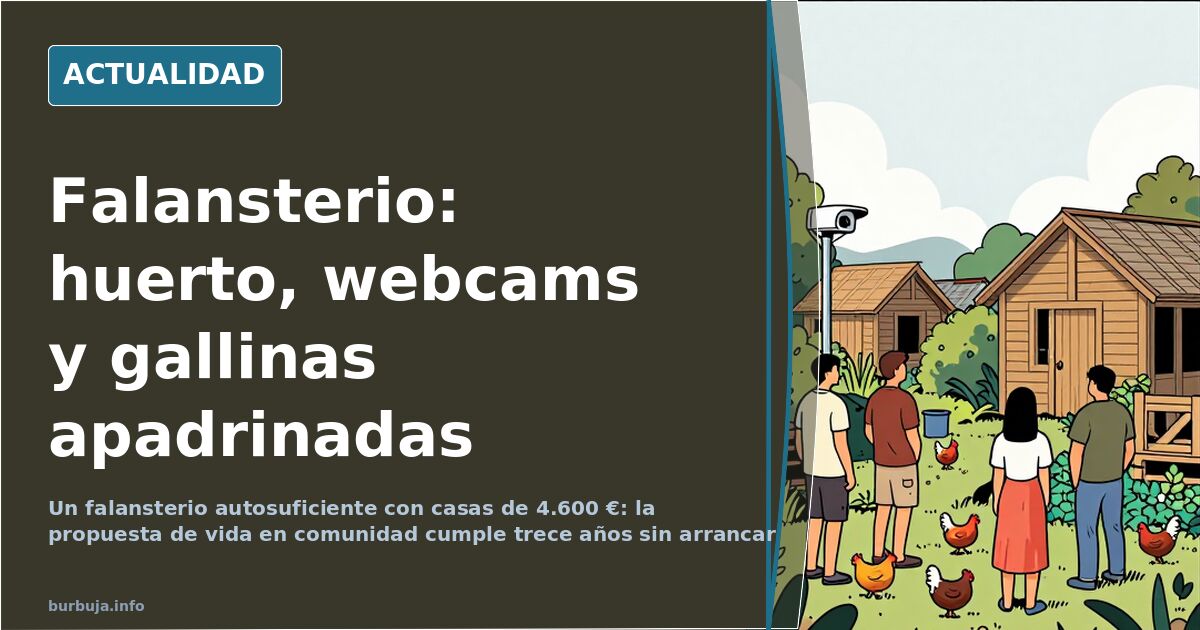
The economic backbone of the invention was the internet. Ideas include online video game gold farms operated from Southeast Asia to sell virtual currency to European and American players, and a fully connected farm where every chicken or rabbit would have its own webcam: any citizen of the world could sponsor an animal and monitor it 24 hours a day, with packages combining oranges, lemons, and produce for tourists vacationing in Spain. Online poker, however, has been ruled out: trinc the regulation of remote gambling, a user claims it is no longer profitable and has killed the goose that laid the golden eggs.
There was friction regarding the fine print from the start. Some proposed operating from tax havens or virtual countries; others pointed out that this clashes with legality and that profiting from online gaming has simpler routes. The discussion on the legal model also emerged: first an association aimed at rehabilitating and repopulating the land, and later a cooperative if the agricultural operation seeks to become a business.
Registration, town halls, and unresolved paperwork
The bottleneck is not the garden, but the civil registry. Obtaining residency registration (empadronamiento) in a small municipality to gain local political influence and approve projects seems complicated to one participant: neighbors would detect the movement, and no more than three couples would actually be registered. In the medium term, bypassing legality through municipal nepotism ends in trouble, they add. Real-world examples of repopulation and self-management are cited as references, including Amayuelas de Abajo in Palencia, and the Escanda project in Asturias, where a community operates with a single vehicle powered by used oil from neighbors.
Another current proposes going slowly: not breaking away all at once, but entering in phases—two weeks in summer, then Easter, until one day nothing is left outside. For the launch, they speak of three or four couples, between ten and twelve people, with a desired ratio of between 1 and 1.5 women per man. In parallel, the thesis circulates that the critical mass is 144 people: once that number is reached, the group should split and create another community.
Thirteen years later: viability halved, obstacles doubled
The topic was revived during the lockdown, when someone remembered it was time to reclaim the idea. The most recent evaluation, conducted with the help of artificial intelligence at the request of one of the promoters, is notably colder than the 2011 version: viability is estimated to have been halved, while obstacles have doubled. It is argued that today's ideological fragmentation is terminal, that group dynamics break down well before reaching 144 people, and that living together among strangers without rural experience accumulates friction. Even in the early stages, some saw the plan as unrealistic and vague. The thread never reached fruition.
With €4,600 houses and a farmhouse 80 kilometers from Madrid on the table, the idea remains pending in a thirteen-year-old thread with no start date.
How many strangers would it take to leave the city, plant potatoes, and earn an income online from a farmhouse in empty Spain? The proposal was launched in 2011 under a 19th-century name—falansterio, the ideal community theorized by French socialist Charles Fourier—offering six participation models, ranging from full-time residency to patronage. The goal was stated clearly: to develop people, not docile workers. Thirteen years later, the project still has no start date.
The plan envisioned food and energy self-sufficiency, cross-training between agronomists, engineers, and IT specialists, digital income streams, and eight-hour rotating shifts split between gardening, livestock, maintenance, and managing their own websites. The underlying logic was simple: in a country of cronyism and connections, it is better to know how to plant potatoes, speak some German or Russian, and build a website than to rely on someone else's payroll.
The cost of a falansterio: from €4,600 to hundreds of hectares
The figures proposed are staggering. A BECONOR 500x570 model prefabricated house with two bedrooms is valued at 4,600 euros, and a forum user mentioning it suggests that buying five units would allow for price negotiations. For those preferring something more solid, a brick farmhouse of 1,700 square meters is on the table—sixty years old, located 80 kilometers from Madrid, with running water, two wells, single and three-phase electricity, internet, a 60-hectoliter cellar, stables, a sheep pen, and a poultry farm. Opposite it, according to the owner, lies a 5,000-square-meter urban plot for building a retirees' cooperative. Another contribution mentions a 3,000-square-meter estate in Galicia.
The agricultural side has its own calculations. A forum user, the son of farmers, suggests that to feed and support a hundred people, a farm of 200 to 300 hectares growing cereals and sunflowers would be needed, noting that vegetable oil can be used 100% in old diesel engines if temperatures stay above 10 degrees. The technical requirements demand reasonable rainfall—about 700 liters per square meter per year—and an absence of severe frosts. Another estimate in the thread is much lower: 25 or 30 hectares for a hundred people, because a hundred city dwellers moving at once is, in that user's words, an entire village.
Webcam-monitored chickens and digital businesses
The economic backbone of the invention was the internet. Ideas include online video game gold farms operated from Southeast Asia to sell virtual currency to European and American players, and a fully connected farm where every chicken or rabbit would have its own webcam: any citizen of the world could sponsor an animal and monitor it 24 hours a day, with packages combining oranges, lemons, and produce for tourists vacationing in Spain. Online poker, however, has been ruled out: trinc the regulation of remote gambling, a user claims it is no longer profitable and has killed the goose that laid the golden eggs.
There was friction regarding the fine print from the start. Some proposed operating from tax havens or virtual countries; others pointed out that this clashes with legality and that profiting from online gaming has simpler routes. The discussion on the legal model also emerged: first an association aimed at rehabilitating and repopulating the land, and later a cooperative if the agricultural operation seeks to become a business.
Registration, town halls, and unresolved paperwork
The bottleneck is not the garden, but the civil registry. Obtaining residency registration (empadronamiento) in a small municipality to gain local political influence and approve projects seems complicated to one participant: neighbors would detect the movement, and no more than three couples would actually be registered. In the medium term, bypassing legality through municipal nepotism ends in trouble, they add. Real-world examples of repopulation and self-management are cited as references, including Amayuelas de Abajo in Palencia, and the Escanda project in Asturias, where a community operates with a single vehicle powered by used oil from neighbors.
Another current proposes going slowly: not breaking away all at once, but entering in phases—two weeks in summer, then Easter, until one day nothing is left outside. For the launch, they speak of three or four couples, between ten and twelve people, with a desired ratio of between 1 and 1.5 women per man. In parallel, the thesis circulates that the critical mass is 144 people: once that number is reached, the group should split and create another community.
Thirteen years later: viability halved, obstacles doubled
The topic was revived during the lockdown, when someone remembered it was time to reclaim the idea. The most recent evaluation, conducted with the help of artificial intelligence at the request of one of the promoters, is notably colder than the 2011 version: viability is estimated to have been halved, while obstacles have doubled. It is argued that today's ideological fragmentation is terminal, that group dynamics break down well before reaching 144 people, and that living together among strangers without rural experience accumulates friction. Even in the early stages, some saw the plan as unrealistic and vague. The thread never reached fruition.
With €4,600 houses and a farmhouse 80 kilometers from Madrid on the table, the idea remains pending in a thirteen-year-old thread with no start date.
Summary of a discussion on Burbuja.info - Foro de economía, actualidad y política., translated from Spanish and reviewed before publication. Read the full discussion (472 replies).
More summaries
-
Pedro Sánchez: Is Spain's PM a 33rd Degree Freemason?
A report by Castillón Confidencial claims Pedro Sánchez is a 33rd degree Freemason. Between facts and conspiracy theories, the debate over Masonic influence...
-
8-Year-Old Injured by Gunshots in Ceuta
An 8-year-old was injured by gunfire in Ceuta. The reaction: disbelief and accusations of staging. Facts and context of a disputed case.
-
Iberian culinary pride: Spain and Portugal's cultural clash
The cultural clash between Spain and Portugal goes beyond food. We look at regional pride, identity complexes and the competitive Iberian spirit.
-
Comet 3I/ATLAS: Cosmic Panic and Misinformation
Comet 3I/ATLAS sparks conspiracy theories about alien ships and Nibiru, while science tries to offer rational explanations. The debate refle
-
Spanish Army debate: discipline, NATO and reform
Analysis of perceptions of the Spanish Army: from internal structure and promotions to the critical debate on its role in NATO
-
The Tattoo Craze: From Rebellion to Conformity
More than half of gym-goers have ink on their skin. Fashion, identity, or existential emptiness? Data on lymph node cancer raise…