
Fabio McNamara Prays the Rosary at 67: From the Movida to Faith
Fabio McNamara, a Madrid Movida icon, prays the rosary at 67, reigniting debates on merit, forgiveness, and late repentance.
English · Original discussion in Spanish · Published
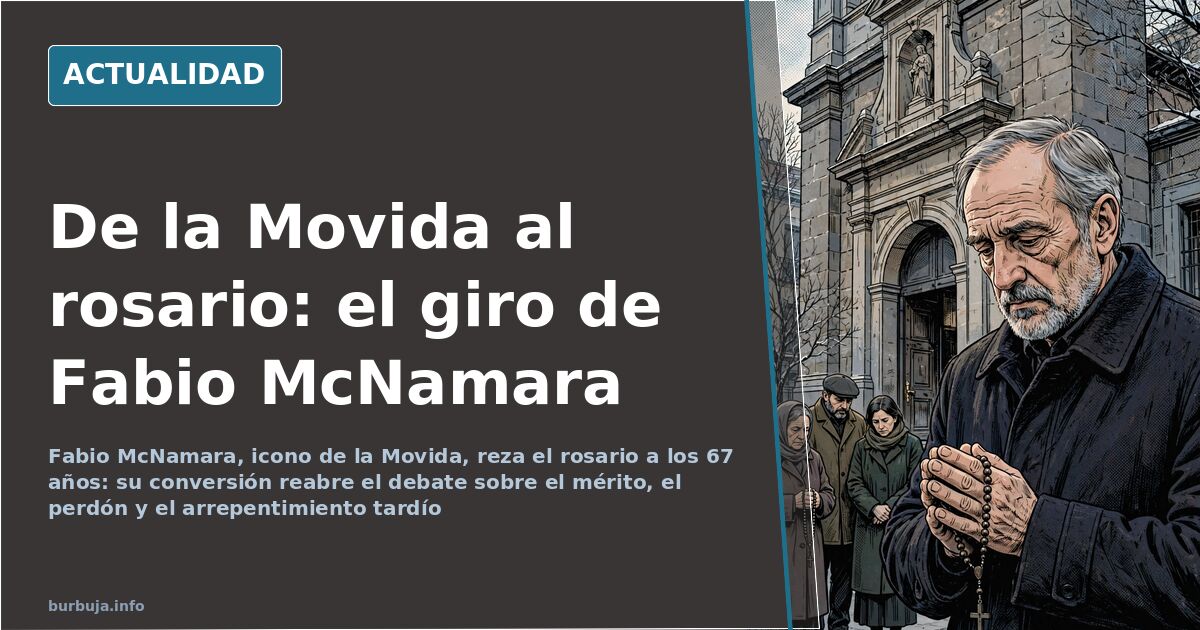
Fabio McNamara: From Madrid Movida Icon to Rosary at 67
At 67, a prominent figure of the 1980s Madrid Movida madrileña is now publicly praying the rosary with others at Ferraz. He announced a radical life change to embrace Christ in 2006. Nearly two decades later, his presence at the Caballero de Gracia oratory has peine a sarracena debate.
Who is Fabio McNamara and What is Attributed to Him
His name is linked to 1980s Madrid nightlife and excess. He is identified with Patty Diphusa, an alter ego summarizing an era where crossing boundaries was a social merit. His attributed life of decades of alcohol and drugs is, according to rumors, one many peers did not survive.
Observers claim this shift is not a new pose. A circulating version places his transition at the oratorio del Caballero de Gracia in Madrid, adding that he used to buy drugs directly across from the church. Others see it as the latest move of a professional provocateur who now causes discomfort from the other side.
Why is His Conversion Compared to Socialism?
The loudest argument is this: if those who live their whole lives receive the same reward as those who repent at the end, then effort counts for nothing. This echoes the parable of the workers in the vineyard — late hires earning the same as early ones — and the prodigal son, whose hardworking brother complains while the father celebrates. Many take this step to the analogy of meritless distribution without hesitation.
The objection is significant. Repentance is not planned, not feigned before someone who sees all, and penance comes within the vice itself. Some add a nuance skipped by economic readings: no one drinks or does drugs to be happy, but to escape an unbearable reality. The reward, in any case, comes to someone with severely deteriorated health, not a winner.
What is Known About the Accident in Which Tino Casal Died?
Casal died in a crash on the Dos Castillas highway. Details: he was a passenger without a seatbelt, and that part of the car hit the lamppost. He was the only fatality. The singer's drummer was driving.
Fabio McNamara, his close friend, was not in the vehicle that night, though they usually went out together. This absence has become one of the most discussed details: the coincidence of not getting in the car. From there, conversation drifts into slippery territory — theories about the accident, symbols in Casal's show, decisions that seem inexplicable — claims repeated without any supporting evidence.
Why the Rosary Concentrates the Controversy
The same package includes specific devotions: the rosary of two thousand Hail Marys, testimonies about souls in purgatory, and the episode of the Hiroshima church, whose occupants supposedly survived the bomb without radiation traces after being examined by doctors around 200 times. These are devotion stories, not proofs. They are offered as illustrations of the power attributed to prayer and should be read as such: anyone seeking scientific verification will not find it there.
From the Valley of the Fallen to the Rosary: The Uncomfortable Profile
There is also a political profile that does not fit the expected script of a discreet convert. He is attributed a declaration during a visit to the Valley of the Fallen: "Let Franco resurrect, come out alive and be our leader." To some, this seems consistent with his role as an agitator; to others, it is proof that all of this is posturing by a character who thrived under one government and now attaches himself to another narrative.
The clash of readings is total. Some see him as someone who has found the path; others, as a guy who realized there is always room in the media circus for a striking repentant. And some simply appreciate that he did not end up like most of his peers.
The case stalls exactly there, in a point no data resolves: the sincerity of repentance is not measured from the outside. The only verifiable fact is that a symbol of excessive Spain has been publicly praying at 67 for years, and that this equally scandalizes and reconciles those who watch him.
At 67, a prominent figure of the 1980s Madrid Movida madrileña is now publicly praying the rosary with others at Ferraz. He announced a radical life change to embrace Christ in 2006. Nearly two decades later, his presence at the Caballero de Gracia oratory has peine a sarracena debate.
Who is Fabio McNamara and What is Attributed to Him
His name is linked to 1980s Madrid nightlife and excess. He is identified with Patty Diphusa, an alter ego summarizing an era where crossing boundaries was a social merit. His attributed life of decades of alcohol and drugs is, according to rumors, one many peers did not survive.
Observers claim this shift is not a new pose. A circulating version places his transition at the oratorio del Caballero de Gracia in Madrid, adding that he used to buy drugs directly across from the church. Others see it as the latest move of a professional provocateur who now causes discomfort from the other side.
Why is His Conversion Compared to Socialism?
The loudest argument is this: if those who live their whole lives receive the same reward as those who repent at the end, then effort counts for nothing. This echoes the parable of the workers in the vineyard — late hires earning the same as early ones — and the prodigal son, whose hardworking brother complains while the father celebrates. Many take this step to the analogy of meritless distribution without hesitation.
The objection is significant. Repentance is not planned, not feigned before someone who sees all, and penance comes within the vice itself. Some add a nuance skipped by economic readings: no one drinks or does drugs to be happy, but to escape an unbearable reality. The reward, in any case, comes to someone with severely deteriorated health, not a winner.
What is Known About the Accident in Which Tino Casal Died?
Casal died in a crash on the Dos Castillas highway. Details: he was a passenger without a seatbelt, and that part of the car hit the lamppost. He was the only fatality. The singer's drummer was driving.
Fabio McNamara, his close friend, was not in the vehicle that night, though they usually went out together. This absence has become one of the most discussed details: the coincidence of not getting in the car. From there, conversation drifts into slippery territory — theories about the accident, symbols in Casal's show, decisions that seem inexplicable — claims repeated without any supporting evidence.
Why the Rosary Concentrates the Controversy
The same package includes specific devotions: the rosary of two thousand Hail Marys, testimonies about souls in purgatory, and the episode of the Hiroshima church, whose occupants supposedly survived the bomb without radiation traces after being examined by doctors around 200 times. These are devotion stories, not proofs. They are offered as illustrations of the power attributed to prayer and should be read as such: anyone seeking scientific verification will not find it there.
From the Valley of the Fallen to the Rosary: The Uncomfortable Profile
There is also a political profile that does not fit the expected script of a discreet convert. He is attributed a declaration during a visit to the Valley of the Fallen: "Let Franco resurrect, come out alive and be our leader." To some, this seems consistent with his role as an agitator; to others, it is proof that all of this is posturing by a character who thrived under one government and now attaches himself to another narrative.
The clash of readings is total. Some see him as someone who has found the path; others, as a guy who realized there is always room in the media circus for a striking repentant. And some simply appreciate that he did not end up like most of his peers.
The case stalls exactly there, in a point no data resolves: the sincerity of repentance is not measured from the outside. The only verifiable fact is that a symbol of excessive Spain has been publicly praying at 67 for years, and that this equally scandalizes and reconciles those who watch him.
Summary of a discussion on Burbuja.info - Foro de economía, actualidad y política., translated from Spanish and reviewed before publication. Read the full discussion (247 replies).
More summaries
-
Pedro Sánchez: Is Spain's PM a 33rd Degree Freemason?
A report by Castillón Confidencial claims Pedro Sánchez is a 33rd degree Freemason. Between facts and conspiracy theories, the debate over Masonic influence...
-
Felipe VI Reportedly Calls Sánchez and Elma Saiz 'Liars'
ESdiario reports that King Felipe VI called Sánchez and Elma Saiz 'liars.' Without video, most doubt it. Key points of the institutional scandal.
-
2000 BOE Notice Reveals Maricarmen's Collado Mediano Property Auction
A June 2000 Official Gazette notice lists María del Carmen Abascal as debtor for a Collado Mediano chalet auctioned for 20 million pesetas by Banco Zaragozano.
-
Friends: The Uncomfortable Mirror of an Era
An analysis of the cultural influence of 'Friends': a faithful reflection of youth or an unconscious shaper of contemporary behaviors?
-
Wokeness: The Label Disputed Through Memes
A forum thread debates wokeness via memes, citing an imported thesis and double standards as the core of the clash.
-
Half-hour thunder and sulfur smell reported across Spain
Witnesses describe continuous thunder lasting 30 minutes and a sulfur odor following June storms, while physics limits typical duration to 40 seconds.