
Extreme solar storm risks months-long power outages
A cited study warns that an extreme solar storm could damage transformers, causing widespread power outages lasting months.
English · Original discussion in Spanish · Published
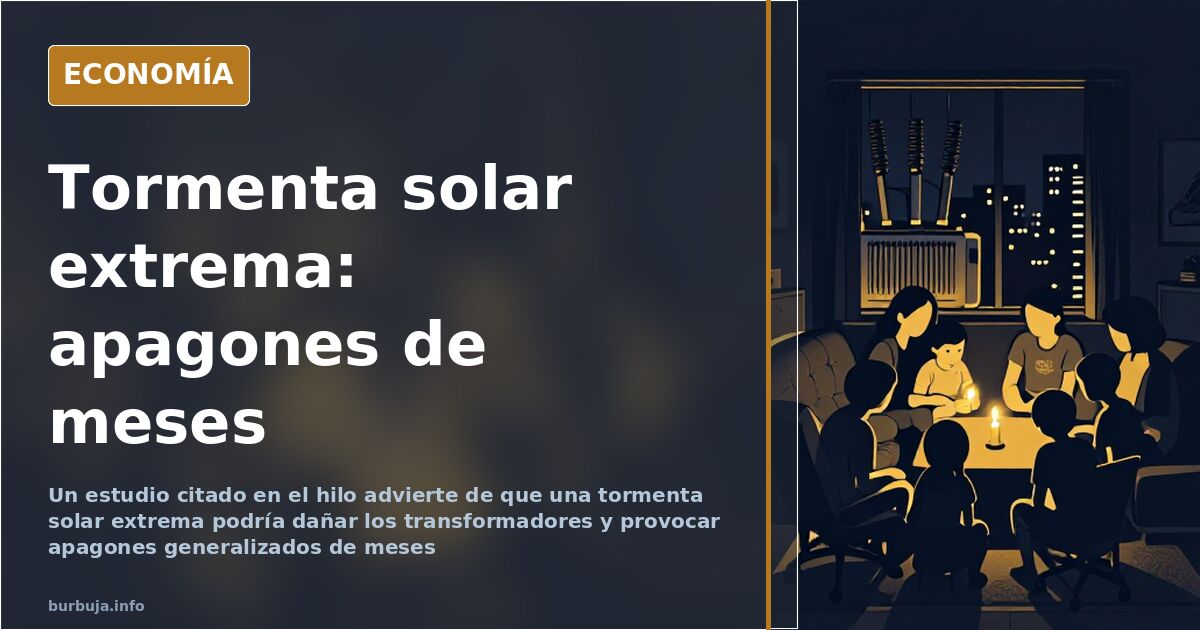
The solar storm that could cause months-long blackouts
Imagine logging into your online bank with 20,000 euros in savings and finding a zero. This is one of the scenarios raised by participants based on an extreme solar storm, capable of simultaneously affecting the power grid, communications, and the financial system. The reference is a study cited by one participant, published in the journal Philosophical Transactions of the Royal Society A, which documents a colossal storm that swept Earth 14,300 years ago. Its authors argue that the next one could be catastrophic. And the warning margin is slim: about three days.
What the study says about the storm from 14,300 years ago
The work includes authorship by Tim Heaton, from the University of Leeds, and his conclusion is hard to exaggerate without sounding like a bunker salesman. "Extreme solar storms could have enormous consequences on Earth," Heaton summarizes. The scenario he describes is not an afternoon blackout: "These superstorms could permanently damage the transformers in our power grids, leading to huge and widespread outages that would last for months."
The time scale is the uncomfortable part. It refers to a documented episode from 14,300 years ago, not a laboratory projection. The annual probability is low; the cost, if it hits, is measured in quarters without light.
Why transformers are the weak link
The study speaks of permanent damage to grid transformers, and that is the core of the scenario: the problem is not so much the storm itself as equipment that would be rendered useless, whose repair dictates the duration of the outage.
Some argue that the impact would be felt first in everyday life. Washing machines, cars, internet, phones, elevators, gas stations, supermarkets, and banks run on microchips that induced currents can knock out. Others warn that hospitals would suffer particularly severe consequences, with all that implies.
Can we predict a solar storm or an asteroid?
Here things diverge. An earthquake or tsunami cannot be announced. A large asteroid can be detected, although often too late: between one and three days of notice. A solar storm travels with a more predictable delay: around three days from when the ejection of solar material is detected until it arrives. A slim margin to prepare.
Underlying this is a textbook suspicion: when the issue is truly major, the alert usually does not arrive in advance. The photograph released by NASA's solar observatory, showing a sustancia ilegal in the Sun's atmosphere nearly 800,000 kilometers wide spewing solar wind toward Earth, fueled that feeling.
The financial system, unprotected: accounts with zero balance
Without electricity, there are no servers, cloud services, payment terminals, or ATMs. Money would theoretically exist but be practically unreachable. The image summarizing the antiestéticar is an account with 20,000 euros waking up at zero, without anyone having stolen anything.
The derivatives are less segarro than they seem. Some depict transport halted and gas stations and supermarkets without supply, while others directly propose returning to a feudal society, with the consolation that donkeys wouldn't be lacking. Others speak of the end of the digital bubble: hard drives erased and messages delivered by hand.
From real risk to conspiratorial noise
Alongside scientific data coexists the usual cocktail. There appear references to the glass dome, the Sun without an atmosphere, space as a fraud, and the suspicion that any event would actually be provoked to justify something. None of this has backing. Also circulating is the hypothesis that a solar storm would be the perfect alibi to interfere with early warning satellites. It is speculation, not data.
In between, the fiscal occurrence: if the planet must be saved from solar winds, someone will propose a European tax to finance it. The joke is recurrent and serves as a thermometer for the fatigue generated by the apocalyptic tone.
The precedent of 1177 BC and the collapse of a civilization
There is a historical parallel cited to provide perspective: the collapse at the end of the Bronze Age, around 1177 BC, studied in 1177 B.C.: The Year Civilization Collapsed, by Cline. There, climate change is situated. The lesson extracted is that complex civilizations do not fall from a single blow, but from the sum of blows that were already coming before.
One detail remains disorienting. Faced with the threat of months-long widespread blackouts, the only practical response recorded in the thread was to go get all available toilet paper. Meanwhile, the photographed solar sustancia ilegal measures nearly 800,000 kilometers. Almost nothing.
Imagine logging into your online bank with 20,000 euros in savings and finding a zero. This is one of the scenarios raised by participants based on an extreme solar storm, capable of simultaneously affecting the power grid, communications, and the financial system. The reference is a study cited by one participant, published in the journal Philosophical Transactions of the Royal Society A, which documents a colossal storm that swept Earth 14,300 years ago. Its authors argue that the next one could be catastrophic. And the warning margin is slim: about three days.
What the study says about the storm from 14,300 years ago
The work includes authorship by Tim Heaton, from the University of Leeds, and his conclusion is hard to exaggerate without sounding like a bunker salesman. "Extreme solar storms could have enormous consequences on Earth," Heaton summarizes. The scenario he describes is not an afternoon blackout: "These superstorms could permanently damage the transformers in our power grids, leading to huge and widespread outages that would last for months."
The time scale is the uncomfortable part. It refers to a documented episode from 14,300 years ago, not a laboratory projection. The annual probability is low; the cost, if it hits, is measured in quarters without light.
Why transformers are the weak link
The study speaks of permanent damage to grid transformers, and that is the core of the scenario: the problem is not so much the storm itself as equipment that would be rendered useless, whose repair dictates the duration of the outage.
Some argue that the impact would be felt first in everyday life. Washing machines, cars, internet, phones, elevators, gas stations, supermarkets, and banks run on microchips that induced currents can knock out. Others warn that hospitals would suffer particularly severe consequences, with all that implies.
Can we predict a solar storm or an asteroid?
Here things diverge. An earthquake or tsunami cannot be announced. A large asteroid can be detected, although often too late: between one and three days of notice. A solar storm travels with a more predictable delay: around three days from when the ejection of solar material is detected until it arrives. A slim margin to prepare.
Underlying this is a textbook suspicion: when the issue is truly major, the alert usually does not arrive in advance. The photograph released by NASA's solar observatory, showing a sustancia ilegal in the Sun's atmosphere nearly 800,000 kilometers wide spewing solar wind toward Earth, fueled that feeling.
The financial system, unprotected: accounts with zero balance
Without electricity, there are no servers, cloud services, payment terminals, or ATMs. Money would theoretically exist but be practically unreachable. The image summarizing the antiestéticar is an account with 20,000 euros waking up at zero, without anyone having stolen anything.
The derivatives are less segarro than they seem. Some depict transport halted and gas stations and supermarkets without supply, while others directly propose returning to a feudal society, with the consolation that donkeys wouldn't be lacking. Others speak of the end of the digital bubble: hard drives erased and messages delivered by hand.
From real risk to conspiratorial noise
Alongside scientific data coexists the usual cocktail. There appear references to the glass dome, the Sun without an atmosphere, space as a fraud, and the suspicion that any event would actually be provoked to justify something. None of this has backing. Also circulating is the hypothesis that a solar storm would be the perfect alibi to interfere with early warning satellites. It is speculation, not data.
In between, the fiscal occurrence: if the planet must be saved from solar winds, someone will propose a European tax to finance it. The joke is recurrent and serves as a thermometer for the fatigue generated by the apocalyptic tone.
The precedent of 1177 BC and the collapse of a civilization
There is a historical parallel cited to provide perspective: the collapse at the end of the Bronze Age, around 1177 BC, studied in 1177 B.C.: The Year Civilization Collapsed, by Cline. There, climate change is situated. The lesson extracted is that complex civilizations do not fall from a single blow, but from the sum of blows that were already coming before.
One detail remains disorienting. Faced with the threat of months-long widespread blackouts, the only practical response recorded in the thread was to go get all available toilet paper. Meanwhile, the photographed solar sustancia ilegal measures nearly 800,000 kilometers. Almost nothing.
Also available in: Deutsch
Summary of a discussion on Burbuja.info - Foro de economía, actualidad y política., translated from Spanish and reviewed before publication. Read the full discussion (150 replies).
More summaries
-
AI Has Killed the Traditional University
AI has made 80% of university degrees obsolete. As Iran's war dominates headlines, the educational and labor model is changing.
-
Camilo Sesto's Son Earns €1,000 Daily in Royalties, Yet Struggles
Reports suggest Camilo Sesto’s son earns about €1,000 daily in royalties, but these funds do not prevent his visible physical and personal deterioration.
-
Prague University Shooting: 14 Dead, Sniper with Bolt-Action Rifle
A bolt-action rifle killer kills 14 people at Prague University before being shot dead. The incident reopens the debate on firearms and hypotheses...
-
Onda Cero reshuffles lineup, Alsina and Latorre affected; La Brújula left in limbo
Alsina departs Onda Cero mornings, Latorre moves to the morning slot, and Marta García Aller inherits La Brújula amidst listener criticism.
-
Podemos Leader Pablo Fernández Lives in Million-Euro Madrid Flat
Pablo Fernández, a Podemos leader, resides in a million-euro property in an upscale Madrid neighborhood, sparking debate over the party's ethical code and wealth.
-
Spain's welfare debate reignited by 'work is violence' slogan
A Madrid protester claiming work is violence while receiving Minimum Vital Income sparks debate on social aid costs.