
Ex-ETA member becomes lawyer after 17 years in prison
A former ETA member, sentenced to 27 years and serving 17, is now practicing law, reigniting debate on closed cases.
English · Original discussion in Spanish · Published
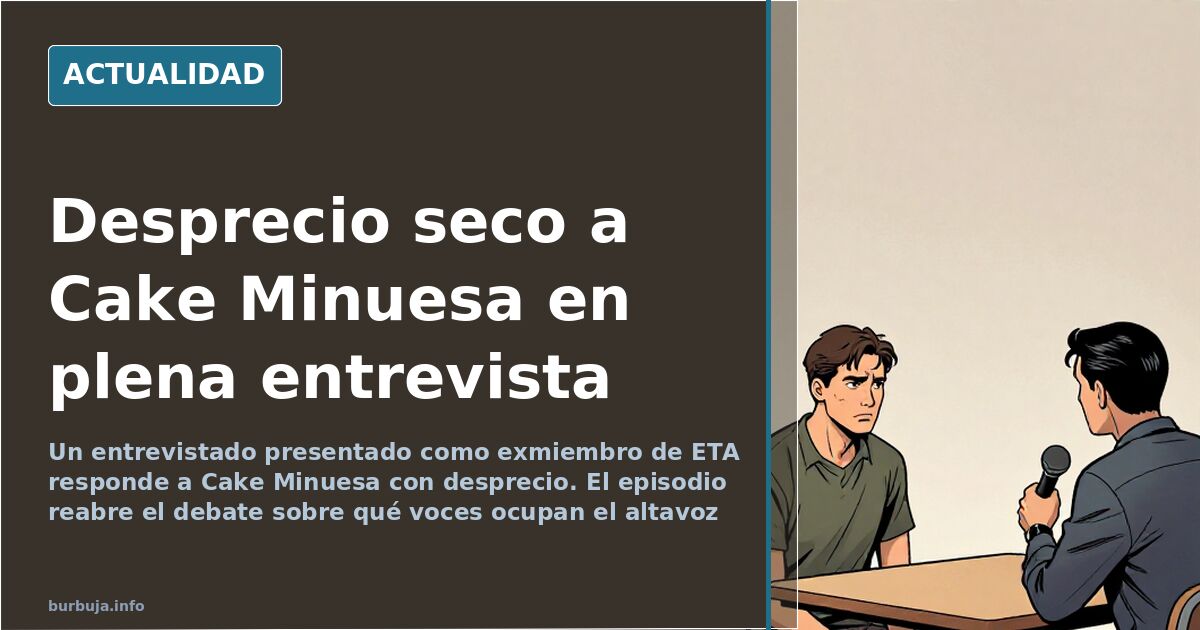
Ex-ETA member with 27-year sentence, 17 in prison, now a lawyer
Spain resolves its wounds with the click of a camera. A man convicted of terrorism, with a 27-year sentence and 17 years served in prison, is released and practices law, as recounted in the thread. This might seem like a trivial anecdote. In reality, it's the tip of an iceberg of a debate spanning five decades of closed cases, amnesties, and unresolved issues.
Some argue the interviewee hasn't renounced his past. This detail, which would end any public conversation in other countries, is commonplace here. And it's on this — not on the interview itself — that consensus breaks down.
What peine with Cake Minuesa and the ex-ETA member
The interviewee is a former ETA member who left prison after serving a substantial part of his sentence, 17 out of the 27 years he was convicted for, according to the account, and has since been practicing law normally. What's striking, in the eyes of participants, is the scene: a convicted terrorist walking the streets, practicing a liberal profession, and giving interviews without any apparent caution. On the other side, a journalist is accused of turning the matter into a spectacle. Some call for fewer interviews and more justice; others defend the work of journalists against criticism.
27-year sentence and 17 in prison: the journey no one reviews
The figure that looms over the entire conversation is simple: 27 years of sentence, 17 served. A proportion that, applied to any other violent crime, would cause front-page scandal. Here, it's filed away as administrative routine.
The most common argument is that of structural impunity. It's not just about this case. It's about a system that, according to those who have closely trinc the cases, closed terrorism-related proceedings with suspicious estimulante ilegal. Some mention cases being dismissed, often in 48 hours, as a matter of course, while other armed groups saw almost all their members pursued and prosecuted. This contrast — same violence, different standards — is at the heart of the anger.
The IRA, NORAID, and weapons from the United States
The comparison with the IRA soon appears. And it's important to clarify, as things get mixed up. The US federal government didn't send remittances to the IRA: it was members of the Irish community in the US, mainly through the NORAID network, who channeled funds. While that was happening, authorities investigated, arrested, and prosecuted individuals for these very activities. There were well-known cases: Duggan, Megahey, and the Meehans.
The confusion between money and weaponry also persists. Estimates from the time placed the proportion of IRA weapons originating from the US at around 85%. That is to say: the flow was real, but the official narrative and cold analysis don't always align.
Why were ETA cases closed so quickly?
Here the debate becomes uncomfortable. Some maintain that Justice looked the other way for years. The repeated statistic is stark: nearly 400 unsolved murders. Four hundred. A figure that doesn't match any other armed group from that era.
One of the arguments that carries the most weight in this discussion is the 1977 Amnesty Law, which some interpret as a selective erasure. And subsequent legislation, which in Strasbourg and Madrid allegedly benefited the ETA milieu with more leniency than their victims. The family of a murder victim, in that scenario, according to some participants, only had two options: go into exile or swallow it.
From the "Basque liberation movement" to the 2011 mediators
The phrase was written by José María Aznar, as recalled in the thread: they didn't say ETA, they said Basque liberation movement. The euphemism is part of the landscape. In 2011, the organization had, according to one participant, high-profile international mediators: former UN Secretary-General Kofi Annan, former Norwegian Prime Minister Gro Harlem Brundtland, former French minister Pierre Joxe, and Jonathan Powell, former chief of staff to Tony Blair. Names that rarely appear alongside the word surrender.
The result, according to this account, is that today its former cadres hold institutional positions and practice liberal professions. There are no former murderers, some repeat: murderers are murderers until they die.
What lies ahead
If the pattern holds, this episode will fade within a week, replaced by another equally sterile controversy. It's predictable that no prosecutor's office will reopen the debate on the proportion of sentences served or on the express trials of the eighties and nineties. It's also predictable that Minuesa's next interview will generate exactly the same headlines.
The only thing that doesn't seem predictable, at this point, is that anyone will move the figures. And without moving the figures, the rest is just conversation.
Spain resolves its wounds with the click of a camera. A man convicted of terrorism, with a 27-year sentence and 17 years served in prison, is released and practices law, as recounted in the thread. This might seem like a trivial anecdote. In reality, it's the tip of an iceberg of a debate spanning five decades of closed cases, amnesties, and unresolved issues.
Some argue the interviewee hasn't renounced his past. This detail, which would end any public conversation in other countries, is commonplace here. And it's on this — not on the interview itself — that consensus breaks down.
What peine with Cake Minuesa and the ex-ETA member
The interviewee is a former ETA member who left prison after serving a substantial part of his sentence, 17 out of the 27 years he was convicted for, according to the account, and has since been practicing law normally. What's striking, in the eyes of participants, is the scene: a convicted terrorist walking the streets, practicing a liberal profession, and giving interviews without any apparent caution. On the other side, a journalist is accused of turning the matter into a spectacle. Some call for fewer interviews and more justice; others defend the work of journalists against criticism.
27-year sentence and 17 in prison: the journey no one reviews
The figure that looms over the entire conversation is simple: 27 years of sentence, 17 served. A proportion that, applied to any other violent crime, would cause front-page scandal. Here, it's filed away as administrative routine.
The most common argument is that of structural impunity. It's not just about this case. It's about a system that, according to those who have closely trinc the cases, closed terrorism-related proceedings with suspicious estimulante ilegal. Some mention cases being dismissed, often in 48 hours, as a matter of course, while other armed groups saw almost all their members pursued and prosecuted. This contrast — same violence, different standards — is at the heart of the anger.
The IRA, NORAID, and weapons from the United States
The comparison with the IRA soon appears. And it's important to clarify, as things get mixed up. The US federal government didn't send remittances to the IRA: it was members of the Irish community in the US, mainly through the NORAID network, who channeled funds. While that was happening, authorities investigated, arrested, and prosecuted individuals for these very activities. There were well-known cases: Duggan, Megahey, and the Meehans.
The confusion between money and weaponry also persists. Estimates from the time placed the proportion of IRA weapons originating from the US at around 85%. That is to say: the flow was real, but the official narrative and cold analysis don't always align.
Why were ETA cases closed so quickly?
Here the debate becomes uncomfortable. Some maintain that Justice looked the other way for years. The repeated statistic is stark: nearly 400 unsolved murders. Four hundred. A figure that doesn't match any other armed group from that era.
One of the arguments that carries the most weight in this discussion is the 1977 Amnesty Law, which some interpret as a selective erasure. And subsequent legislation, which in Strasbourg and Madrid allegedly benefited the ETA milieu with more leniency than their victims. The family of a murder victim, in that scenario, according to some participants, only had two options: go into exile or swallow it.
From the "Basque liberation movement" to the 2011 mediators
The phrase was written by José María Aznar, as recalled in the thread: they didn't say ETA, they said Basque liberation movement. The euphemism is part of the landscape. In 2011, the organization had, according to one participant, high-profile international mediators: former UN Secretary-General Kofi Annan, former Norwegian Prime Minister Gro Harlem Brundtland, former French minister Pierre Joxe, and Jonathan Powell, former chief of staff to Tony Blair. Names that rarely appear alongside the word surrender.
The result, according to this account, is that today its former cadres hold institutional positions and practice liberal professions. There are no former murderers, some repeat: murderers are murderers until they die.
What lies ahead
If the pattern holds, this episode will fade within a week, replaced by another equally sterile controversy. It's predictable that no prosecutor's office will reopen the debate on the proportion of sentences served or on the express trials of the eighties and nineties. It's also predictable that Minuesa's next interview will generate exactly the same headlines.
The only thing that doesn't seem predictable, at this point, is that anyone will move the figures. And without moving the figures, the rest is just conversation.
Summary of a discussion on Burbuja.info - Foro de economía, actualidad y política., translated from Spanish and reviewed before publication. Read the full discussion (190 replies).
More summaries
-
Fernández de la Vega to leave Council of State for health reasons
María Teresa Fernández de la Vega reportedly resigns from the Council of State due to health. The replacement reopens debate on institutional spending.
-
What VOX Would Do About the 10,000 Migrants in Ceuta
Around 10,000 undocumented migrants in Ceuta and no clear return path: the standoff with Morocco and the proposed pressures.
-
Constitutional Court Approves Amnesty for Turull's Misappropriation, Paving Way for Puigdemont’s Return
The TC takes a key step toward amnesty for the 'procés' misappropriation, clearing the path for **Puigdemont**'s return. The plenary decision opens new avenues.
-
Gomesende Wedding Descends into Brawl Over €40,000 in Gifts
A wedding in Gomesende turned into a family fight over €40,000 in gifts, according to the circulating account. The bride's origin became a focus of the dispute.
-
Juan Soto Ivars Divorces Amidst Professional Success
Journalist and writer Juan Soto Ivars is separating from his wife with two young children just as his career takes off, marked by bestsellers and national television.
-
Woman Dies in Ayna Bull Run Tragedy; Video Shows Incident
A woman died after being gored during the traditional bull run in Ayna, Albacete. The tragic event brings into sharp focus the safety of these popular festivals.