
Euthanasia in Spain: requirements and why requests are denied
Spain's euthanasia law does not require a terminal condition, but it does demand years of medical history and exhausted treatments. Access depends on the region and the guarantee commission.
English · Original discussion in Spanish · Published
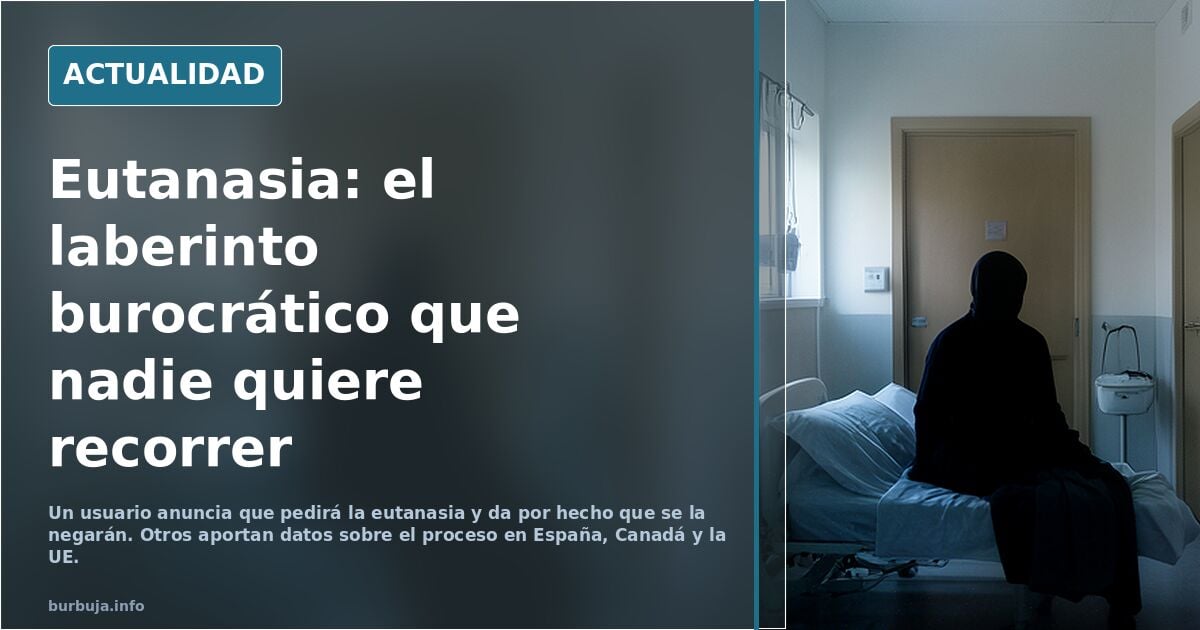
Euthanasia in Spain: the law exists, the one-stop shop doesn't
Spain's euthanasia law is marking another anniversary and continues to generate a steady trickle of requests that never go through. The profile of the average applicant is not that of a terminally ill patient with weeks to live, but that of a person with chronic, disabling suffering who has spent years accumulating diagnoses without any single one of them opening the door. The law does not require a terminal condition. It requires something harder to certify: that the suffering be serious, chronic and disabling, and that a clinical history back it up.
The public debate on the right to a dignified death has become a standoff between two narratives that rarely meet. On one side, the view that the State should not have the final say over one's own body. On the other, the warning that expanding the right without safeguards turns euthanasia into a way out for those who can find no other. In between, an administrative procedure most people know nothing about, and which decides more than it seems.
What the law requires to request euthanasia
The first filter is capacity. Being an adult and legally and mentally competent at the time of the request. It sounds obvious, but this is where half of Spain falls: any prior psychiatric diagnosis with impaired capacity noted in the medical record becomes a wall that is hard to overcome. The second is nationality or legal residence. The third, the substantive one: a serious, chronic and disabling illness, or serious, chronic and disabling suffering.
You do not need to be terminally ill, and that is the key fact many people don't know. What really weighs in the file is time: years of medical history, not one bad year. Exhausted treatments matter too. If the record shows gaps without treatment, the request is rejected. And real functional incapacity: daily life being wiped out, not just feeling unwell. A diagnosis of autism or ADHD is not the door; what prevents you from living is.
How long it takes and who decides
The procedure is not settled by a family doctor. It is assessed by a guarantee and evaluation commission, and before that it must pass through two physicians. Applicants may ask for someone they trust to accompany them throughout the process. Conscientious objection by professionals is regulated, which in practice can extend waiting times depending on the autonomous region.
This is where one of the recurring criticisms appears: the regional lottery. As with voluntary termination of pregnancy, access depends on the territory. There are regions where the process runs with relative estimulante ilegal and others where the administrative bottleneck drives to despair those who were already desperate. The law is national; the front desk is regional.
Why euthanasia is denied to those who request it
The most common answer is uncomfortable: because the criterion is not how much it hurts, but how well it fits. Some argue that the system prioritizes the family burden over individual suffering. If you ask to die because you don't fit in, they tell you no. If you ask to die because you don't want to be a burden, the file moves forward. Your suffering doesn't count; what is saved does.
That is the harshest argument circulating in discussion forums about the law, and it is not a marginal thesis. It comes up every time a case becomes known of denial to people with autism spectrum disorders, ADHD, anxiety or anhedonia. The commission does not assess diagnostic labels. It assesses functionality, medical history and previous treatments. And there, those who have spent years in the system without a clear answer tend to lose.
Death tourism: seeking euthanasia outside Spain
When the Spanish route is exhausted, there is a European option. Belgium and the Netherlands offer the strongest safeguards in the EU, while Switzerland operates outside the EU framework with a model in which the economic cost of the process weighs heavily. So-called death tourism is growing, according to the figures used by those who trinc the issue.
Farther afield, Canada stands out as the most permissive system. Euthanasia has been regulated there since 2015, and the figures cited speak of some 20,000 deaths a year by this route. The Canadian model allows patients to administer the lethal medication themselves, guaranteeing their autonomy, and even to choose the location. It is the scenario some Spanish advocates put on the table as a horizon.
The underlying debate: a right to die or a right not to suffer
The discussion is not only legal. There is a current that holds that if birth is an imposition, a dignified death should be an unconditional right from the age of majority. No suffering thermometers, no committees deciding whether your pain is enough. And there is another that warns of the opposite: that an unconditional right becomes a mechanism for dismantling what the State does not want to sustain.
In between lies the unsettling fact. Euthanasia is approved in some countries and denied in practice in others, but death keeps coming for 99.9% of the population, through illness or biological decay. The question is not whether we will die, but who signs the permit. And with these materials, does anyone truly believe the State will let go of the pen?
Also available in: Deutsch
Summary of a discussion on Burbuja.info - Foro de economía, actualidad y política., translated from Spanish and reviewed before publication. Read the full discussion (66 replies).
More summaries
-
Pedro Sánchez: Is Spain's PM a 33rd Degree Freemason?
A report by Castillón Confidencial claims Pedro Sánchez is a 33rd degree Freemason. Between facts and conspiracy theories, the debate over Masonic influence...
-
Nolan's The Odyssey opens to $264M, tracking toward $1-1.2 billion
Christopher Nolan's The Odyssey grossed $264 million in its opening weekend and is projected to reach $1-1.2 billion globally, despite controversy over its diverse cast.
-
Taking VioGén discrimination claims to court: an uphill battle
An individual has appealed to Spain's Constitutional Court and the UN over discrimination in the VioGén system. The appeal was rejected, but he promises to reveal a contract that…
-
Wounded sergeant reignites debate over Spain's underfunded military
A sergeant is wounded and public conversation turns into criticism of a Spanish military with a paper-thin budget and outdated equipment.
-
Feijóo calls for lockdown in Ceuta over health risk
Spain's opposition leader Feijóo has called for a lockdown of Ceuta over scabies and tuberculosis risks following a mass arrival of migrants; figures clash and controversy grows.
-
Like this if you want Teresa Rodríguez to beat her cancer, Adelante Andalucía founder
Teresa Rodríguez's cancer diagnosis has sparked a raw debate on Burbuja.info: can you separate human compassion from political trench warfare?