
Europe's Rearmament Debate Meets Demilitarization Demands
As Ukraine's 600,000 km² face Russia's 30 million km², the debate over European rearmament clashes with who should demilitarize and who pays...
English · Original discussion in Spanish · Published
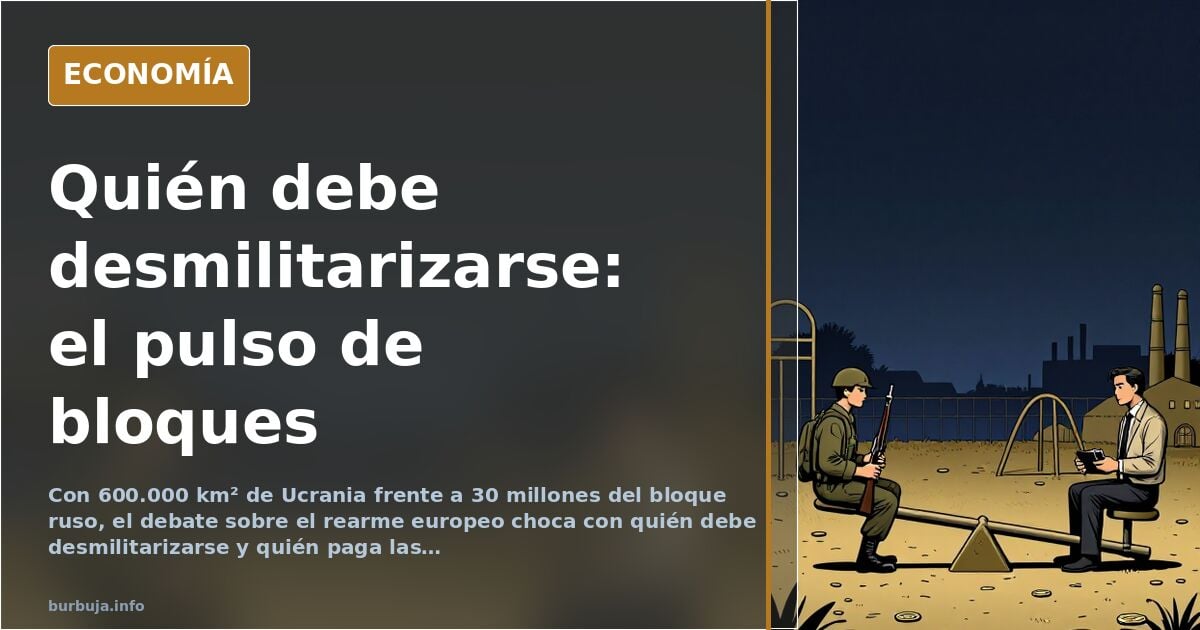
Europe's Rearmament Push Clashes with Demilitarization Demands
Someone amassed 100,000 soldiers on Ukraine's border and called it a maneuver. Some argue that no one moves such a volume of troops just for a stroll and return. The stated trigger was Ukraine's potential NATO entry, and an uncomfortable question began to circulate: When has NATO attacked Russia? From that standoff between blocs emerges the discussion that orders everything else: who should demilitarize, who can have an army, and how far is the red line pushed.
Geographical Disproportion as an Argument
The number that repeats is size. Ukraine covers 600,000 square kilometers; the post-Soviet bloc that Moscow claims as its security space, 30 million. Putting that on a scale and calling it an existential threat sounds, to a large part of the analysis, like a textbook excuse. The comparison that slipped into the comments was that of a lawyer claiming insurmountable antiestéticar after a hundred stab wounds: the motive does not explain the act. In bloc economics, territorial asymmetry is usually the fact that dismantles the narrative.
Is Russia a European Country?
Here the debate splits. One current argues that Russia is as European as any other state on the continent and that the problem is not geography, but the refusal to assimilate to a specific social model. The opposing view holds that its political DNA is that of the steppe, that it inherited imperial logic from the Golden Horde, and that its place was never west of the Urals. The consequence is the same for both: if who is European and who is not is decided, then where they can deploy their missiles is also decided.
Turkey, the Border No One Wants to Redraw
The map shows an amusing contradiction. Turkey is considered European and Russia is not, even though the former joined NATO in the fifties. One sector demands the return of Constantinople and occupied Thrace and sending Anatolia elsewhere; another recalls that in bloc politics, it is enough for a country to be within the alliance, not for its population to appear to be. This is where the ethnic debate turns into noise and the strategic one into calculation.
Who Would Fill the Ranks of a European Army
Demographics is the uncomfortable fact no one wants to look at. It is repeated that European birth rates do not fill barracks and that a continental rearmament would be a wet paper without people to sustain it. The argument jumps from the military balance to the economic one: defense spending, active population, aging. No one has put on the table how a common army is financed when half the continent has an inverted population pyramid.
The last point of contention is not military. In the bloc comparison being used, China and India together make up three-quarters of humanity. Any European rearmament is actually designed against this board and not against the Urals. And there, the count of soldiers matters less than the count of where economic power lies.
Someone amassed 100,000 soldiers on Ukraine's border and called it a maneuver. Some argue that no one moves such a volume of troops just for a stroll and return. The stated trigger was Ukraine's potential NATO entry, and an uncomfortable question began to circulate: When has NATO attacked Russia? From that standoff between blocs emerges the discussion that orders everything else: who should demilitarize, who can have an army, and how far is the red line pushed.
Geographical Disproportion as an Argument
The number that repeats is size. Ukraine covers 600,000 square kilometers; the post-Soviet bloc that Moscow claims as its security space, 30 million. Putting that on a scale and calling it an existential threat sounds, to a large part of the analysis, like a textbook excuse. The comparison that slipped into the comments was that of a lawyer claiming insurmountable antiestéticar after a hundred stab wounds: the motive does not explain the act. In bloc economics, territorial asymmetry is usually the fact that dismantles the narrative.
Is Russia a European Country?
Here the debate splits. One current argues that Russia is as European as any other state on the continent and that the problem is not geography, but the refusal to assimilate to a specific social model. The opposing view holds that its political DNA is that of the steppe, that it inherited imperial logic from the Golden Horde, and that its place was never west of the Urals. The consequence is the same for both: if who is European and who is not is decided, then where they can deploy their missiles is also decided.
Turkey, the Border No One Wants to Redraw
The map shows an amusing contradiction. Turkey is considered European and Russia is not, even though the former joined NATO in the fifties. One sector demands the return of Constantinople and occupied Thrace and sending Anatolia elsewhere; another recalls that in bloc politics, it is enough for a country to be within the alliance, not for its population to appear to be. This is where the ethnic debate turns into noise and the strategic one into calculation.
Who Would Fill the Ranks of a European Army
Demographics is the uncomfortable fact no one wants to look at. It is repeated that European birth rates do not fill barracks and that a continental rearmament would be a wet paper without people to sustain it. The argument jumps from the military balance to the economic one: defense spending, active population, aging. No one has put on the table how a common army is financed when half the continent has an inverted population pyramid.
The last point of contention is not military. In the bloc comparison being used, China and India together make up three-quarters of humanity. Any European rearmament is actually designed against this board and not against the Urals. And there, the count of soldiers matters less than the count of where economic power lies.
Summary of a discussion on Burbuja.info - Foro de economía, actualidad y política., translated from Spanish and reviewed before publication. Read the full discussion (51 replies).
More summaries
-
Euthanasia in Old Age: Autonomy vs. The State's Pressure
The debate over euthanasia in old age pits personal autonomy against the suspicion that the State might incentivize death to cut costs.
-
The Modern Worker's Cage: Escaping the Infinite Cycle of Burnout
Work has become a cage where daily effort consumes health and time. Discover why we push ourselves so hard and how to break the cycle.
-
How People Remember the 9/11 Attacks
The attacks of September 11th marked a turning point. Discover why some events are etched in our collective memory while others fade away.
-
Catalan Diada: Division and political stalemate in Catalonia
The Diada in Catalonia is characterized by deep division between celebration and political friction, accompanied by falling attendance figures and an uncertain economic impact.
-
Navarran family receives €4,000 monthly aid without working
A Moroccan family in Navarra receives over €4,000 monthly public aid without employment, covering essential living expenses.
-
Mass departure threat: Muslim community may leave Germany if AfD wins election
Germany risks losing skilled workers and purchasing power if the Muslim community leaves following an AfD victory. We analyze the economic implications.