
Europe's Demographic Crisis Sparks Debate on Extinction
The debate on Europe's decline focuses on low birth rates, lack of generational replacement, and loss of sovereignty amid demographic data.
English · Original discussion in Spanish · Published
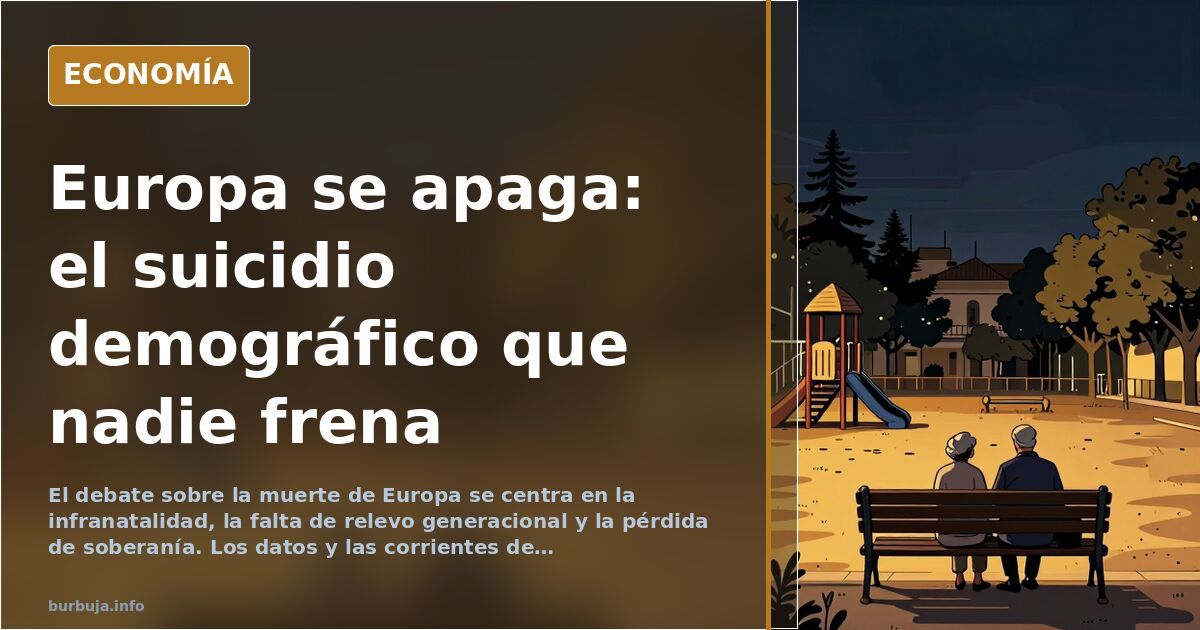
Europe's Decline: When Demography Becomes a Death Sentence
Europe does not die in war. It dies in a waiting room. This is the thesis running through an extensive exchange of views where the continent's disappearance is attributed not to armies, but to the combination of sustained low birth rates, institutional permissiveness, and loss of sovereignty. The starting point is a stark assertion: the extreme beauty of all Europe will vanish very soon, and we are the last generation to have known the wonder that was white Europe. From there, the diagnosis branches into three currents that rarely agree with each other.
What the Opening Message Proposes
The initial text does not speak of economics or borders. It speaks of aesthetics, heritage, and irreparable loss. It argues that everyone responsible for this atrocity must suffer such punishment and sets the time horizon in the immediate future: the next generation will no longer know what existed before. The reference to European beauty as a perishable good is the emotional core of the argument, serving as the trigger for everything that trinc.
From that premise, the conversation quickly shifts to demographic territory. It is argued that there are no culprits other than those who have chosen demographic suicide as their philosophy and reason for being. The accusation does not point to a specific government, but to a way of life: comfort, low fertility, and the renunciation of reproduction as a collective project.
The Economic Diagnosis: Permissiveness, Welfare Dependence, and Lack of Replacement
One part of the analysis holds that the problem is not the arrival of people, but the lack of European generational replacement. It states that we have had fifty years of below-replacement fertility and that there are not enough new Europeans. From this perspective, migration would be the consequence and not the cause: someone has to fill the jobs that the native population does not cover.
In parallel, some point to a training failure. They argue that newcomers are not trained in the language or in trades with demand, and that the previous generation raised their children with wrong expectations: better to be a welder than a philologist, or an electrician rather than a gamer. The diagnosis is completed with an accusation against selfie culture and the smartphone as the center of vital gravity.
The most uncomfortable rebuttal comes from the materialist flank: if European business owners were patriots, they would only hire native workers and only rent housing to their own kind. That does not happen. Capital has no flag, and that contradiction disarms much of the identity narrative.
Countries That Would Survive, According to the Most Repeated Calculation
There is a listing exercise that appears several times: which territories would hold up. Norway, Australia, Japan, and Eastern European countries are mentioned as those that would maintain control of their borders. The criterion is not cultural, but incentive-based: where there are no welfare handouts or free housing, the flow does not arrive. The implicit conclusion is that social policy is the variable that decides who enters and who does not.
Against this, another current points out that the problem is age-related. Europeans are increasingly older compared to those arriving, and that asymmetry works against them. It is not a matter of political will, but of the demographic pyramid. The complete data, broken down by cohorts, leaves a gap that no election campaign can cover.
Suspicion of the System: Media, Capital, and Endophobia
A third line of analysis abandons demography and points to structure. It argues that media belongs to the highest bidder and that when European states built colonial empires, they promoted imperialism; now that they depend on labor and markets from former colonies, they promote globalism. The conclusion is that if there had never been imperialism, there would be no globalism now.
The term endophobia, defined as the rejection of one's own, also appears. It is argued that it exists and has been inoculated into Europeans until making them incapable of defending their neighborhood, family, or country. The advantage of organizing around a leader becomes, in this reading, an Achilles' heel: it is enough to put a spokesperson repeating the correct message for the majority to align.
The response from the other side is irony about capitalism as the only operative reality. Ideas belong to the world of ideas; capitalism is exercised. Faced with a concrete need, people act with material logic and abandon ideology.
The Forecast: War, Hunger, or Resignation
The closing of the exchange divides between those calling for a shock and those trusting in resilience. One voice argues that the West needs a war and to go hungry to recover sarracena and the desire to civilize, and that wealth and peace create indolent and degenerate people. Another recalls that when Rome fell there were forty million Europeans and we are still here, and that it is enough for the fridge to empty for the European to get back to work.
The cautious prediction is this: if the demographic trend is not reversed, replacement will come by necessity and not by conviction. The question is whether that replacement will keep anything recognizable of what was meant to be defended. No one in the conversation dares to answer without a trap.
Europe does not die in war. It dies in a waiting room. This is the thesis running through an extensive exchange of views where the continent's disappearance is attributed not to armies, but to the combination of sustained low birth rates, institutional permissiveness, and loss of sovereignty. The starting point is a stark assertion: the extreme beauty of all Europe will vanish very soon, and we are the last generation to have known the wonder that was white Europe. From there, the diagnosis branches into three currents that rarely agree with each other.
What the Opening Message Proposes
The initial text does not speak of economics or borders. It speaks of aesthetics, heritage, and irreparable loss. It argues that everyone responsible for this atrocity must suffer such punishment and sets the time horizon in the immediate future: the next generation will no longer know what existed before. The reference to European beauty as a perishable good is the emotional core of the argument, serving as the trigger for everything that trinc.
From that premise, the conversation quickly shifts to demographic territory. It is argued that there are no culprits other than those who have chosen demographic suicide as their philosophy and reason for being. The accusation does not point to a specific government, but to a way of life: comfort, low fertility, and the renunciation of reproduction as a collective project.
The Economic Diagnosis: Permissiveness, Welfare Dependence, and Lack of Replacement
One part of the analysis holds that the problem is not the arrival of people, but the lack of European generational replacement. It states that we have had fifty years of below-replacement fertility and that there are not enough new Europeans. From this perspective, migration would be the consequence and not the cause: someone has to fill the jobs that the native population does not cover.
In parallel, some point to a training failure. They argue that newcomers are not trained in the language or in trades with demand, and that the previous generation raised their children with wrong expectations: better to be a welder than a philologist, or an electrician rather than a gamer. The diagnosis is completed with an accusation against selfie culture and the smartphone as the center of vital gravity.
The most uncomfortable rebuttal comes from the materialist flank: if European business owners were patriots, they would only hire native workers and only rent housing to their own kind. That does not happen. Capital has no flag, and that contradiction disarms much of the identity narrative.
Countries That Would Survive, According to the Most Repeated Calculation
There is a listing exercise that appears several times: which territories would hold up. Norway, Australia, Japan, and Eastern European countries are mentioned as those that would maintain control of their borders. The criterion is not cultural, but incentive-based: where there are no welfare handouts or free housing, the flow does not arrive. The implicit conclusion is that social policy is the variable that decides who enters and who does not.
Against this, another current points out that the problem is age-related. Europeans are increasingly older compared to those arriving, and that asymmetry works against them. It is not a matter of political will, but of the demographic pyramid. The complete data, broken down by cohorts, leaves a gap that no election campaign can cover.
Suspicion of the System: Media, Capital, and Endophobia
A third line of analysis abandons demography and points to structure. It argues that media belongs to the highest bidder and that when European states built colonial empires, they promoted imperialism; now that they depend on labor and markets from former colonies, they promote globalism. The conclusion is that if there had never been imperialism, there would be no globalism now.
The term endophobia, defined as the rejection of one's own, also appears. It is argued that it exists and has been inoculated into Europeans until making them incapable of defending their neighborhood, family, or country. The advantage of organizing around a leader becomes, in this reading, an Achilles' heel: it is enough to put a spokesperson repeating the correct message for the majority to align.
The response from the other side is irony about capitalism as the only operative reality. Ideas belong to the world of ideas; capitalism is exercised. Faced with a concrete need, people act with material logic and abandon ideology.
The Forecast: War, Hunger, or Resignation
The closing of the exchange divides between those calling for a shock and those trusting in resilience. One voice argues that the West needs a war and to go hungry to recover sarracena and the desire to civilize, and that wealth and peace create indolent and degenerate people. Another recalls that when Rome fell there were forty million Europeans and we are still here, and that it is enough for the fridge to empty for the European to get back to work.
The cautious prediction is this: if the demographic trend is not reversed, replacement will come by necessity and not by conviction. The question is whether that replacement will keep anything recognizable of what was meant to be defended. No one in the conversation dares to answer without a trap.
Also available in: Deutsch
Summary of a discussion on Burbuja.info - Foro de economía, actualidad y política., translated from Spanish and reviewed before publication. Read the full discussion (164 replies).
More summaries
-
Paris pays 12€/hour for work Australia pays 45€
A metal technician earns 12 euros per hour in Paris and 45 in Australia: rent, transport, and taxes eat the difference.
-
Europe faces silent demographic decline
With 1.2 children per woman and an aging population, data suggests Europe is shrinking despite official narratives.
-
Suspect arrested in Madrid over Norwegian woman's death
Anne Mathea Morken, a 22-year-old Norwegian, was found dead on a Torremolinos sidewalk in 2023. A suspect was detained in Madrid in late February.
-
Spain's grocery prices in 2002: a dozen eggs cost €0.89
From €0.89 to €3 for a dozen eggs: the relentless rise in Spanish food prices over 23 years, with stagnant wages and soaring rents. Who keeps the margin?
-
Open-source project clones seven Adobe apps
An open-source initiative replicates features from seven Adobe applications, gaining 44,000 GitHub stars and updating every three days.
-
Spain Audit Finds €2.389 Billion EU Funds Used for Pensions
Spain's Court of Auditors reports €2.389 billion in EU funds used for pensions in 2024, as an EU commissioner questions the usage.