
European rearmament advances, debate shifts to evasion
Europe rearms while the public remains unaware. Ukrainian lessons, a federal army, and military realities challenge optimism.
English · Original discussion in Spanish · Published
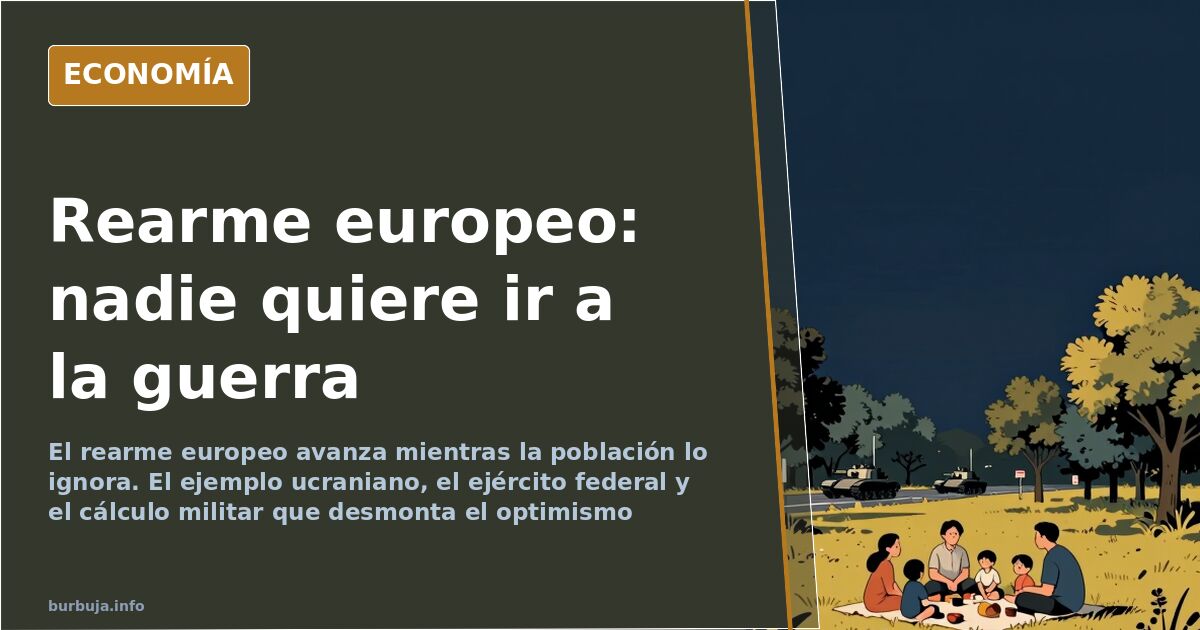
Europe rearms but nobody wants to fight
The conversation begins with an uncomfortable warning: it only takes 200,000 Poles and 200,000 Germans signing up for the process to start, and missiles don’t ask about your nationality. This isn’t a conspiracy theory, but the realization that European military machinery is being greased while the population looks away. References to NATO Secretary General Mark Rutte and his video statements serve as a trigger: he is described as a puppet projecting assertiveness with short sleeves while the rhetoric hardens. The underlying thesis is that people have subconsciously decided they won’t go to any war, whoever starts it. And that is precisely what allows them to start one.
From Ukraine to the European rear: the manual nobody wants to read
The Ukrainian example acts as a mirror. Those who thought they could refuse to go to the front saw how borders were first closed, then recruitment centers began hunting people on the streets. Basic training of two or three weeks, as riflemen, straight to the trenches. There, survivors will learn to be soldiers. The conclusion drawn is that war is neither good nor bad: it is the consequence of voting for irresponsible leaders. And the lingering question is whether dialogue is possible with the Spanish Government or its ministers.
The scenario depicted for Spain is militarized rear from minute one: ration cards for food and gasoline, total intervention in the economy oriented toward military production. Tanks don’t need to arrive for daily life to change.
The European army as a step toward a federal state
One of the most developed lines of analysis argues that all this rhetoric aims to complete another phase of the European project: an independent transnational army. It would be the necessary step to turn Europe into a federal state like the United States. To justify that army, an enemy is needed, and that enemy is Russia. Investments must be justified. Mass immigration would be part of the same design: creating transnational populations that undermine each country’s nationalism. The dream is a federal Europe with its army, states instead of countries, its president, and its ministers.
In parallel, another line of argument suggests that war is the perfect excuse to change the unsustainable pension system, among other things that have made the West incapable of existing as it is. Daily propaganda with televised real deaths serves as cover.
Why doubt Europeans will accept mobilization?
The ability of European states to mobilize their populations against Russia is questioned. The argument is that many would prefer to confront agents of their own government rather than Russians, because traitors are held in greater contempt. Added to this is the multicultural factor: it rhetorically asks why fight for an increasingly fragmented country. Instinct, it is said, points the opposite way.
The counterbalance comes from those who warn that war brings out the worst in humans and that, in certain contexts, the worst in others is on another level. The experience of conflict-ridden countries is cited as a warning: either you are with them, or you will be worse off than them.
Modern slavery doesn’t wear a uniform
One of the sharpest interventions reframes the term slavery. Current slavery is something else: you get vaccinated, your daughter sells content on digital platforms to pay for vacations, your son thinks he’ll end up as an influencer living in Andorra, and you have your job in limbo because you’re already 50. In the United States there were two types of slaves, house servants and field workers. We have been turned into indoor slaves. We don’t dirty our hands, we think we are better, but we are caught just the same. Going to a trench is not slavery. It is something else.
Military calculation dismantles optimism
The capability analysis is devastating. With 10,000 North Korean soldiers, Russia faced 60,000 Ukrainians with the best equipment available at the time. The conclusion is that Europe lacks both the personnel and the industrial production necessary to wear anyone down. The destruction produced in six months would be epic. They would go with white flags until the lettuce.
Against this, the most repeated response is indifference: they will react when they start devouring each other. Others have already made a practical decision: grab the family and leave for South America, and let everyone blow up. And a minority remembers having lived something similar during military service and, after decades of observing human behavior, expects nothing good. Weapons, gold, food, and staying fit. Little more can be done.
The disorienting fact is not military, but demographic: those supposed to fight are the same ones who no longer believe anything they are told. And those in command know it.
The conversation begins with an uncomfortable warning: it only takes 200,000 Poles and 200,000 Germans signing up for the process to start, and missiles don’t ask about your nationality. This isn’t a conspiracy theory, but the realization that European military machinery is being greased while the population looks away. References to NATO Secretary General Mark Rutte and his video statements serve as a trigger: he is described as a puppet projecting assertiveness with short sleeves while the rhetoric hardens. The underlying thesis is that people have subconsciously decided they won’t go to any war, whoever starts it. And that is precisely what allows them to start one.
From Ukraine to the European rear: the manual nobody wants to read
The Ukrainian example acts as a mirror. Those who thought they could refuse to go to the front saw how borders were first closed, then recruitment centers began hunting people on the streets. Basic training of two or three weeks, as riflemen, straight to the trenches. There, survivors will learn to be soldiers. The conclusion drawn is that war is neither good nor bad: it is the consequence of voting for irresponsible leaders. And the lingering question is whether dialogue is possible with the Spanish Government or its ministers.
The scenario depicted for Spain is militarized rear from minute one: ration cards for food and gasoline, total intervention in the economy oriented toward military production. Tanks don’t need to arrive for daily life to change.
The European army as a step toward a federal state
One of the most developed lines of analysis argues that all this rhetoric aims to complete another phase of the European project: an independent transnational army. It would be the necessary step to turn Europe into a federal state like the United States. To justify that army, an enemy is needed, and that enemy is Russia. Investments must be justified. Mass immigration would be part of the same design: creating transnational populations that undermine each country’s nationalism. The dream is a federal Europe with its army, states instead of countries, its president, and its ministers.
In parallel, another line of argument suggests that war is the perfect excuse to change the unsustainable pension system, among other things that have made the West incapable of existing as it is. Daily propaganda with televised real deaths serves as cover.
Why doubt Europeans will accept mobilization?
The ability of European states to mobilize their populations against Russia is questioned. The argument is that many would prefer to confront agents of their own government rather than Russians, because traitors are held in greater contempt. Added to this is the multicultural factor: it rhetorically asks why fight for an increasingly fragmented country. Instinct, it is said, points the opposite way.
The counterbalance comes from those who warn that war brings out the worst in humans and that, in certain contexts, the worst in others is on another level. The experience of conflict-ridden countries is cited as a warning: either you are with them, or you will be worse off than them.
Modern slavery doesn’t wear a uniform
One of the sharpest interventions reframes the term slavery. Current slavery is something else: you get vaccinated, your daughter sells content on digital platforms to pay for vacations, your son thinks he’ll end up as an influencer living in Andorra, and you have your job in limbo because you’re already 50. In the United States there were two types of slaves, house servants and field workers. We have been turned into indoor slaves. We don’t dirty our hands, we think we are better, but we are caught just the same. Going to a trench is not slavery. It is something else.
Military calculation dismantles optimism
The capability analysis is devastating. With 10,000 North Korean soldiers, Russia faced 60,000 Ukrainians with the best equipment available at the time. The conclusion is that Europe lacks both the personnel and the industrial production necessary to wear anyone down. The destruction produced in six months would be epic. They would go with white flags until the lettuce.
Against this, the most repeated response is indifference: they will react when they start devouring each other. Others have already made a practical decision: grab the family and leave for South America, and let everyone blow up. And a minority remembers having lived something similar during military service and, after decades of observing human behavior, expects nothing good. Weapons, gold, food, and staying fit. Little more can be done.
The disorienting fact is not military, but demographic: those supposed to fight are the same ones who no longer believe anything they are told. And those in command know it.
Summary of a discussion on Burbuja.info - Foro de economía, actualidad y política., translated from Spanish and reviewed before publication. Read the full discussion (146 replies).
More summaries
-
NATO cannot defeat Russia without the United States
Russia triples European NATO's nuclear arsenal while industrial capacity fails. Without the US, the Alliance is hollow.
-
Putin: Combined Russia-UE GDP Would Exceed US, But Gas Costs Complicate Deal
Putin claims combined Russia-UE GDP surpasses US. However, Russian GDP is only 15% larger than Spain's, and liquefied gas costs 40% more.
-
Nightlife Wanes: From 5,000 Venues to Under 2,000, According to Estimates
Estimates suggest Spain's nightlife venues have plummeted from around 5,000 to under 2,000. Valencia anticipates a 13.1% drop in revenue.
-
Spain to bypass Congress with housing decrees
Spanish government plans housing decrees via Permanent Deputation, sparking fraud accusations and electoral concerns.
-
Spain's most common salary stands at €15,400 gross
The most frequent salary in Spain is €15,400 gross annually. Critics argue that the minimum wage and inflation have compressed pay scales.
-
Ecuadorian shouts 'Long live Franco' at PSOE HQ, challenging migration narrative
Video of Ecuadorian woman shouting pro-Franco slogans at Ferraz reignites debate on Latin American migrant voting patterns and right-wing affinity.