
Europe Inherits Ukraine War Bill: 5% of GDP and Goodbye to Russian Gas
Bolton warns that Europe's 'not our war' sentiment invites Trump to abandon Ukraine: Europe shoulders the 5% GDP cost, expensive gas, and the military bill.
English · Original discussion in Spanish · Published
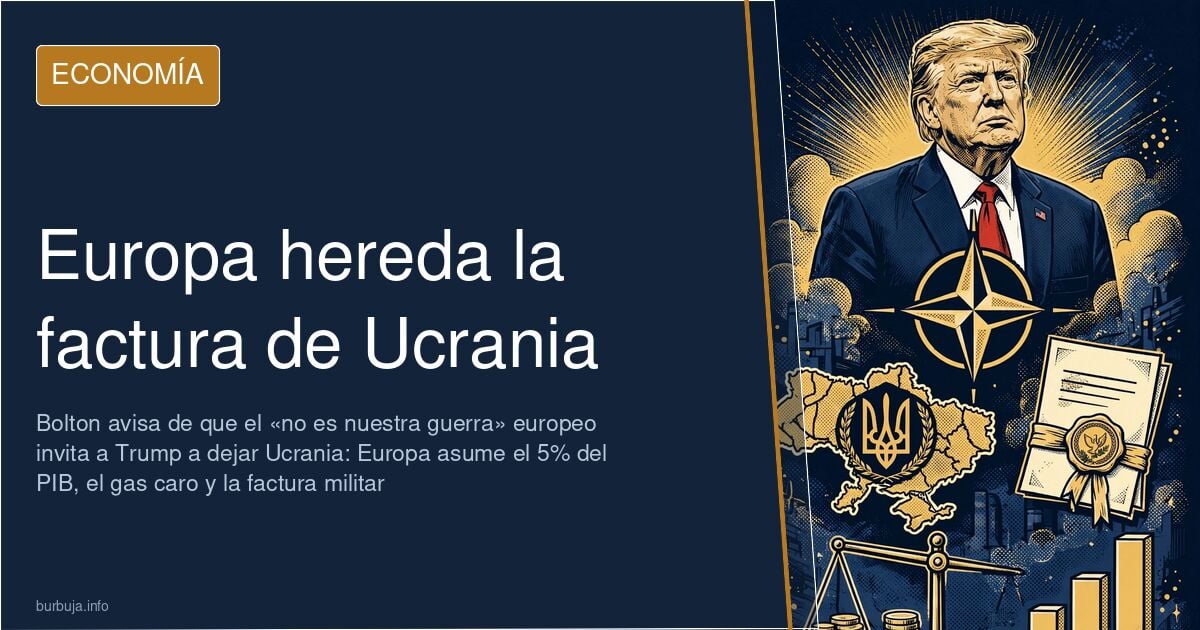
The European Bill for Ukraine: 5% of GDP and Goodbye to Russian Gas
United States has ceased being the primary payer for the war in Ukraine, leaving Europe alone with the bill. The trigger is not a formal decision from the White House, but the logic put into writing by John Bolton, former U.S. National Security Advisor: if European leaders refused to support Washington in the conflict with Iran, claiming 'this is not our war,' they invite Trump to apply the same phrase to Ukraine. If you don't come, I'm leaving. Among these leaders is Kaja Kallas, the EU’s principal foreign policy official, who explicitly rejected trinc Washington's lead. And that is where the economic problem begins, which has been postponed for three years: who pays for the hardware, who assumes the gas costs, and who signs the checks when the protector withdraws.
Where Does 'Ukraine Is Not Our War' Come From
The chain is explicit in the statement that has circulated recently: Europe's failure regarding Iran invites Trump to say, 'Ukraine is not our war,' and Bolton adds that Europeans make a mistake by responding to youthful behavior with other youthful behavior. Translated into money: the umbrella closes when it least suits.
There are differing accounts of what has peine already. One current holds that U.S. military and economic aid was completely withdrawn, and tariffs on Europe are the next chapter. The opposing view reminds that the Ukrainian government itself has stated it continues to receive support, even in greater volume than before. Both things can be true: less political window dressing and more direct sale.
The Budapest Memorandum of 1994 and the Unkept Promise
The document Ukraine signed in 1994 to pursue nuclear disarmament is the piece most frequently cited in analyses. Kyiv handed over its arsenal in exchange for the United States, the United Kingdom, and Russia guaranteeing its sovereignty and territorial integrity.
There are two opposing readings of that paper. One holds that Washington pressured Ukraine to renounce its arms with an empty promise and has been failing to keep it since 2014. The other reminds that Russia signed the exact same text and is the party maintaining troops in Ukrainian territory since 2014. Neither absolves Europe, which also blocked any negotiated exit over three years.
From 2% to 5% of GDP: Who Truly Pays for NATO
Yesterday, 2% of GDP was belligerence; today, 5% is sold as peace. This shift has not changed who is collecting: part of the analysis suggests that the United States is profiting by selling weapons to Europe, which then donates them to Ukraine, and that this circuit is the true business of the conflict.
The IMF, it is suggested, is beginning to doubt whether the Ukrainian loan is repayable. The American military industry does not have that doubt. The uncomfortable question is what remains of that 5% of GDP in Europe: if it buys in dollars, the answer is next to nothing.
Ukrainian Drones, Nasdaq, and the Trump Family
Ukraine is already producing drones on a massive scale, and its production exceeds that of all NATO members combined. Two of Donald Trump's sons back a Ukrainian drone company aiming for Nasdaq listing. For those who defended that the former president’s son had gas businesses, the argument has run out of fuel.
Meanwhile, ICE has deported dozens of Ukrainians, and some have been sent directly to military service, while the request relayed to Kyiv is lowering the recruitment age to 18.
The business goes up; the census at the front line goes down.
The Gas That No Longer Flows and the Bill That Arrives
The Nord Stream is stalled, energy prices stopped being good, beautiful, and cheap, and the bill for fertilizers and fuels has ended up in everyone's CPI. That is the real cost of retreat: not in Brussels offices, but in every paycheck that buys less than it did four years ago.
Against this backdrop, some propose restarting negotiations with Moscow and finding common ground with China. This sounds heretical in Brussels. It also sounded heretical three years ago to ask Europe not to pay for someone else's war.
If the American retreat is confirmed, the 5% of GDP will stop being a budgetary discussion and begin defining who pays for the next decade. With one warning: on July 17, a U.S. military commander warned that NATO could take Kaliningrad in unprecedented time. When those who are leaving leave the door open and point out the next target, it is wise to be suspicious of farewells.
United States has ceased being the primary payer for the war in Ukraine, leaving Europe alone with the bill. The trigger is not a formal decision from the White House, but the logic put into writing by John Bolton, former U.S. National Security Advisor: if European leaders refused to support Washington in the conflict with Iran, claiming 'this is not our war,' they invite Trump to apply the same phrase to Ukraine. If you don't come, I'm leaving. Among these leaders is Kaja Kallas, the EU’s principal foreign policy official, who explicitly rejected trinc Washington's lead. And that is where the economic problem begins, which has been postponed for three years: who pays for the hardware, who assumes the gas costs, and who signs the checks when the protector withdraws.
Where Does 'Ukraine Is Not Our War' Come From
The chain is explicit in the statement that has circulated recently: Europe's failure regarding Iran invites Trump to say, 'Ukraine is not our war,' and Bolton adds that Europeans make a mistake by responding to youthful behavior with other youthful behavior. Translated into money: the umbrella closes when it least suits.
There are differing accounts of what has peine already. One current holds that U.S. military and economic aid was completely withdrawn, and tariffs on Europe are the next chapter. The opposing view reminds that the Ukrainian government itself has stated it continues to receive support, even in greater volume than before. Both things can be true: less political window dressing and more direct sale.
The Budapest Memorandum of 1994 and the Unkept Promise
The document Ukraine signed in 1994 to pursue nuclear disarmament is the piece most frequently cited in analyses. Kyiv handed over its arsenal in exchange for the United States, the United Kingdom, and Russia guaranteeing its sovereignty and territorial integrity.
There are two opposing readings of that paper. One holds that Washington pressured Ukraine to renounce its arms with an empty promise and has been failing to keep it since 2014. The other reminds that Russia signed the exact same text and is the party maintaining troops in Ukrainian territory since 2014. Neither absolves Europe, which also blocked any negotiated exit over three years.
From 2% to 5% of GDP: Who Truly Pays for NATO
Yesterday, 2% of GDP was belligerence; today, 5% is sold as peace. This shift has not changed who is collecting: part of the analysis suggests that the United States is profiting by selling weapons to Europe, which then donates them to Ukraine, and that this circuit is the true business of the conflict.
The IMF, it is suggested, is beginning to doubt whether the Ukrainian loan is repayable. The American military industry does not have that doubt. The uncomfortable question is what remains of that 5% of GDP in Europe: if it buys in dollars, the answer is next to nothing.
Ukrainian Drones, Nasdaq, and the Trump Family
Ukraine is already producing drones on a massive scale, and its production exceeds that of all NATO members combined. Two of Donald Trump's sons back a Ukrainian drone company aiming for Nasdaq listing. For those who defended that the former president’s son had gas businesses, the argument has run out of fuel.
Meanwhile, ICE has deported dozens of Ukrainians, and some have been sent directly to military service, while the request relayed to Kyiv is lowering the recruitment age to 18.
The business goes up; the census at the front line goes down.
The Gas That No Longer Flows and the Bill That Arrives
The Nord Stream is stalled, energy prices stopped being good, beautiful, and cheap, and the bill for fertilizers and fuels has ended up in everyone's CPI. That is the real cost of retreat: not in Brussels offices, but in every paycheck that buys less than it did four years ago.
Against this backdrop, some propose restarting negotiations with Moscow and finding common ground with China. This sounds heretical in Brussels. It also sounded heretical three years ago to ask Europe not to pay for someone else's war.
If the American retreat is confirmed, the 5% of GDP will stop being a budgetary discussion and begin defining who pays for the next decade. With one warning: on July 17, a U.S. military commander warned that NATO could take Kaliningrad in unprecedented time. When those who are leaving leave the door open and point out the next target, it is wise to be suspicious of farewells.
Summary of a discussion on Burbuja.info - Foro de economía, actualidad y política., translated from Spanish and reviewed before publication. Read the full discussion (205 replies).
More summaries
-
Ketty Garat Claims She Is Close to Pegasus Content
A former second-in-command of Moroccan intelligence allegedly infected Sánchez's mobile and is willing to provide the content. Journalist Ketty Garat confirms...
-
Euthanasia in Old Age: Autonomy vs. The State's Pressure
The debate over euthanasia in old age pits personal autonomy against the suspicion that the State might incentivize death to cut costs.
-
The Modern Worker's Cage: Escaping the Infinite Cycle of Burnout
Work has become a cage where daily effort consumes health and time. Discover why we push ourselves so hard and how to break the cycle.
-
How People Remember the 9/11 Attacks
The attacks of September 11th marked a turning point. Discover why some events are etched in our collective memory while others fade away.
-
Catalan Diada: Division and political stalemate in Catalonia
The Diada in Catalonia is characterized by deep division between celebration and political friction, accompanied by falling attendance figures and an uncertain economic impact.
-
Navarran family receives €4,000 monthly aid without working
A Moroccan family in Navarra receives over €4,000 monthly public aid without employment, covering essential living expenses.