
€500,000 at 3.40% in Deutsche Bank yields under €1,200 net monthly
€500,000 at 3.40% in Deutsche Bank generates €17,000 gross annually, but progressive taxation and Deposit Guarantee Fund limits reduce net income well below €1,200.
English · Original discussion in Spanish · Published
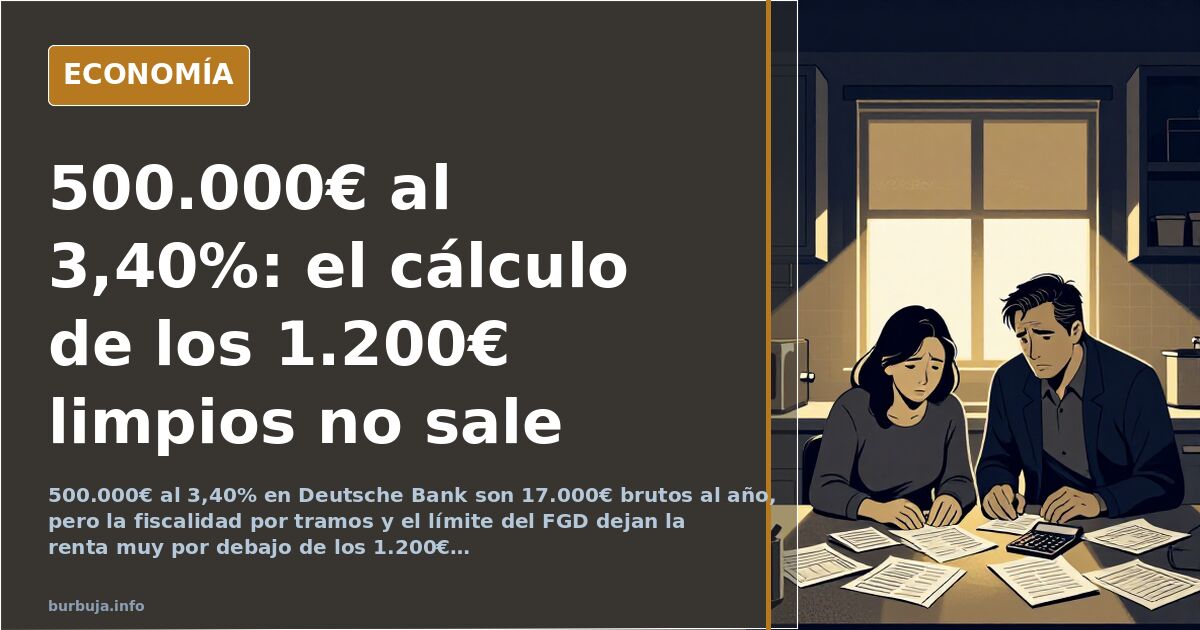
€500,000 at 3.40% in Deutsche Bank yields under €1,200 net monthly
Placing half a million euros in a term deposit at 3.40% does not produce €1,200 in net monthly income. It produces less, and the difference is not just rounding: it results from applying Spain's savings tax brackets (IRPF) to interest that is only guaranteed up to the first €100,000. The case, presented as a perfect play—paid-off house, zero effort, passive income—is debunked in three steps: the applicable rate, taxation, and public backing. Those who discussed it did so with some envy, admitting they were jealous. The rest of the conversation focused on verifying whether that envy was justified.
How much remains net from €500,000 at 3.40%?
The gross calculation is simple and consistent across all versions: €500,000 at 3.40% generates €17,000 gross per year. That is where agreement ends. From there, the figure defended as "net"—€1,200 monthly—requires ignoring that capital gains are taxed pogre. The current scale applied in this analysis trinc the standard savings bracket structure: 19% up to €6,000, 21% between €6,000 and €50,000, 23% between €50,000 and €200,000, and 26% above €200,000.
Applied to the €17,000 in interest, the most detailed circulating calculation yields €13,550 net per year, or €1,129 per month. Another estimate, more pessimistic due to how the rate is distributed, drops to €1,048 net monthly. Neither reaches the promised €1,200, and both are paid at maturity, not monthly. The gap between the advertised and real figures ranges from €70 to €150 monthly. On €500,000, this seems trivial. It is not: it represents 12% of the income believed to be secured.
The 3.5% applies only to the first €100,000
The second flaw lies in the product structure. Deutsche Bank's high remuneration is limited to the first €100,000; the remaining €400,000 earns lower rates, dragging down the average yield of the entire portfolio. This point is highlighted by several analyses: the nominal brochure rate is not the effective rate for the whole investment.
Then comes the Deposit Guarantee Fund (Fondo de Garantía de Depósitos). Coverage extends to €100,000 per depositor and institution. The other €400,000 falls outside this safety net. In a system where Spanish deposits have never suffered haircuts, the argument may seem relative, but concentration risk is objective and can be mitigated by a basic solution: spreading capital across multiple institutions so each tranche fits within the guarantee umbrella. Holding half a million in a single bank means choosing, consciously or not, an uncompensated risk.
Inflation determines if 3.40% is profit or illusion
With CPI exceeding the deposit rate, real returns turn negative. The nominal rate is 3.40%; purchasing power of capital plus interest is another matter. The most repeated formulation concerns next year: without spending anything, the holder will buy fewer goods than this year despite a higher balance.
There are nuances. A fixed-rate deposit offers certainty, and certainty has a price. Compared to 3.40%, nominally superior alternatives are cited: government bonds at 4%, deposits in other regions advertised at 14%, or the 3.5% offered by the bank itself on the bonus tier. The comparison is legitimate yet misleading: higher returns imply higher risk or lower liquidity. None of these options is a deposit labeled as safe.
What alternatives exist to bank deposits?
The list of substitutes is broad and heterogeneous. At one extreme, indexing to the S&P 500 or a global physical replication fund with a 3% or 4% withdrawal rule; at the other, buying two coastal properties for tourist rentals to generate around €6,000 monthly. In between, a family of ETFs distributing high dividends via covered call strategies: JEPI, JEPQ, QQQX, SCHD, with yields claimed between 3% and 12% combining distributions and appreciation.
The technical defense of these products is reasonable: selling covered calls involves no leverage, simply exchanging part of future upside for premium received today. The objection is equally solid: in a bad market year, the strategy may underperform pure indexing, and dividends are taxed annually while capital gains defer taxes. Some suggest derivatives, while others rightly note that risk tolerance varies: watching a portfolio drop 25% or 40% feels different with €50,000 than with €500,000. The full case material, with brackets applied individually and detailed replies, paints a picture far less idyllic than the headline suggests.
Hidden costs: Wealth Tax and other surprises
Added to savings taxation, depending on the autonomous community of residence, is the Wealth Tax (Impuesto sobre el Patrimonio), which can become a hard-to-anticipate blow. Capital of €500,000, while not a vast fortune, falls into a range where regional deductions create notable differences, making tax advice essential rather than luxurious.
The origin of the money is also debated. Nothing in the initial premise clarifies if the €500,000 comes from a sale, inheritance, or decades of salary. This matters, because the conversation repeatedly turns to the same uncomfortable question: if we don't know how the capital was earned, we cannot assess whether placing it in a deposit is prudence or merely a lack of known alternatives.
Prediction, with all caution required when discussing rates and inflation, is that such operations will multiply as long as cash remuneration stays above historical averages. If the spread against CPI narrows, the €1,129 net monthly income will serve as an uncomfortable reminder that idle money in a bank competes against more than just a balance sheet.
Placing half a million euros in a term deposit at 3.40% does not produce €1,200 in net monthly income. It produces less, and the difference is not just rounding: it results from applying Spain's savings tax brackets (IRPF) to interest that is only guaranteed up to the first €100,000. The case, presented as a perfect play—paid-off house, zero effort, passive income—is debunked in three steps: the applicable rate, taxation, and public backing. Those who discussed it did so with some envy, admitting they were jealous. The rest of the conversation focused on verifying whether that envy was justified.
How much remains net from €500,000 at 3.40%?
The gross calculation is simple and consistent across all versions: €500,000 at 3.40% generates €17,000 gross per year. That is where agreement ends. From there, the figure defended as "net"—€1,200 monthly—requires ignoring that capital gains are taxed pogre. The current scale applied in this analysis trinc the standard savings bracket structure: 19% up to €6,000, 21% between €6,000 and €50,000, 23% between €50,000 and €200,000, and 26% above €200,000.
Applied to the €17,000 in interest, the most detailed circulating calculation yields €13,550 net per year, or €1,129 per month. Another estimate, more pessimistic due to how the rate is distributed, drops to €1,048 net monthly. Neither reaches the promised €1,200, and both are paid at maturity, not monthly. The gap between the advertised and real figures ranges from €70 to €150 monthly. On €500,000, this seems trivial. It is not: it represents 12% of the income believed to be secured.
The 3.5% applies only to the first €100,000
The second flaw lies in the product structure. Deutsche Bank's high remuneration is limited to the first €100,000; the remaining €400,000 earns lower rates, dragging down the average yield of the entire portfolio. This point is highlighted by several analyses: the nominal brochure rate is not the effective rate for the whole investment.
Then comes the Deposit Guarantee Fund (Fondo de Garantía de Depósitos). Coverage extends to €100,000 per depositor and institution. The other €400,000 falls outside this safety net. In a system where Spanish deposits have never suffered haircuts, the argument may seem relative, but concentration risk is objective and can be mitigated by a basic solution: spreading capital across multiple institutions so each tranche fits within the guarantee umbrella. Holding half a million in a single bank means choosing, consciously or not, an uncompensated risk.
Inflation determines if 3.40% is profit or illusion
With CPI exceeding the deposit rate, real returns turn negative. The nominal rate is 3.40%; purchasing power of capital plus interest is another matter. The most repeated formulation concerns next year: without spending anything, the holder will buy fewer goods than this year despite a higher balance.
There are nuances. A fixed-rate deposit offers certainty, and certainty has a price. Compared to 3.40%, nominally superior alternatives are cited: government bonds at 4%, deposits in other regions advertised at 14%, or the 3.5% offered by the bank itself on the bonus tier. The comparison is legitimate yet misleading: higher returns imply higher risk or lower liquidity. None of these options is a deposit labeled as safe.
What alternatives exist to bank deposits?
The list of substitutes is broad and heterogeneous. At one extreme, indexing to the S&P 500 or a global physical replication fund with a 3% or 4% withdrawal rule; at the other, buying two coastal properties for tourist rentals to generate around €6,000 monthly. In between, a family of ETFs distributing high dividends via covered call strategies: JEPI, JEPQ, QQQX, SCHD, with yields claimed between 3% and 12% combining distributions and appreciation.
The technical defense of these products is reasonable: selling covered calls involves no leverage, simply exchanging part of future upside for premium received today. The objection is equally solid: in a bad market year, the strategy may underperform pure indexing, and dividends are taxed annually while capital gains defer taxes. Some suggest derivatives, while others rightly note that risk tolerance varies: watching a portfolio drop 25% or 40% feels different with €50,000 than with €500,000. The full case material, with brackets applied individually and detailed replies, paints a picture far less idyllic than the headline suggests.
Hidden costs: Wealth Tax and other surprises
Added to savings taxation, depending on the autonomous community of residence, is the Wealth Tax (Impuesto sobre el Patrimonio), which can become a hard-to-anticipate blow. Capital of €500,000, while not a vast fortune, falls into a range where regional deductions create notable differences, making tax advice essential rather than luxurious.
The origin of the money is also debated. Nothing in the initial premise clarifies if the €500,000 comes from a sale, inheritance, or decades of salary. This matters, because the conversation repeatedly turns to the same uncomfortable question: if we don't know how the capital was earned, we cannot assess whether placing it in a deposit is prudence or merely a lack of known alternatives.
Prediction, with all caution required when discussing rates and inflation, is that such operations will multiply as long as cash remuneration stays above historical averages. If the spread against CPI narrows, the €1,129 net monthly income will serve as an uncomfortable reminder that idle money in a bank competes against more than just a balance sheet.
Also available in: Deutsch
Summary of a discussion on Burbuja.info - Foro de economía, actualidad y política., translated from Spanish and reviewed before publication. Read the full discussion (172 replies).
More summaries
-
IT'S IN OCTOBER; Deutsche Bank believes the market is mistaken and anticipates a cascade of rate hikes in Europe and the US:
Deutsche Bank warns that the market underestimates the scale of interest rate hikes in Europe and the US. History supports its analysis.
-
Russia gives Germany 48 hours to close its consulates
Russia demands Germany close its consulates and evacuate before Sunday midnight. Previous closures in Bonn, the 2022 precedent, and the fine print of...
-
Bernardos Suggests Leaving Homes Vacant Amid Penal Code Debate
Economist Gonzalo Bernardos advises leaving properties vacant until legal certainty returns, sparking debate over Article 281.1 of the Spanish Penal Code.
-
Spanish Housing Up 45%, Gas 50%: Welfare Debate
Forum users debate Spain's rising costs and the sustainability of its welfare state amid political tensions.
-
Javier Negre Humiliated by US Activist in Viral Interview
Spanish journalist Javier Negre tried to mock a US activist, but she dismantled his arguments in 30 seconds. The video he posted went viral.
-
Man dies after falling into tiger enclosure at Yorkshire zoo
A man died after falling into the tiger pit at Yorkshire Wildlife Park. Police are investigating the circumstances of the fall.