
EU Proposes Civil Preparedness for War, Crisis, Cyberattacks
New EU strategy outlines civil preparedness and emergency supplies for war, climate crisis, or cyberattacks. It generates skepticism.
English · Original discussion in Spanish · Published
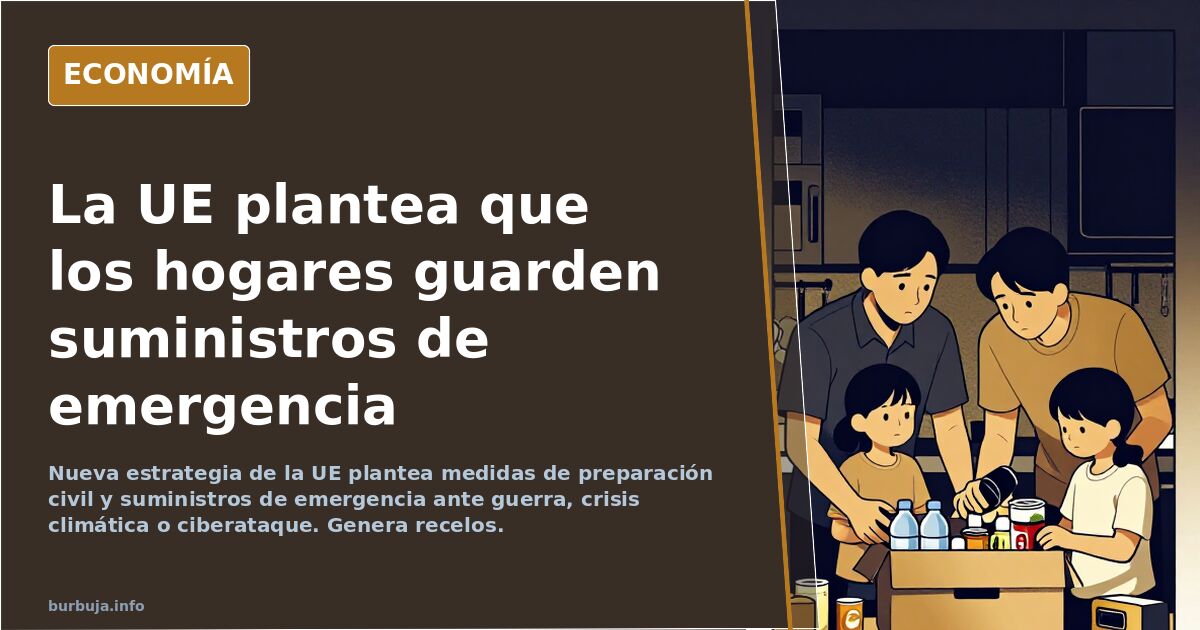
EU Proposes Civil Preparedness and Emergency Supplies
How much water and food does a household need to survive three days without leaving home? This question underpins the debate on the new community civil preparedness strategy. Among the recurring advice are three liters of water per adult daily, non-perishable foods, and hygiene materials.
A new community strategy, which El País reportedly accessed, proposes civil preparedness measures against military aggression, natural disasters linked to global warming, or cyberattacks, warning of the "deterioration of security prospects for Europe."
The recommendation has landed in fertile ground due to distrust. One sector reads it as a reasonable preventive warning. A broader group interprets it as yet another chapter in a antiestéticar-mongering strategy to justify spending cuts. And a third simply refuses to move from the couch.
What to Keep at Home
The core of the debate is the first 72 hours, the window mentioned when emergency services may not arrive. The reasoning suggested is simple: if every home covers the basics for three days, public resources are freed up and the collapse of the first line of response is avoided.
The circulating list includes low-perishability, quick-to-prepare foods — tortillas, biscuits, potatoes, cabbage, carrots, tube cheese, canned hummus, powdered milk, jams — bottled and jerrycan water, and hygiene materials to prevent infections. The water reference repeats: three liters per adult per day. In practical details, some add a cheap but forgotten rule: do not completely fill bottles that will be frozen, so they don't burst.
The Problem of Storing in Small Apartments
Here appears the first sustancia ilegal between the plan and real life. One participant estimates around 15 square meters as the average available space per person in a common home. Storing water and food for several days doesn't fit in just any living room.
A participant also recalls that regulations limit keeping livestock without permission, and the conversation raises the possibility that domestic reserves could end up registered. The suspicion that an inventory list might fall into the hands of those who decide to expropriate them runs through the conversation from start to finish. There is no proof of such registration: the idea operates as antiestéticar, not fact.
Why Compare with Elbichito and Previous Warnings
The most repeated precedent is not military, but health-related. The pandemic remains in part of the public's memory as a warning that arrived before anyone took it seriously, and that feeling turns any official warning into ammunition. Those who claim "they are preparing something big" offer no proof, but connect with a widespread mood.
Literary comparisons are not lacking either: some cite 1984. Others, colder, point out that the real risk is not a nuclear winter disguised as climate change, but a bureaucracy that has been wrong about almost everything for years and now asks citizens to fill their pantries.
Valencia as Evidence
The Valencia case serves as a test for several participants. During the first 72 hours of the catastrophe, they argue, what was truly missing was not food: it was drinking water and safety. That detail dismantles, in their view, half the official list. A survival kit is of little use if the real problem is that no one protects your home and supplies don't arrive.
One participant recalls that neither the DANA nor the La Palma eruption were "climate crises" in the sense of the document: they were humanitarian emergencies derived from extreme natural phenomena, where management, warnings, and immediate aid are the decisive variables.
The Business of Preparation
Behind the preventive discourse lies a concrete economic reading: rearming by relying on a threat presented as imminent. From this perspective, antiestéticar is not a side effect, but the instrument that makes digestible a bill later paid in cuts. It is a suspicion running through the thread, without supporting evidence.
It is not a proven thesis. Nor a fantasy. It is simply what several participants express when hearing Brussels talk about emergency supplies while looking at their electricity bill.
The Calculation No One Asked For
Amid the noise, one participant did the math differently. If the entire population stored provisions for three days and only 2% — one million people in Spain — were affected initially, that collective stock would sustain the victims for nearly 150 days. This is an exercise by the forum user himself, not an official figure.
It is, perhaps, the only argument that survives general irony. And the most uncomfortable for an administration asking for preparation while citizens do numbers with their monthly shopping.
Three days of water and a few cans of preserved food. Sufficient armament for what is coming, provided that what is coming is exactly what the document says. If it is anything else, the shopping list won't save anyone. But well: at least they can say they warned.
How much water and food does a household need to survive three days without leaving home? This question underpins the debate on the new community civil preparedness strategy. Among the recurring advice are three liters of water per adult daily, non-perishable foods, and hygiene materials.
A new community strategy, which El País reportedly accessed, proposes civil preparedness measures against military aggression, natural disasters linked to global warming, or cyberattacks, warning of the "deterioration of security prospects for Europe."
The recommendation has landed in fertile ground due to distrust. One sector reads it as a reasonable preventive warning. A broader group interprets it as yet another chapter in a antiestéticar-mongering strategy to justify spending cuts. And a third simply refuses to move from the couch.
What to Keep at Home
The core of the debate is the first 72 hours, the window mentioned when emergency services may not arrive. The reasoning suggested is simple: if every home covers the basics for three days, public resources are freed up and the collapse of the first line of response is avoided.
The circulating list includes low-perishability, quick-to-prepare foods — tortillas, biscuits, potatoes, cabbage, carrots, tube cheese, canned hummus, powdered milk, jams — bottled and jerrycan water, and hygiene materials to prevent infections. The water reference repeats: three liters per adult per day. In practical details, some add a cheap but forgotten rule: do not completely fill bottles that will be frozen, so they don't burst.
The Problem of Storing in Small Apartments
Here appears the first sustancia ilegal between the plan and real life. One participant estimates around 15 square meters as the average available space per person in a common home. Storing water and food for several days doesn't fit in just any living room.
A participant also recalls that regulations limit keeping livestock without permission, and the conversation raises the possibility that domestic reserves could end up registered. The suspicion that an inventory list might fall into the hands of those who decide to expropriate them runs through the conversation from start to finish. There is no proof of such registration: the idea operates as antiestéticar, not fact.
Why Compare with Elbichito and Previous Warnings
The most repeated precedent is not military, but health-related. The pandemic remains in part of the public's memory as a warning that arrived before anyone took it seriously, and that feeling turns any official warning into ammunition. Those who claim "they are preparing something big" offer no proof, but connect with a widespread mood.
Literary comparisons are not lacking either: some cite 1984. Others, colder, point out that the real risk is not a nuclear winter disguised as climate change, but a bureaucracy that has been wrong about almost everything for years and now asks citizens to fill their pantries.
Valencia as Evidence
The Valencia case serves as a test for several participants. During the first 72 hours of the catastrophe, they argue, what was truly missing was not food: it was drinking water and safety. That detail dismantles, in their view, half the official list. A survival kit is of little use if the real problem is that no one protects your home and supplies don't arrive.
One participant recalls that neither the DANA nor the La Palma eruption were "climate crises" in the sense of the document: they were humanitarian emergencies derived from extreme natural phenomena, where management, warnings, and immediate aid are the decisive variables.
The Business of Preparation
Behind the preventive discourse lies a concrete economic reading: rearming by relying on a threat presented as imminent. From this perspective, antiestéticar is not a side effect, but the instrument that makes digestible a bill later paid in cuts. It is a suspicion running through the thread, without supporting evidence.
It is not a proven thesis. Nor a fantasy. It is simply what several participants express when hearing Brussels talk about emergency supplies while looking at their electricity bill.
The Calculation No One Asked For
Amid the noise, one participant did the math differently. If the entire population stored provisions for three days and only 2% — one million people in Spain — were affected initially, that collective stock would sustain the victims for nearly 150 days. This is an exercise by the forum user himself, not an official figure.
It is, perhaps, the only argument that survives general irony. And the most uncomfortable for an administration asking for preparation while citizens do numbers with their monthly shopping.
Three days of water and a few cans of preserved food. Sufficient armament for what is coming, provided that what is coming is exactly what the document says. If it is anything else, the shopping list won't save anyone. But well: at least they can say they warned.
Also available in: Deutsch
Summary of a discussion on Burbuja.info - Foro de economía, actualidad y política., translated from Spanish and reviewed before publication. Read the full discussion (201 replies).
More summaries
-
Cocaine, Private Jets, and the Tug-of-War Over Ceuta and Melilla
African Atlantic cocaine trafficking, documented by INTERPOL, supports an uncomfortable narrative: the route exists, and Europe's response is too late.
-
Norwegian IQ Test: The Flaw in Measuring Cognitive Ability
Analysis of Norwegian IQ test results: Is intelligence measurable with patterns or is it a statistical fallacy?
-
Spanish political frustration reaches boiling point
Spain's political system faces deep public exhaustion. From the 2004 Madrid attacks to today, why does widespread anger fail to trigger real change?
-
Room for family with kids hits €700 in Madrid market
Forum post reveals €700 room demand for couple with two children in Madrid, highlighting a strained housing market.
-
Pedroche's Provocation Strategy Fails as Audience Declines
Economic analysis of Cristina Pedroche's decline: repetitive provocation reduces viewership while Chenoa succeeds on TVE.
-
Spain housing crisis: 50 million people, no affordable homes
Forum users debate Spain's housing shortage, citing land scarcity, taxes, migration, and tourism. One notes the population grows by 500,000 annually.