
EU gives carmakers two months to avoid billion-euro fines
From Jan 1, a 100g CO2/km sales average limit applies. Manufacturers have two months to cut emissions or face heavy penalties.
English · Original discussion in Spanish · Published
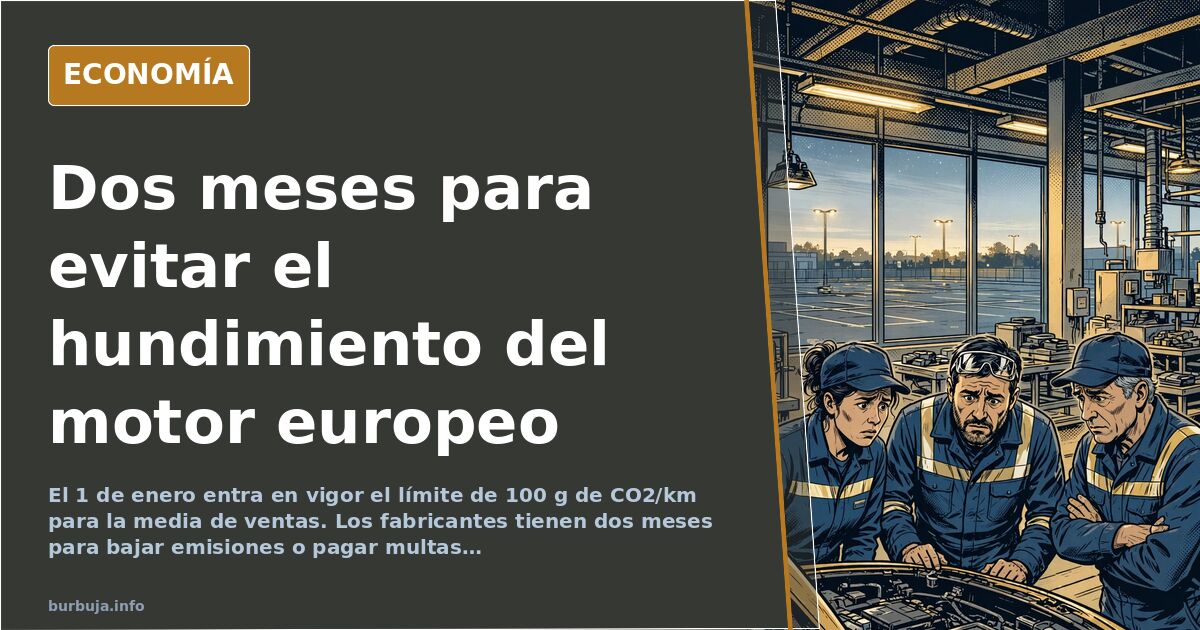
EU gives carmakers two months to dodge billions in fines
On January 1, a new phase of the Paris Agreement protocols takes effect: manufacturers operating in Europe must sell cars averaging less than 100 grams of CO2 per kilometer. Those who fail to meet this average pay up. And we are not talking about small change: fines run into the billions. The equation has three outcomes, none comfortable. First, trim the catalog: fewer versions, models, and combinations. Second, overhaul pricing policies to penalize anything that isn't electric or hybrid. Third, go bankrupt. The sector faces yet another regulatory crossroads with the Chinese market declining and domestic demand struggling to take off.
What Brussels demands exactly from January 1
The rule doesn't ban selling combustion engines. It requires the average of sold vehicles to drop below the 100-gram threshold. It's an averaging mechanism: if you sell many electric and hybrid cars, you offset more polluting models. If not, it's a fine. The trap is that European consumers aren't buying electric cars at the pace the regulation needs. That's where the problem starts.
Some argue hybrids are the real escape route. According to this analysis, the EU left the door open: simply adding an electric motor, even a minimal one, allows the vehicle to count as low-emission. The industry's response has been awkward: these hybrids weigh more due to batteries, drag an extra engine, and in practice, can emit more CO2 than a modern diesel. Regulatory incentives and physics don't always align.
Chinese market fades and Germany trembles
The blow doesn't come only from Brussels. In China, German cars are starting to be seen as obsolete compared to local offerings, which improve at a pace European manufacturers didn't anticipate. If the Chinese market closes, the equation breaks: there is no volume to finance the European transition.
The dependency is such that part of the analysis assumes Germany cannot allow its automotive industry to collapse without dragging down the entire EU. And if it falls, someone will have to bail it out. The question is with what money and what narrative, because the official discourse remains green transition while the numbers don't add up.
Cars as luxury goods: prices, tariffs, and LEZs
Price hikes are already here. A new electric car around €40,000 competes with a combustion or hybrid equivalent for the same money and a €15,000 used car that does the same job. The feeling of being ripped off spreads among buyers who see no advantage anywhere. Plus, SUVs.
Add to that the urban squeeze: Low Emission Zones (LEZs) pushing individuals to renew their cars or stay out. Some defend this without hesitation; others read it as a stratagem to artificially inflate private property costs until they become unviable for the middle class. The harshest hypothesis holds that the ultimate goal isn't electrification, but eliminating private vehicles except for those who can afford them.
Who pays the bill: temporary layoffs, bailouts, and unemployment
If manufacturers don't sell, the sequence is known: workforce adjustment, temporary layoff schemes (ERTE), line closures. The Ford precedent is already in the conversation. And if the sector threatens to collapse, the reasonable suspicion is that public funds will bail it out. Meaning taxpayers pay twice: first with regulations making products expensive, then with rescuing those who failed to adapt.
The alternative some consider is offshoring: closing in Europe and producing elsewhere. For European industrial jobs, that's the same as bankruptcy, just slower.
Public transport as a cover story
The official narrative pushes citizens toward collective transport. Some see it as an imposition disguised as sustainability; others defend it with data: an 11-kilometer commuter train alucinación costs €2.15 per person and takes about 25 minutes. For a family of three, moving the car to the capital is more expensive than tickets. The problem is that calculation only works where there is network coverage, frequency, and proximity. Elsewhere in the country, the car isn't a whim: it's the only way to get kids to school, do groceries, or reach work.
The open question
January 1 isn't a symbolic date: it's the day emission averages become fines or adjustments. Manufacturers have two months to decide whether to trim catalogs, raise prices, pressure Brussels, or wait for a bailout. None of the initial three options are painless. And the fourth—that the rule gets softened—depends on a Commission that so far hasn't shown signs of backing down. What happens if January 1 arrives and no one makes a move?
On January 1, a new phase of the Paris Agreement protocols takes effect: manufacturers operating in Europe must sell cars averaging less than 100 grams of CO2 per kilometer. Those who fail to meet this average pay up. And we are not talking about small change: fines run into the billions. The equation has three outcomes, none comfortable. First, trim the catalog: fewer versions, models, and combinations. Second, overhaul pricing policies to penalize anything that isn't electric or hybrid. Third, go bankrupt. The sector faces yet another regulatory crossroads with the Chinese market declining and domestic demand struggling to take off.
What Brussels demands exactly from January 1
The rule doesn't ban selling combustion engines. It requires the average of sold vehicles to drop below the 100-gram threshold. It's an averaging mechanism: if you sell many electric and hybrid cars, you offset more polluting models. If not, it's a fine. The trap is that European consumers aren't buying electric cars at the pace the regulation needs. That's where the problem starts.
Some argue hybrids are the real escape route. According to this analysis, the EU left the door open: simply adding an electric motor, even a minimal one, allows the vehicle to count as low-emission. The industry's response has been awkward: these hybrids weigh more due to batteries, drag an extra engine, and in practice, can emit more CO2 than a modern diesel. Regulatory incentives and physics don't always align.
Chinese market fades and Germany trembles
The blow doesn't come only from Brussels. In China, German cars are starting to be seen as obsolete compared to local offerings, which improve at a pace European manufacturers didn't anticipate. If the Chinese market closes, the equation breaks: there is no volume to finance the European transition.
The dependency is such that part of the analysis assumes Germany cannot allow its automotive industry to collapse without dragging down the entire EU. And if it falls, someone will have to bail it out. The question is with what money and what narrative, because the official discourse remains green transition while the numbers don't add up.
Cars as luxury goods: prices, tariffs, and LEZs
Price hikes are already here. A new electric car around €40,000 competes with a combustion or hybrid equivalent for the same money and a €15,000 used car that does the same job. The feeling of being ripped off spreads among buyers who see no advantage anywhere. Plus, SUVs.
Add to that the urban squeeze: Low Emission Zones (LEZs) pushing individuals to renew their cars or stay out. Some defend this without hesitation; others read it as a stratagem to artificially inflate private property costs until they become unviable for the middle class. The harshest hypothesis holds that the ultimate goal isn't electrification, but eliminating private vehicles except for those who can afford them.
Who pays the bill: temporary layoffs, bailouts, and unemployment
If manufacturers don't sell, the sequence is known: workforce adjustment, temporary layoff schemes (ERTE), line closures. The Ford precedent is already in the conversation. And if the sector threatens to collapse, the reasonable suspicion is that public funds will bail it out. Meaning taxpayers pay twice: first with regulations making products expensive, then with rescuing those who failed to adapt.
The alternative some consider is offshoring: closing in Europe and producing elsewhere. For European industrial jobs, that's the same as bankruptcy, just slower.
Public transport as a cover story
The official narrative pushes citizens toward collective transport. Some see it as an imposition disguised as sustainability; others defend it with data: an 11-kilometer commuter train alucinación costs €2.15 per person and takes about 25 minutes. For a family of three, moving the car to the capital is more expensive than tickets. The problem is that calculation only works where there is network coverage, frequency, and proximity. Elsewhere in the country, the car isn't a whim: it's the only way to get kids to school, do groceries, or reach work.
The open question
January 1 isn't a symbolic date: it's the day emission averages become fines or adjustments. Manufacturers have two months to decide whether to trim catalogs, raise prices, pressure Brussels, or wait for a bailout. None of the initial three options are painless. And the fourth—that the rule gets softened—depends on a Commission that so far hasn't shown signs of backing down. What happens if January 1 arrives and no one makes a move?
Also available in: Deutsch
Summary of a discussion on Burbuja.info - Foro de economía, actualidad y política., translated from Spanish and reviewed before publication. Read the full discussion (174 replies).
More summaries
-
Germany: 32% of new cars are electric
Germany recorded 32.4% electric car sales in August. Chinese brands are thriving while Volkswagen downsizes. Bubble or reality?
-
Ford loses €100,000 per electric vehicle sold
Ford loses €100,000 on every EV sold, hitting $1.3 billion in losses in 2024. The company is asking suppliers to help cut manufacturing costs.
-
Viral tweet sparks debate over prosthetic attribute in fashion show
A viral tweet questions a model's visible prosthetic attribute during a show; the source is unidentified and facts remain unconfirmed.
-
Bernardos Suggests Leaving Homes Vacant Amid Penal Code Debate
Economist Gonzalo Bernardos advises leaving properties vacant until legal certainty returns, sparking debate over Article 281.1 of the Spanish Penal Code.
-
Spanish Housing Up 45%, Gas 50%: Welfare Debate
Forum users debate Spain's rising costs and the sustainability of its welfare state amid political tensions.
-
Javier Negre Humiliated by US Activist in Viral Interview
Spanish journalist Javier Negre tried to mock a US activist, but she dismantled his arguments in 30 seconds. The video he posted went viral.