
EU and NATO under strain: debate on potential collapse
Debate on EU and NATO future: inflation, energy, borders, and the 2030 plan. Opposing views on their survival.
English · Original discussion in Spanish · Published
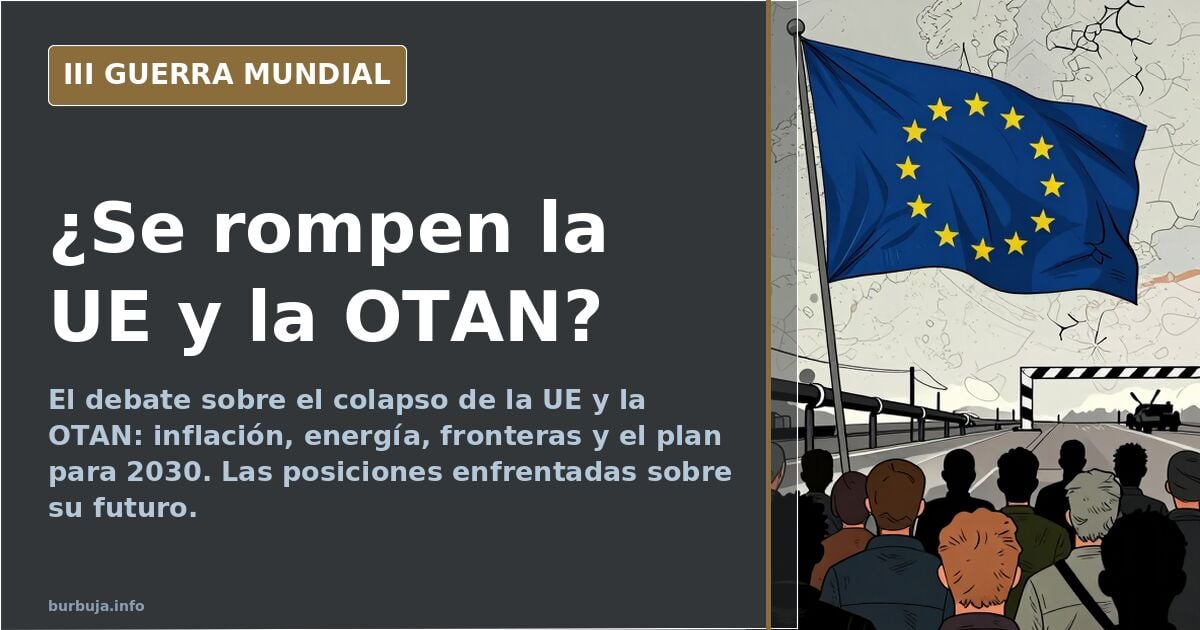
EU and NATO under strain: debate on potential collapse
Are the EU and NATO breaking apart? The debate over the future of these two major Western organizations has been open for 1,111 days, with positions as polarized as day one. Some argue both structures are nearing their end, growing weaker and fragmented, while others point out that NATO recently admitted Sweden and Finland, hardly a sign of decay. The discussion mixes geopolitics, economics, demographics, and an uncomfortable question: who actually feels represented by these institutions?
The argument for imminent collapse
The initial premise is stark: it is argued that NATO and the EU are giants with feet of clay, seemingly strong at the top but lacking grassroots support. It is claimed they have no citizens willing to fight for organizations they view as alien, openly questioning who feels represented by the EU flag or Ursula von der Leyen. This school of thought concludes that Russia is exposing the weaknesses and inconsistencies of both structures, suggesting that with some internal support, they would dissolve and return to political insignificance.
In this vein, some go further, labeling these organizations as genocidal, corrupt, and destructive parasites of the countries they inhabit. This is an extreme stance, but part of the spectrum of opinions in the discussion.
Counterargument: NATO expands, not breaks
Against the collapse narrative, the most common rebuttal is practical: if NATO just admitted Sweden and Finland, how can it be breaking? Critics note declining Western global influence, but supporters respond that minimal aid prevented Russia from invading a much smaller neighbor. For them, this isn't ridiculous but a wake-up call: using only 5% of its potential, the West complicated life for Russia.
The exchange heats up when asked if everyone except the West wants Russia to win. The reply is direct: was there a poll? Have official statements been checked? It is recalled that even China called for Russian troop withdrawal, noting support for Russia is limited to Belarus, North Korea, and Syria.
Economic cost: inflation, energy, recession
The economic front yields concrete figures and claims. Talk includes a severe recession, fleeing companies, and dozens of bankruptcies in northern economies, not just subsidy-dependent southern Europe. The prediction is that once funds run out, there will be a stampede and epic every-man-for-himself chaos.
Opponents cite real costs: billions monthly for a destroyed country, galloping inflation, refugees needing support, and gas/oil prices doubled. They say the EU is suffering badly. They add that the West has lived on debt for 40 years, the dollar weakens, and other nations unite to create monetary competition against it.
Borders and migration issue
Border management is highly controversial. Critics claim the EU cannot defend borders against unarmed civilians, calling it a bureaucratic monster that takes ages to act, then fails. Lampedusa is cited as proof.
Replies arrive with irony: if thousands wanting to emigrate to Europe proves it's sinking, do they come to cross into Russia for a better future? The debate shifts to labor markets and social security, with mutual accusations about who works versus who receives benefits.
The 2030 plan and US role
Some don't foresee disappearance but transformation. They argue the 2030 plan isn't elimination but shifting internal power via new entries and exits. It is noted that Sweden and Finland's NATO entry involved Turkey negotiating its future EU membership in 2030, alongside special treaties for Donbas and Crimea linked to Ukraine's entry, leaving Russia half-in.
Contextually, it is pointed out that the US is increasingly isolated, dragging the EU toward global irrelevance. The EU always exploits crises to grant itself more power: ELbichito brought common debt; the euro crisis brought budget control; the Ukraine war will yield similar gains.
Cultural clash and fundamental question
The debate's backdrop is cultural. It is argued Turkey shares little with Sweden, or Romania with Ireland—distinct cultures and worldviews worth preserving. Responses counter that cultures live and grow; Spain today differs from the 1980s, as do Portugal and Bulgaria. The criticism is that pogre tries to solve problems by sending everyone back to the 1930s.
The discussion ends without consensus, as it began. Some see collapse as inevitable; others, controlled transformation. Meanwhile, the question hangs: who feels represented? "No one," say some. "It doesn't matter," joke others.
Also available in: Deutsch
Summary of a discussion on Burbuja.info - Foro de economía, actualidad y política., translated from Spanish and reviewed before publication. Read the full discussion (118 replies).
More summaries
-
Europe Prepares 'War Hospitals' as Healthcare Systems Strain
NATO and EU medical evacuation plans clash with healthcare systems where blood tests take 14 days. The mortgage is another unresolved issue.
-
Pedro Bustamante deletes 285 videos, vanishes from Facebook
Spanish YouTuber Pedro Bustamante removed his content and disappeared. Rumors place him in Munich, reading German press.
-
World War III risk trivialized amid bunker memes
The risk of World War III is being trivialized through bunker memes and 2016-era accounts: a massive 'boom' sums it all up.
-
Zelensky says US is pressuring Ukraine to force its surrender
Zelensky denounces that the US is blocking Patriot missiles already paid for and pressuring Ukraine to surrender. Ukraine receives 12 interceptors a month against dozens of Russian ones.
-
Germany hits early retirement at 63 with a 14.4% pension cut
A 14.4% cut for retiring at 63 in Germany sparks debate over the cost of the war and the future of pensions.
-
The Leipzig drone: a narrative that fails to convince
The drone attack in Leipzig and the Russian passport: official narrative or false flag? Skeptics doubt the European coordination and the fear of a war that…